



Question: Comments Your text covers this topic, but the general principle in an organization is to allow people with knowledge about a topic to make decisions
Comments
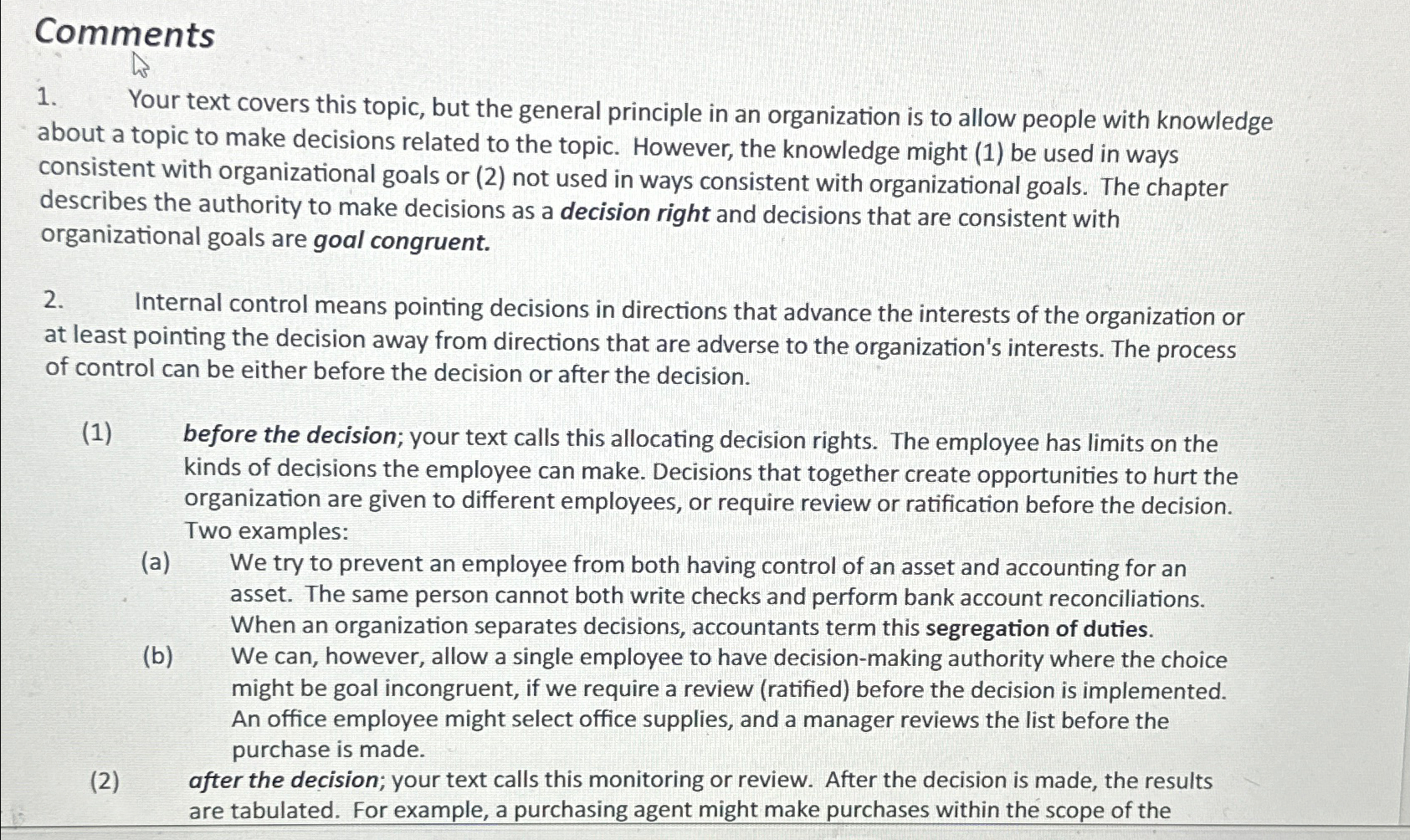
Your text covers this topic, but the general principle in an organization is to allow people with knowledge about a topic to make decisions related to the topic. However, the knowledge might be used in ways consistent with organizational goals or not used in ways consistent with organizational goals. The chapter describes the authority to make decisions as a decision right and decisions that are consistent with organizational goals are goal congruent.
Internal control means pointing decisions in directions that advance the interests of the organization or at least pointing the decision away from directions that are adverse to the organization's interests. The process of control can be either before the decision or after the decision.
before the decision; your text calls this allocating decision rights. The employee has limits on the kinds of decisions the employee can make. Decisions that together create opportunities to hurt the organization are given to different employees, or require review or ratification before the decision. Two examples:
a We try to prevent an employee from both having control of an asset and accounting for an asset. The same person cannot both write checks and perform bank account reconciliations. When an organization separates decisions, accountants term this segregation of duties.
b We can, however, allow a single employee to have decisionmaking authority where the choice might be goal incongruent, if we require a review ratified before the decision is implemented. An office employee might select office supplies, and a manager reviews the list before the purchase is made.
after the decision; your text calls this monitoring or review. After the decision is made, the results are tabulated. For example, a purchasing agent might make purchases within the scope of the
Step by Step Solution
There are 3 Steps involved in it
1 Expert Approved Answer
Step: 1 Unlock

Question Has Been Solved by an Expert!
Get step-by-step solutions from verified subject matter experts
Step: 2 Unlock
Step: 3 Unlock