Question: committed to their forecasts, they eventually real- ized they could find common ground by sharing the risk of future oil price movements while at the
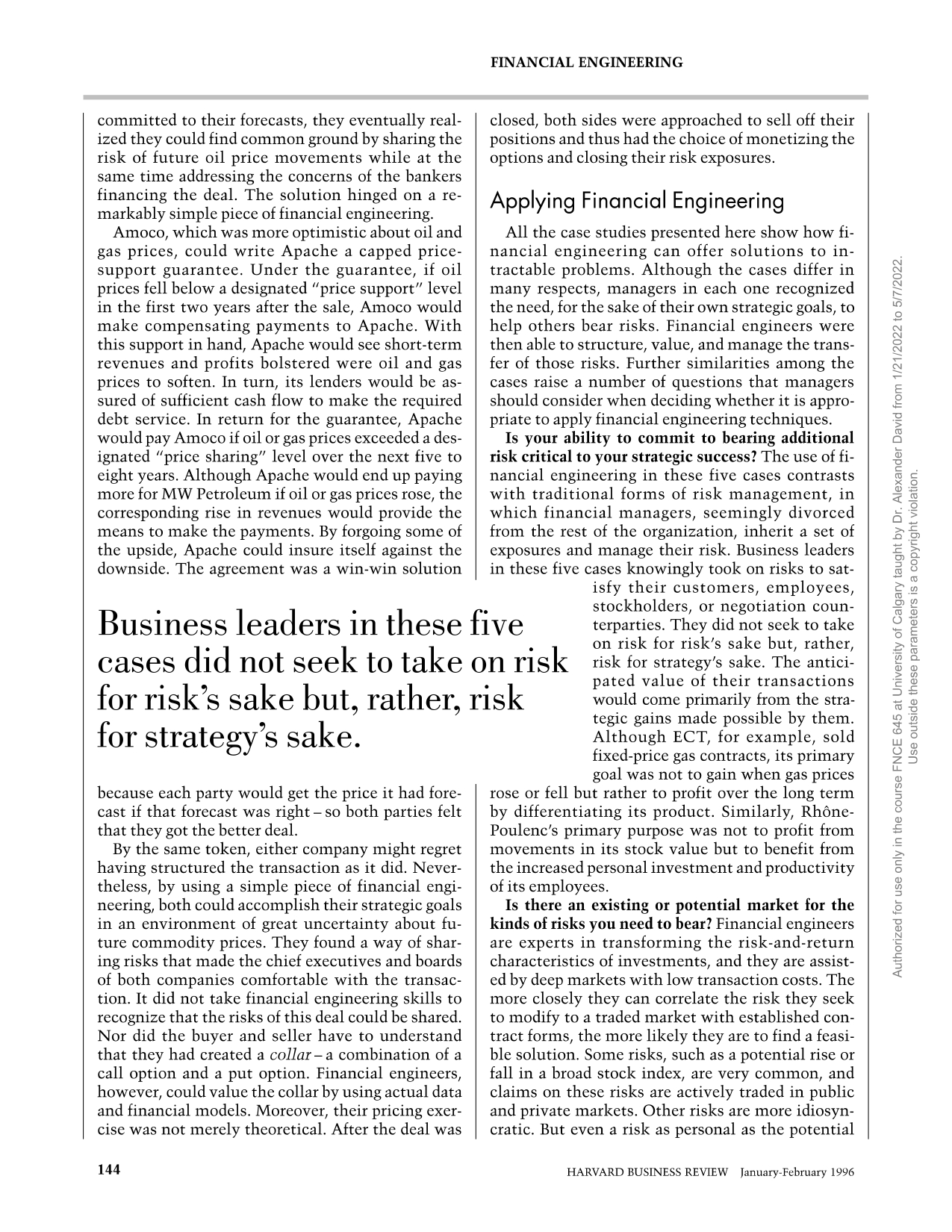
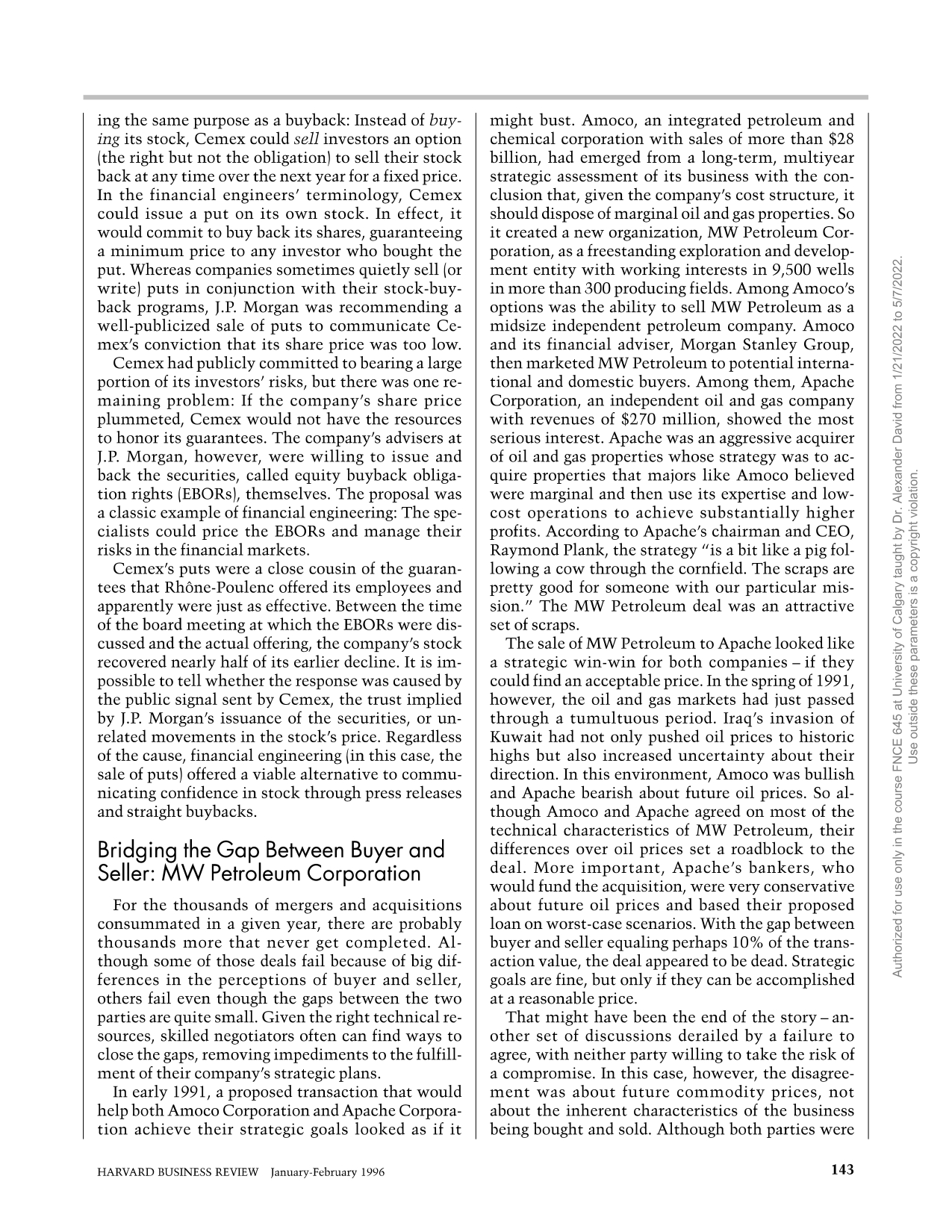
committed to their forecasts, they eventually real- ized they could find common ground by sharing the risk of future oil price movements while at the same time addressing the concerns of the bankers financing the deal. The solution hinged on a re- markably simple piece of financial engineering. Amoco, which was more optimistic about oil and gas prices, could write Apache a capped price- support guarantee. Under the guarantee, if oil prices fell below a designated \"price support\" level in the first two years after the sale, Amoco would make compensating payments to Apache. With this support in hand, Apache would see short-term revenues and profits bolstered were oil and gas prices to soften. In turn, its lenders would be as- sured of sufficient cash flow to make the required debt service. In return for the guarantee, Apache would pay Amoco if oil or gas prices exceeded a des ignated \"price sharing\" level over the next five to eight years. Although Apache would end up paying more for MW Petroleum if oil or gas prices rose, the corresponding rise in revenues would provide the means to make the payments. By forgoing some of the upside, Apache could insure itself against the downside. The agreement was a winwin solution Business leaders in these five cases did not seek to take on risk risk for risk's sake but, rather, for strategy's sake. because each party would get the price it had fore- cast if that forecast was right so both parties felt that they got the better deal. By the same token, either company might regret having structured the transaction as it did. Never- theless, by using a simple piece of financial engi- neering, both could accomplish their strategic goals in an environment of great uncertainty about fu- ture commodity prices. They found a way of shar- ing risks that made the chief executives and boards of both companies comfortabie with the transac- tion. It did not take financial engineering skills to recognize that the risks of this deal could be shared. Nor did the buyer and seller have to understand that they had created a collara combination of a call option and a put option. Financial engineers, however, could value the collar by using actual data and financial models. Moreover, their pricing exers cisc was not merely theoretical. After the deal was 144 FINANCIAL ENGINEERING closed, both sides were approached to sell off their positions and thus had the choice of monetizing the options and closing their risk exposures. Applying Financial Engineering All the case studies presented here show how fi- nancial engineering can offer solutions to in- tractable problems. Although the cases differ in many respects, managers in each one recognized the need, for the sake of their own strategic goals, to help others hear risks. Financial engineers were then able to structure, value, and manage the trans- fer of those risks. Further similarities among the cases raise a number of questions that managers should consider when deciding whether it is appro- priate to apply financial engineering techniques. Is your ability to commit to beating additional risk critical to your strategic success? The use of fi- nancial engineering in these five cases contrasts with traditional forms of risk management, in which financial managers, seemingly divorced from the rest of the organization, inherit a set of exposures and manage their risk. Business leaders in these five cases knowingly took on risks to sat- isfy their customers, employees, stockholders, or negotiation coun terparties. They did not seek to take on risk for risk's sake but, rather, risk for strategy's sake. The antici- pated value of their transactions would come primarily from the stra- tegic gains made possible by them. Although ECT, for example, sold fixedprice gas contracts, its primary goal was not to gain when gas prices rose or fell but rather to profit over the long term by differentiating its product. Similarly, Rhne- Poulenc's primary purpose was not to profit from movements in its stock value but to benefit from the increased personal investment and productivity of its employees. Is there an existing or potential market for the kinds of risks you need to bear? financial engineers are experts in transforming the risk-and-return characteristics of investments, and they are assist- ed by deep markets with low transaction costs. The more closely they can correlate the risk they seek to modify to a traded market with established con- tract forms, the more likely they are to find a feasi- ble solution. Some risks, such as a potential rise or fall in a broad stock index, are very common, and claims on these risks are actively traded in public and private markets. Other risks are more idiosyns cratic. But even a risk as personal as the potential HARVARD BUSINESS REVIEW lanuaIy-Eebrnary 1996 i'i Ti" "H 1: 'l -' D .7.- '-.- Arl'o 'i, nti i-Wr us: ing the same purpose as a buyback: Instead of buy- might bust. Amoco, an integrated petroleum and ing its stock, Cemex could sell investors an option chemical corporation with sales of more than $28 the right but not the obligation) to sell their stock billion, had emerged from a long-term, multiyear back at any time over the next year for a fixed price. strategic assessment of its business with the con- In the financial engineers' terminology, Cemex clusion that, given the company's cost structure, it could issue a put on its own stock. In effect, it should dispose of marginal oil and gas properties. So would commit to buy back its shares, guaranteeing it created a new organization, MW Petroleum Cor- a minimum price to any investor who bought the poration, as a freestanding exploration and develop- put. Whereas companies sometimes quietly sell (or ment entity with working interests in 9,500 wells write) puts in conjunction with their stock-buy- in more than 300 producing fields. Among Amoco's back programs, J.P. Morgan was recommending a options was the ability to sell MW Petroleum as a well-publicized sale of puts to communicate Ce- midsize independent petroleum company. Amoco mex's conviction that its share price was too low. and its financial adviser, Morgan Stanley Group, Cemex had publicly committed to bearing a large then marketed MW Petroleum to potential interna- portion of its investors' risks, but there was one re- cional and domestic buyers. Among them, Apache maining problem: If the company's share price Corporation, an independent oil and gas company plummeted, Cemex would not have the resources with revenues of $270 million, showed the most to honor its guarantees. The company's advisers at serious interest. Apache was an aggressive acquirer J.P. Morgan, however, were willing to issue and of oil and gas properties whose strategy was to ac- back the securities, called equity buyback obliga- quire properties that majors like Amoco believed tion rights (EBORs), themselves. The proposal was were marginal and then use its expertise and low- a classic example of financial engineering: The spe- cost operations to achieve substantially higher cialists could price the EBORs and manage their profits. According to Apache's chairman and CEO, risks in the financial markets. Raymond Plank, the strategy "is a bit like a pig fol- Cemex's puts were a close cousin of the guaran- lowing a cow through the cornfield. The scraps are tees that Rhone-Poulenc offered its employees and pretty good for someone with our particular mis- apparently were just as effective. Between the time sion." The MW Petroleum deal was an attractive Authorized for use only in the course FNCE 645 at University of Calgary taught by Dr. Alexander David from 1/21/2022 to 5/7/2022. Use outside these parameters is a copyright violation. of the board meeting at which the EBORs were dis- set of scraps. cussed and the actual offering, the company's stock The sale of MW Petroleum to Apache looked like recovered nearly half of its earlier decline. It is im- a strategic win-win for both companies - if they possible to tell whether the response was caused by could find an acceptable price. In the spring of 1991, the public signal sent by Cemex, the trust implied however, the oil and gas markets had just passed by J.P. Morgan's issuance of the securities, or un- through a tumultuous period. Iraq's invasion of related movements in the stock's price. Regardless Kuwait had not only pushed oil prices to historic of the cause, financial engineering (in this case, the highs but also increased uncertainty about their sale of puts) offered a viable alternative to commu- direction. In this environment, Amoco was bullish nicating confidence in stock through press releases and Apache bearish about future oil prices. So al- and straight buybacks. though Amoco and Apache agreed on most of the technical characteristics of MW Petroleum, their Bridging the Gap Between Buyer and differences over oil prices set a roadblock to the Seller: MW Petroleum Corporation deal. More important, Apache's bankers, who would fund the acquisition, were very conservative For the thousands of mergers and acquisitions about future oil prices and based their proposed consummated in a given year, there are probably loan on worst-case scenarios. With the gap between thousands more that never get completed. Al- buyer and seller equaling perhaps 10% of the trans- though some of those deals fail because of big dif- action value, the deal appeared to be dead. Strategic ferences in the perceptions of buyer and seller, goals are fine, but only if they can be accomplished others fail even though the gaps between the two at a reasonable price. parties are quite small. Given the right technical re- That might have been the end of the story - an- sources, skilled negotiators often can find ways to other set of discussions derailed by a failure to close the gaps, removing impediments to the fulfill- agree, with neither party willing to take the risk of ment of their company's strategic plans. a compromise. In this case, however, the disagree- In early 1991, a proposed transaction that would ment was about future commodity prices, not help both Amoco Corporation and Apache Corpora- about the inherent characteristics of the business tion achieve their strategic goals looked as if it being bought and sold. Although both parties were HARVARD BUSINESS REVIEW January-February 1996 143
Step by Step Solution
There are 3 Steps involved in it
1 Expert Approved Answer
Step: 1 Unlock
Question Has Been Solved by an Expert!
Get step-by-step solutions from verified subject matter experts
Step: 2 Unlock
Step: 3 Unlock
Students Have Also Explored These Related Accounting Questions!









 Study Help