Question: Common Law Terms Problem for Question 1 and 2: Stanley (an IT student at Monash College and freelance web designer) approached Jack, an experienced computer
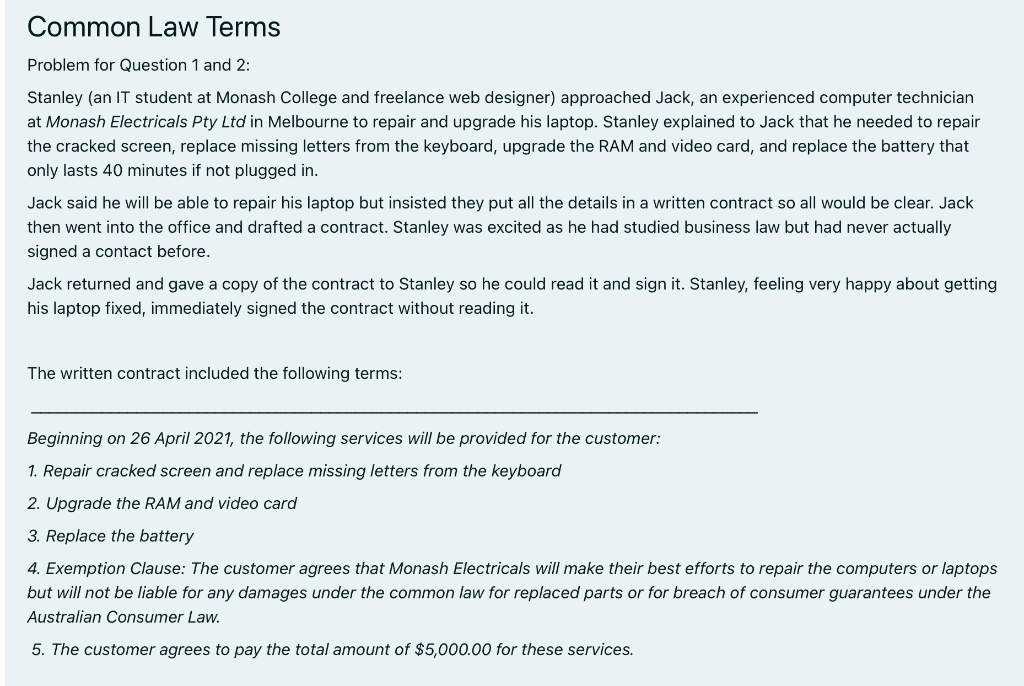
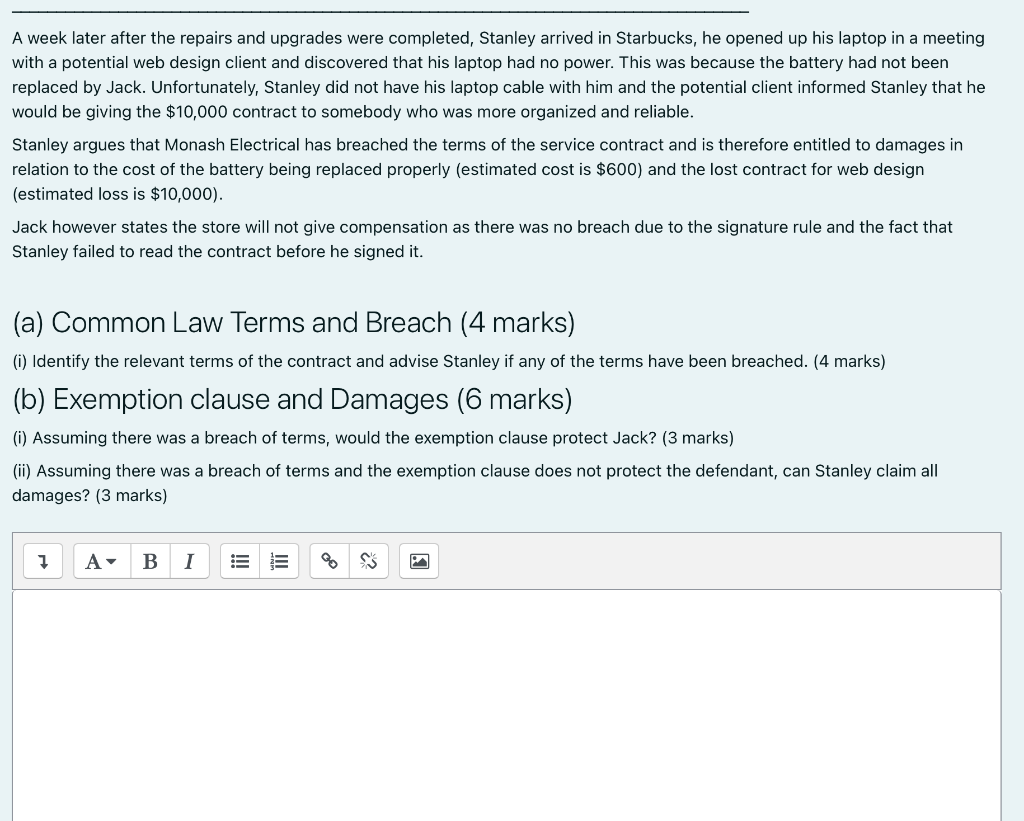
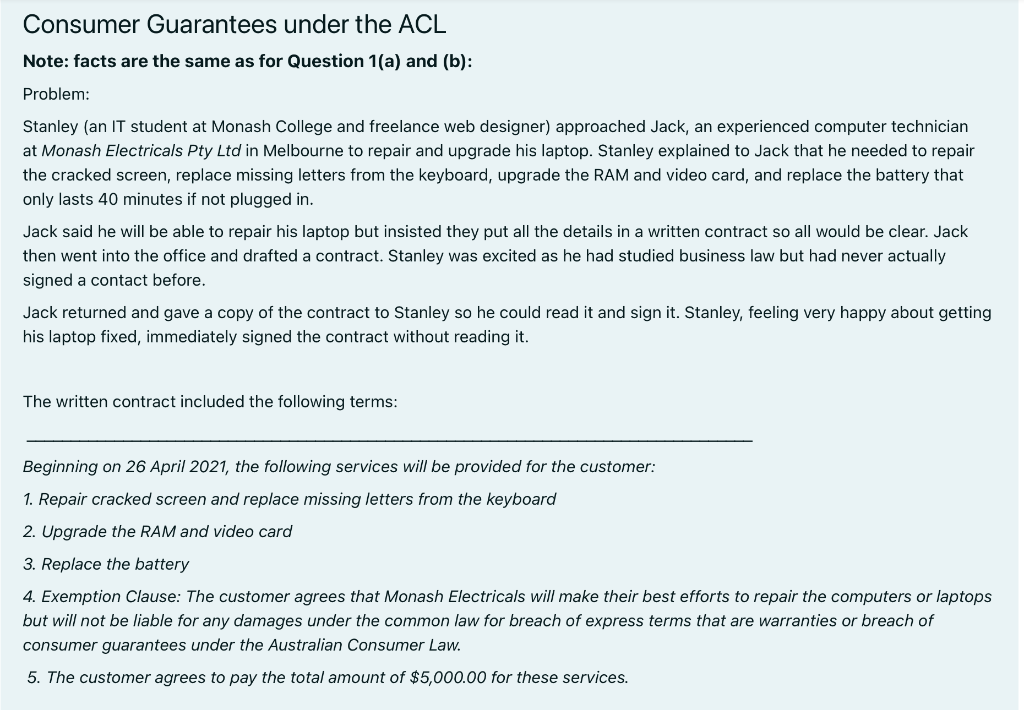
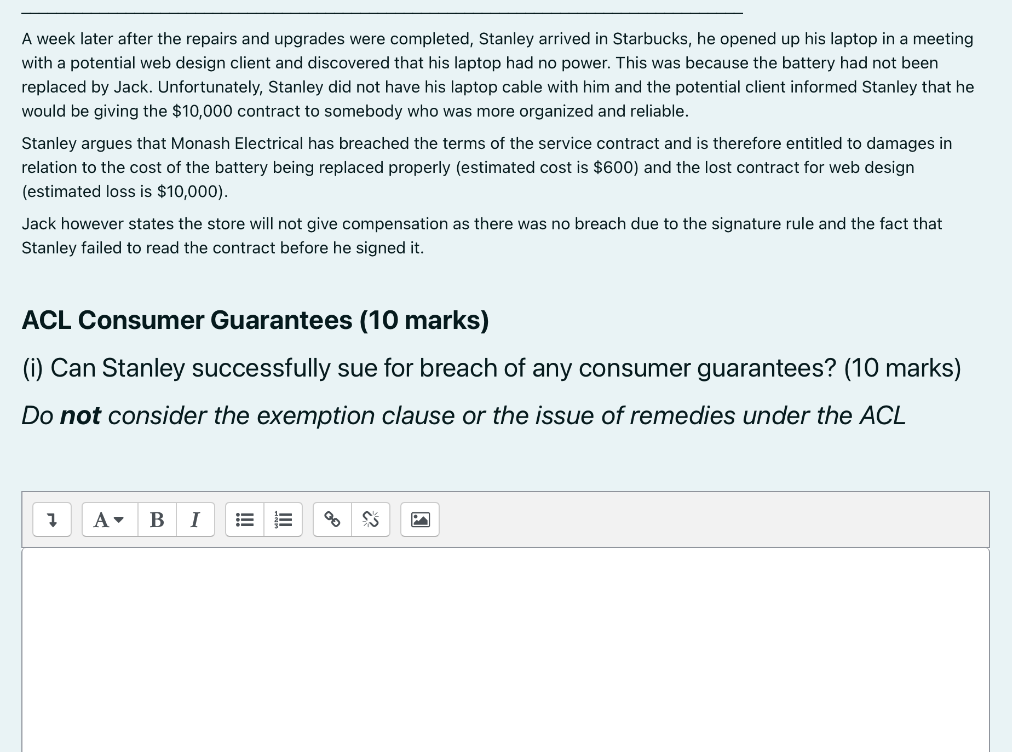
Common Law Terms Problem for Question 1 and 2: Stanley (an IT student at Monash College and freelance web designer) approached Jack, an experienced computer technician at Monash Electricals Pty Ltd in Melbourne to repair and upgrade his laptop. Stanley explained to Jack that he needed to repair the cracked screen, replace missing letters from the keyboard, upgrade the RAM and video card, and replace the battery that only lasts 40 minutes if not plugged in. Jack said he will be able to repair his laptop but insisted they put all the details in a written contract so all would be clear. Jack then went into the office and drafted a contract. Stanley was excited as he had studied business law but had never actually signed a contact before. Jack returned and gave a copy of the contract to Stanley so he could read it and sign it. Stanley, feeling very happy about getting his laptop fixed, immediately signed the contract without reading it. The written contract included the following terms: Beginning on 26 April 2021, the following services will be provided for the customer: 1. Repair cracked screen and replace missing letters from the keyboard 2. Upgrade the RAM and video card 3. Replace the battery 4. Exemption Clause: The customer agrees that Monash Electricals will make their best efforts to repair the computers or laptops but will not be liable for any damages under the common law for replaced parts or for breach of consumer guarantees under the Australian Consumer Law. 5. The customer agrees to pay the total amount of $5,000.00 for these services. A week later after the repairs and upgrades were completed, Stanley arrived in Starbucks, he opened up his laptop in a meeting with a potential web design client and discovered that his laptop had no power. This was because the battery had not been replaced by Jack. Unfortunately, Stanley did not have his laptop cable with him and the potential client informed Stanley that he would be giving the $10,000 contract to somebody who was more organized and reliable. Stanley argues that Monash Electrical has breached the terms of the service contract and is therefore entitled to damages in relation to the cost of the battery being replaced properly (estimated cost is $600) and the lost contract for web design (estimated loss is $10,000). Jack however states the store will not give compensation as there was no breach due to the signature rule and the fact that Stanley failed to read the contract before he signed it. (a) Common Law Terms and Breach (4 marks) (i) Identify the relevant terms of the contract and advise Stanley if any of the terms have been breached. (4 marks) (b) Exemption clause and Damages (6 marks) (i) Assuming there was a breach of terms, would the exemption clause protect Jack? (3 marks) (ii) Assuming there was a breach of terms and the exemption clause does not protect the defendant, can Stanley claim all damages? (3 marks) 1 A B I = Consumer Guarantees under the ACL Note: facts are the same as for Question 1(a) and (b): Problem: Stanley (an IT student at Monash College and freelance web designer) approached Jack, an experienced computer technician at Monash Electricals Pty Ltd in Melbourne to repair and upgrade his laptop. Stanley explained to Jack that he needed to repair the cracked screen, replace missing letters from the keyboard, upgrade the RAM and video card, and replace the battery that only lasts 40 minutes if not plugged in. Jack said he will be able to repair his laptop but insisted they put all the details in a written contract so all would be clear. Jack then went into the office and drafted a contract. Stanley was excited as he had studied business law but had never actually signed a contact before. Jack returned and gave a copy of the contract to Stanley so he could read it and sign it. Stanley, feeling very happy about getting his laptop fixed, immediately signed the contract without reading it. The written contract included the following terms: Beginning on 26 April 2021, the following services will be provided for the customer: 1. Repair cracked screen and replace missing letters from the keyboard 2. Upgrade the RAM and video card 3. Replace the battery 4. Exemption Clause: The customer agrees that Monash Electricals will make their best efforts to repair the computers or laptops but will not be liable for any damages under the common law for breach of express terms that are warranties or breach of consumer guarantees under the Australian Consumer Law. 5. The customer agrees to pay the total amount of $5,000.00 for these services. A week later after the repairs and upgrades were completed, Stanley arrived in Starbucks, he opened up his laptop in a meeting with a potential web design client and discovered that his laptop had no power. This was because the battery had not been replaced by Jack. Unfortunately, Stanley did not have his laptop cable with him and the potential client informed Stanley that he would be giving the $10,000 contract to somebody who was more organized and reliable. Stanley argues that Monash Electrical has breached the terms of the service contract and is therefore entitled to damages in relation to the cost of the battery being replaced properly (estimated cost is $600) and the lost contract for web design (estimated loss is $10,000). Jack however states the store will not give compensation as there was no breach due to the signature rule and the fact that Stanley failed to read the contract before he signed it. ACL Consumer Guarantees (10 marks) (i) Can Stanley successfully sue for breach of any consumer guarantees? (10 marks) Do not consider the exemption clause or the issue of remedies under the ACL 7 A- B 1 2









 Study Help