







Question: Common-Size Balance Sheets Consider the following balance sheet data for Great Buy Co., Inc., an electronics and major appliance retailer, at February 26,2013 and February
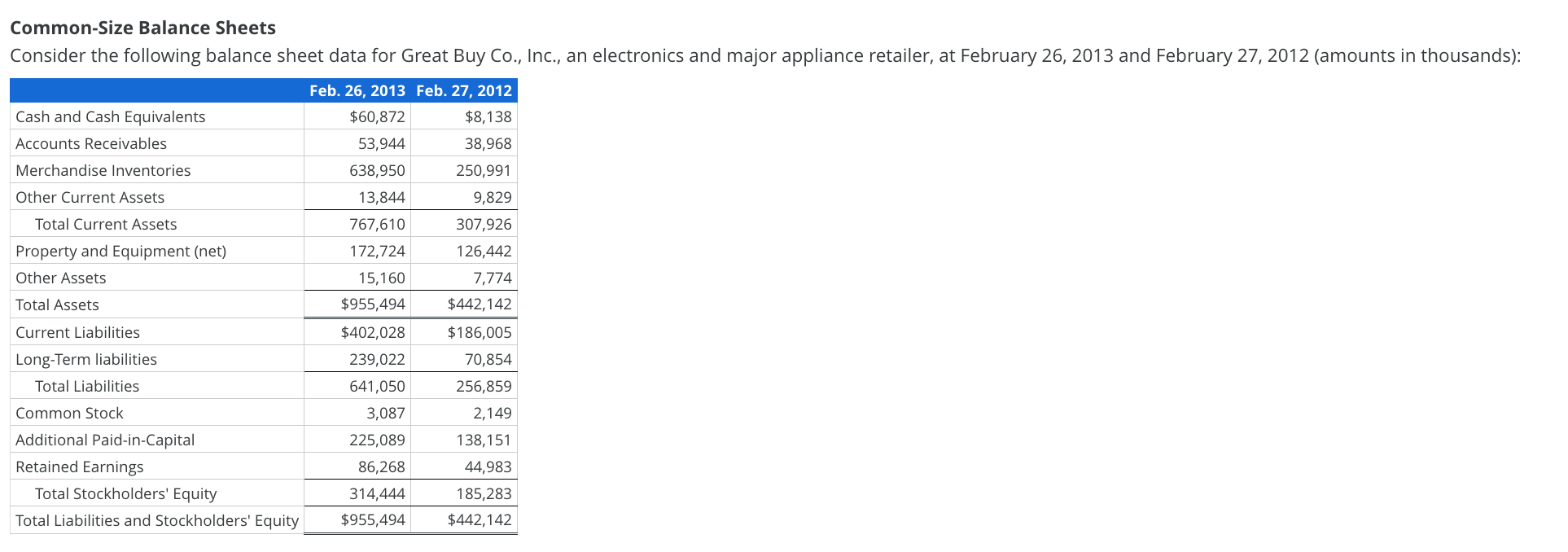
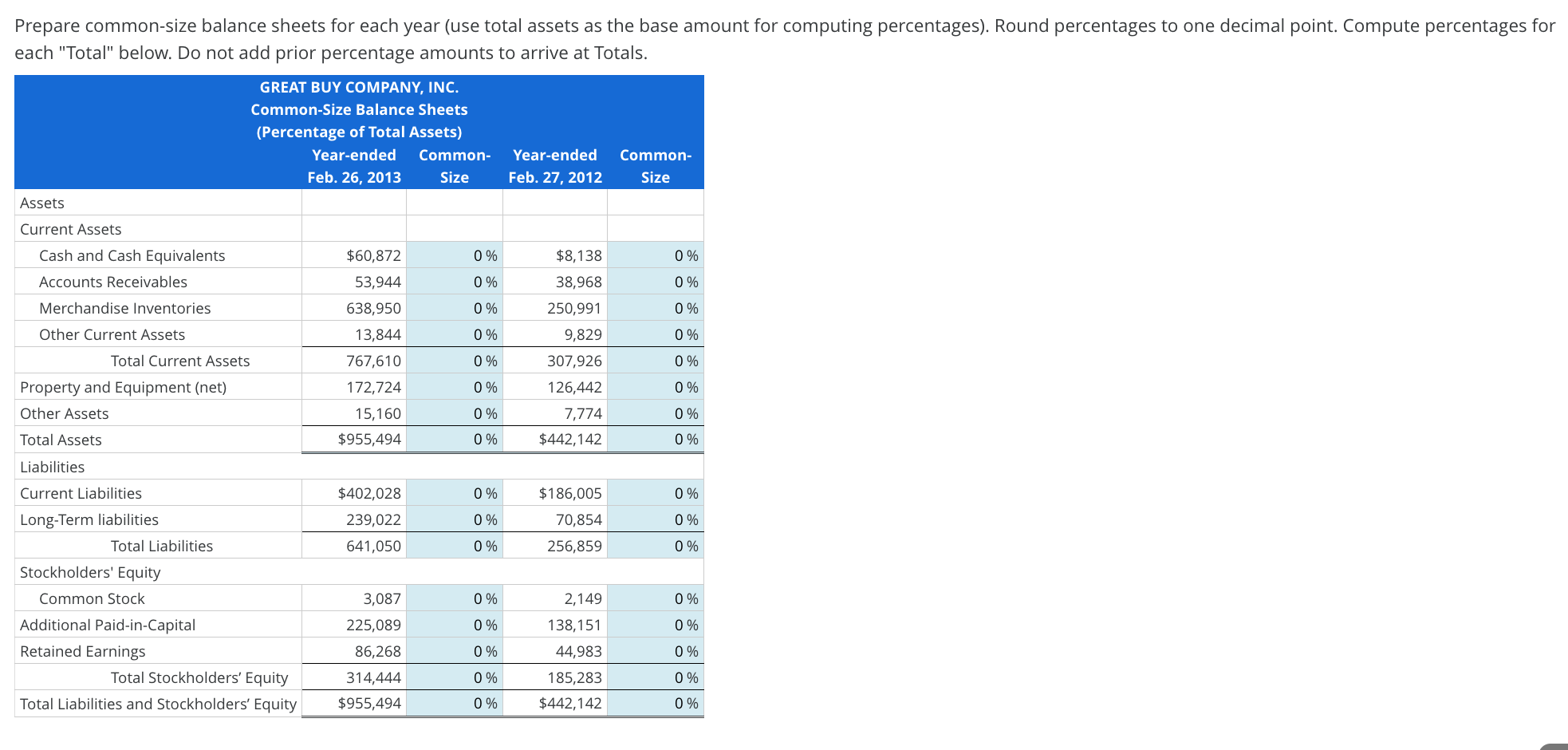
Common-Size Balance Sheets Consider the following balance sheet data for Great Buy Co., Inc., an electronics and major appliance retailer, at February 26,2013 and February 27,2012 (amounts in thousands): \begin{tabular}{|l|r|r|} \hline & Feb. 26, 2013 & Feb. 27, 2012 \\ \hline Cash and Cash Equivalents & $60,872 & $8,138 \\ \hline Accounts Receivables & 53,944 & 38,968 \\ \hline Merchandise Inventories & 638,950 & 250,991 \\ \hline Other Current Assets & 13,844 & 9,829 \\ \hline \multicolumn{1}{|c|}{ Total Current Assets } & 767,610 & 307,926 \\ \hline Property and Equipment (net) & 172,724 & 126,442 \\ \hline Other Assets & 15,160 & 7,774 \\ \hline Total Assets & $955,494 & $442,142 \\ \hline Current Liabilities & $402,028 & $186,005 \\ \hline Long-Term liabilities & 239,022 & 70,854 \\ \hline Total Liabilities & 641,050 & 256,859 \\ \hline Common Stock & 3,087 & 2,149 \\ \hline Additional Paid-in-Capital & 225,089 & 138,151 \\ \hline Retained Earnings & 86,268 & 44,983 \\ \hline Total Stockholders' Equity & 314,444 & 185,283 \\ \hline Total Liabilities and Stockholders' Equity & $955,494 & $442,142 \\ \hline \hline \end{tabular} Prepare common-size balance sheets for each year (use total assets as the base amount for computing percentages). Round percentages to one decimal point. Compute percentages for each "Total" below. Do not add prior percentage amounts to arrive at Totals
Step by Step Solution
There are 3 Steps involved in it

Get step-by-step solutions from verified subject matter experts
 Study Help