







Question: Communication (14 marks) True/False Indicate whether the statement is true or false. 15. The instantaneous rate of change is determined by finding the difference
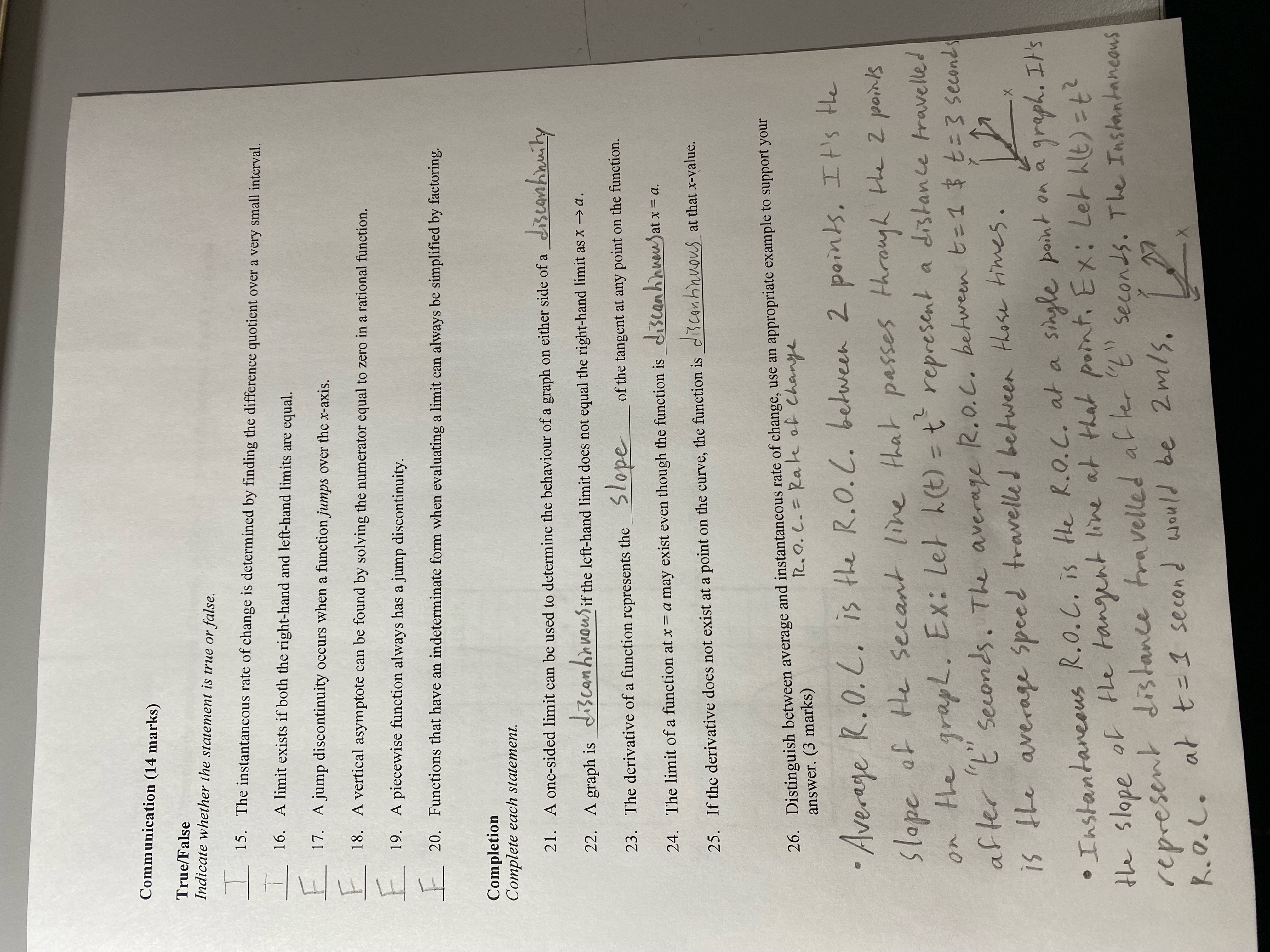
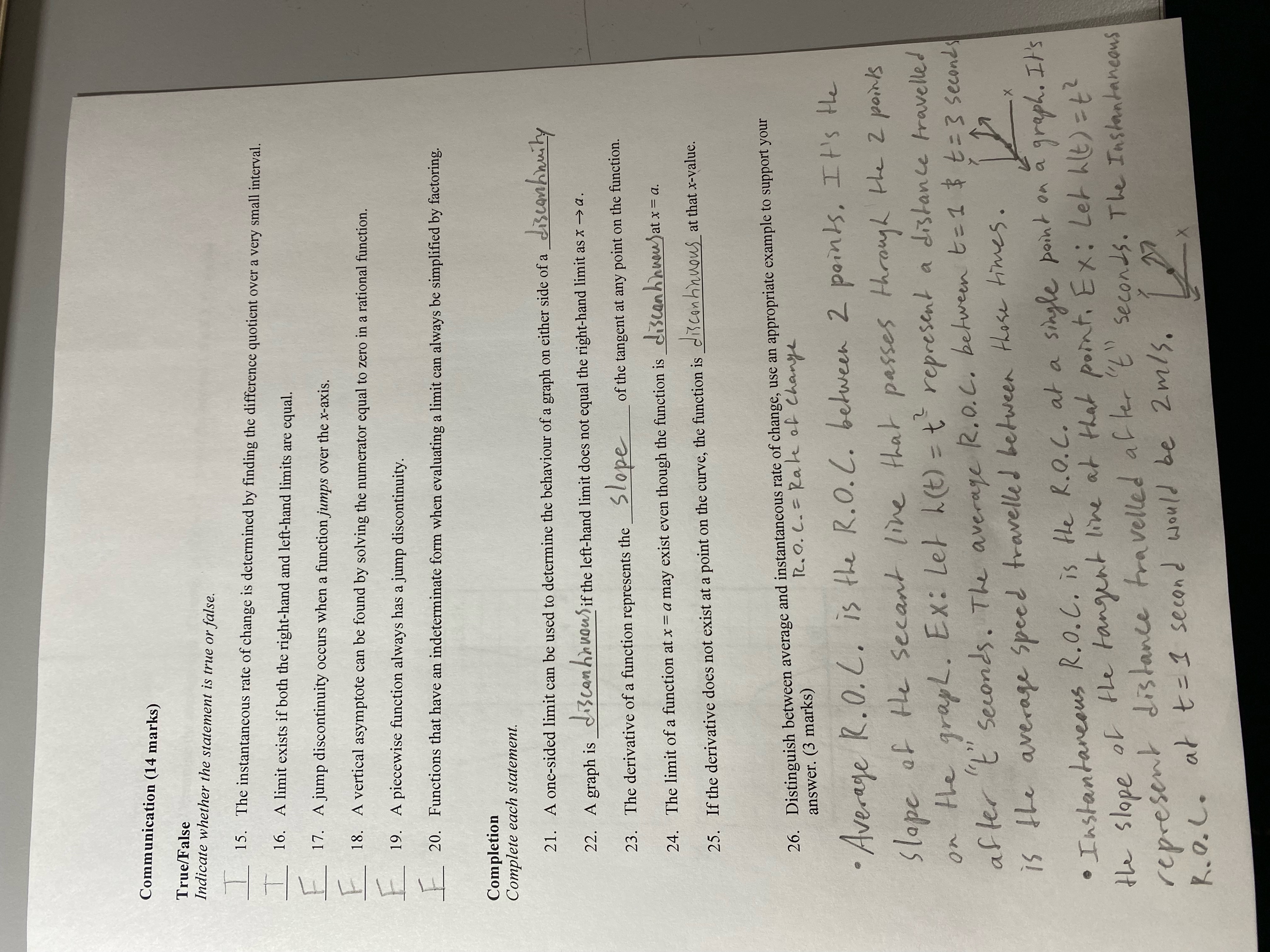
Communication (14 marks) True/False Indicate whether the statement is true or false. 15. The instantaneous rate of change is determined by finding the difference quotient over a very small interval. 16. A limit exists if both the right-hand and left-hand limits are equal. 17. A jump discontinuity occurs when a function jumps over the x-axis. 18. A vertical asymptote can be found by solving the numerator equal to zero in a rational function. 19. A piecewise function always has a jump discontinuity. F 20. Functions that have an indeterminate form when evaluating a limit can always be simplified by factoring. Completion Complete each statement. 21. A one-sided limit can be used to determine the behaviour of a graph on either side of a discontinuity 22. A graph is discanhnuous if the left-hand limit does not equal the right-hand limit as x a. Slope of the tangent at any point on the function. 23. The derivative of a function represents the 24. The limit of a function at x = a may exist even though the function is discontinuous at x = a. 25. If the derivative does not exist at a point on the curve, the function is discontinuous at that x-value. 26. Distinguish between average and instantaneous rate of change, use an appropriate example to support your R.O.C.= Rate of Change answer. (3 marks) Average R.O.L. is the R.O.C. between 2 points. It's the slope of the secant line that passes through the 2 points on the graph. Ex: Let h(t) = t represent after "t" seconds. The average R.O.C. between t=1&t=3 seconds 2 a distance travelled is the average speed travelled between those times. [ on a X graph. It's Instantaneous R.O.C. is the R.Q.C. at a single point the slope of the tangent live at that point. Ex: Let h(t)=t? represent distance travelled after "t" seconds. The Instantaneous R.O.L. at t= 1 second would be 2m/s.
Step by Step Solution
There are 3 Steps involved in it

Get step-by-step solutions from verified subject matter experts
 Study Help