







Question: communication skills Writing Assignment 2: Listening Styles Assignment Directions: Spring 2019 The revised Listening Styles Profile (LSP-R) measures four constructs including relational listening, analytical listening,
communication skills
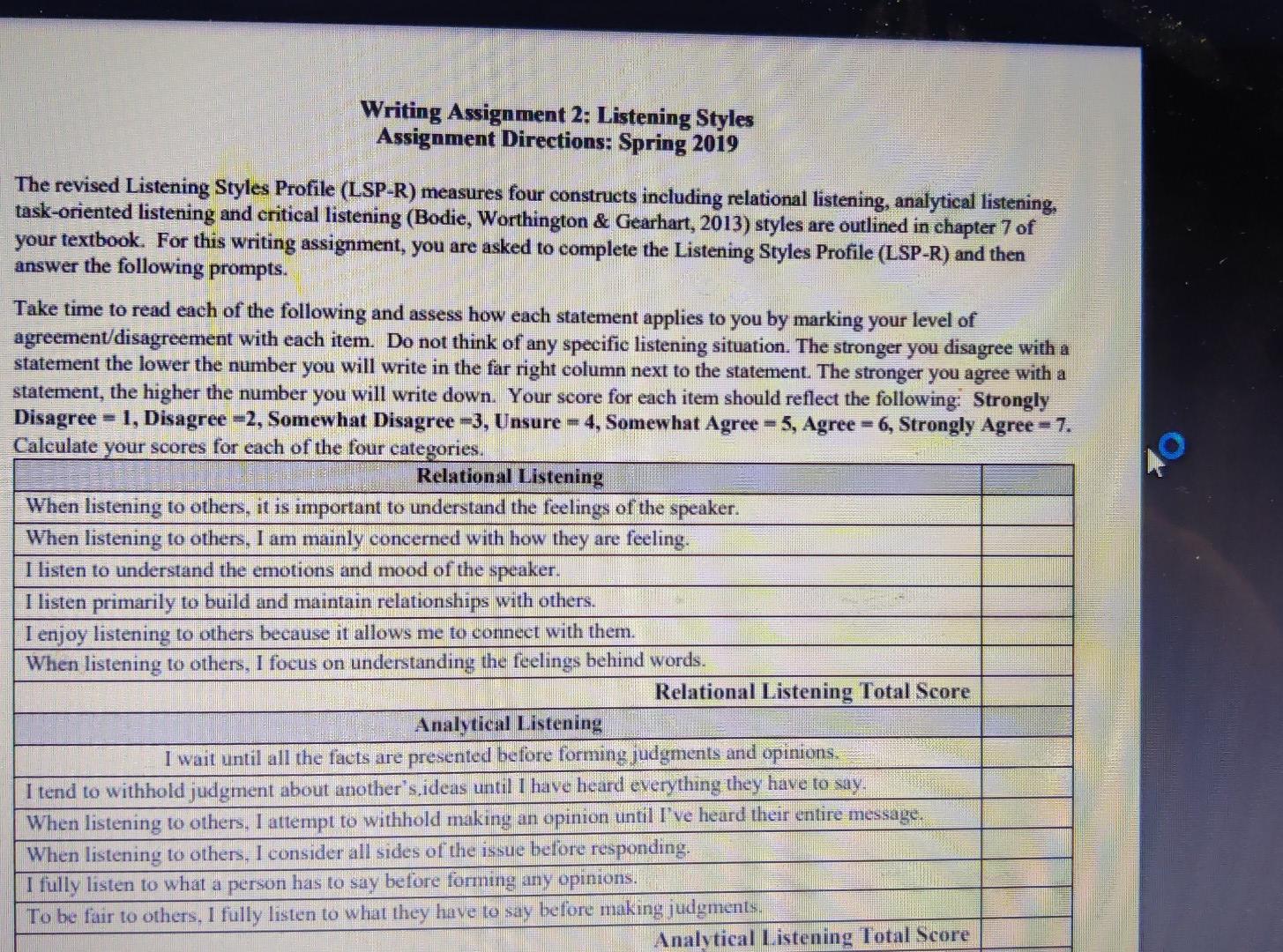
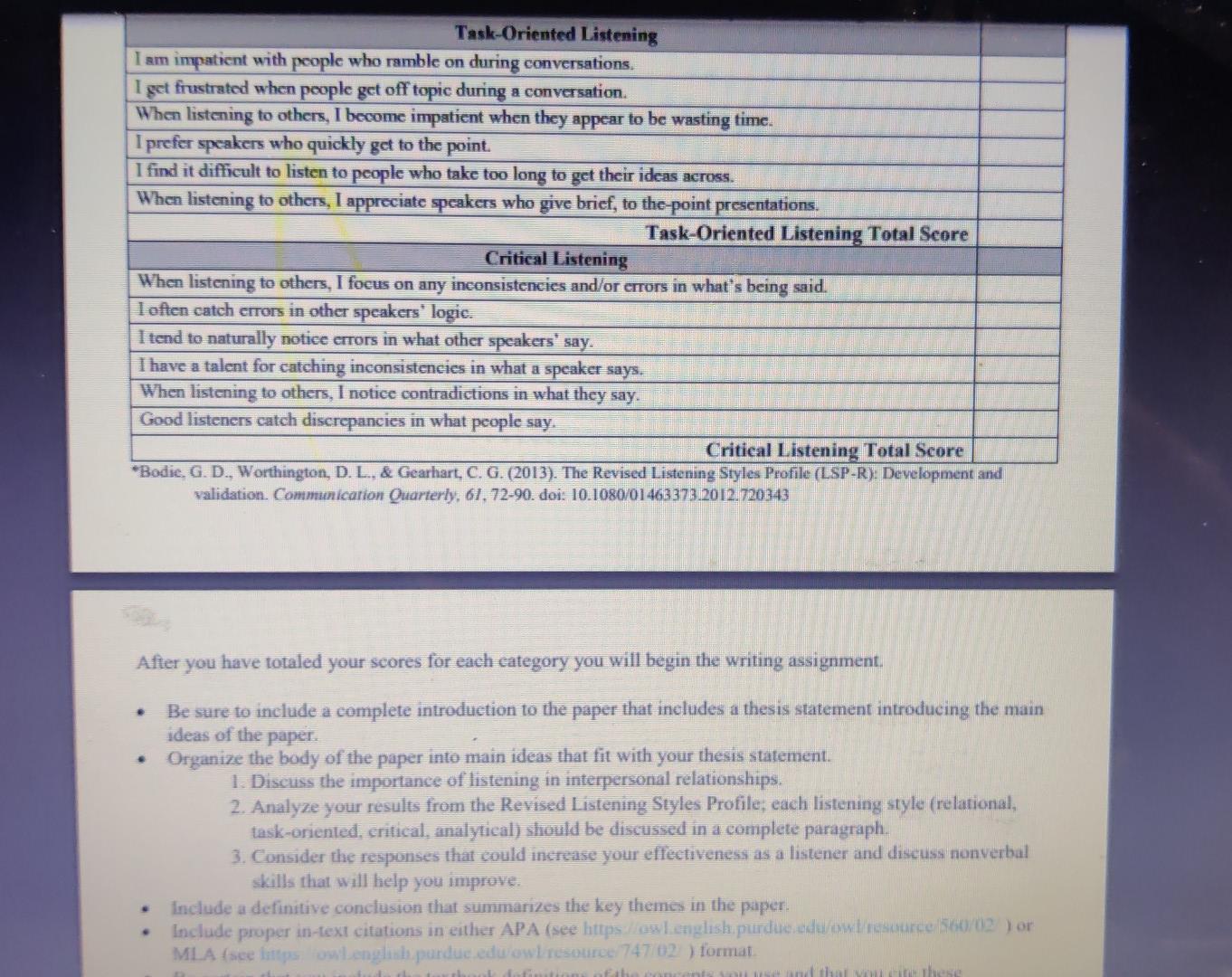
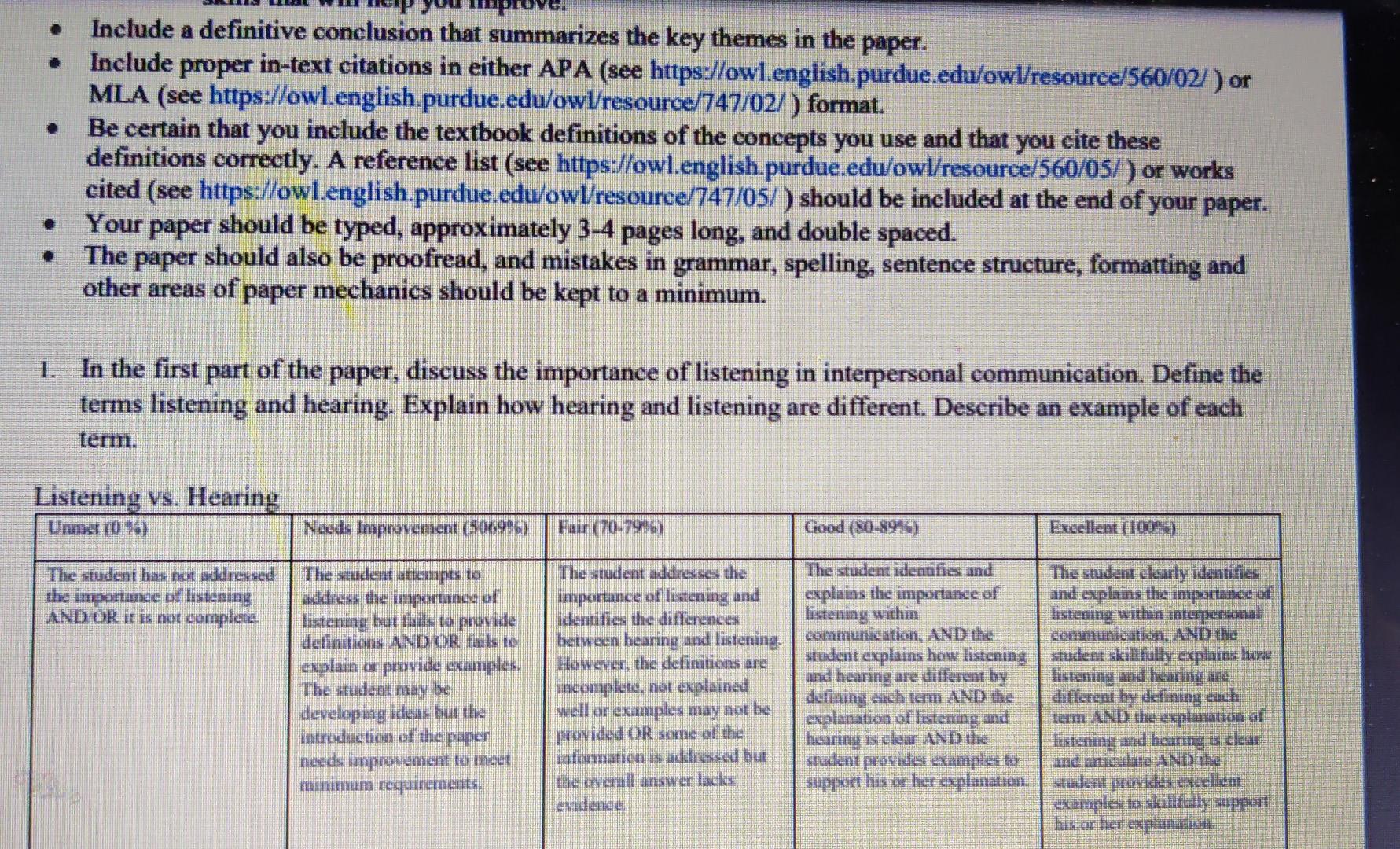
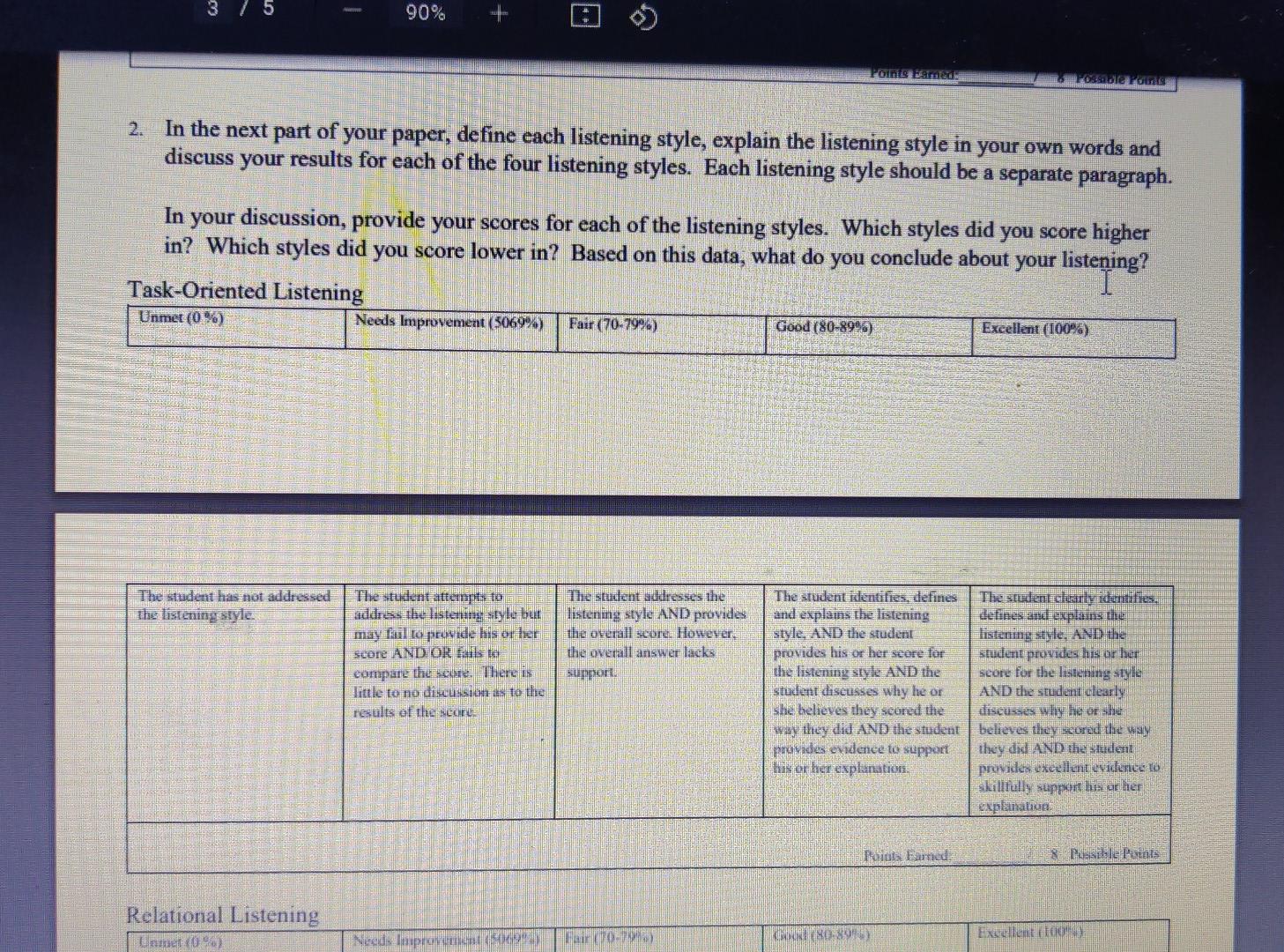
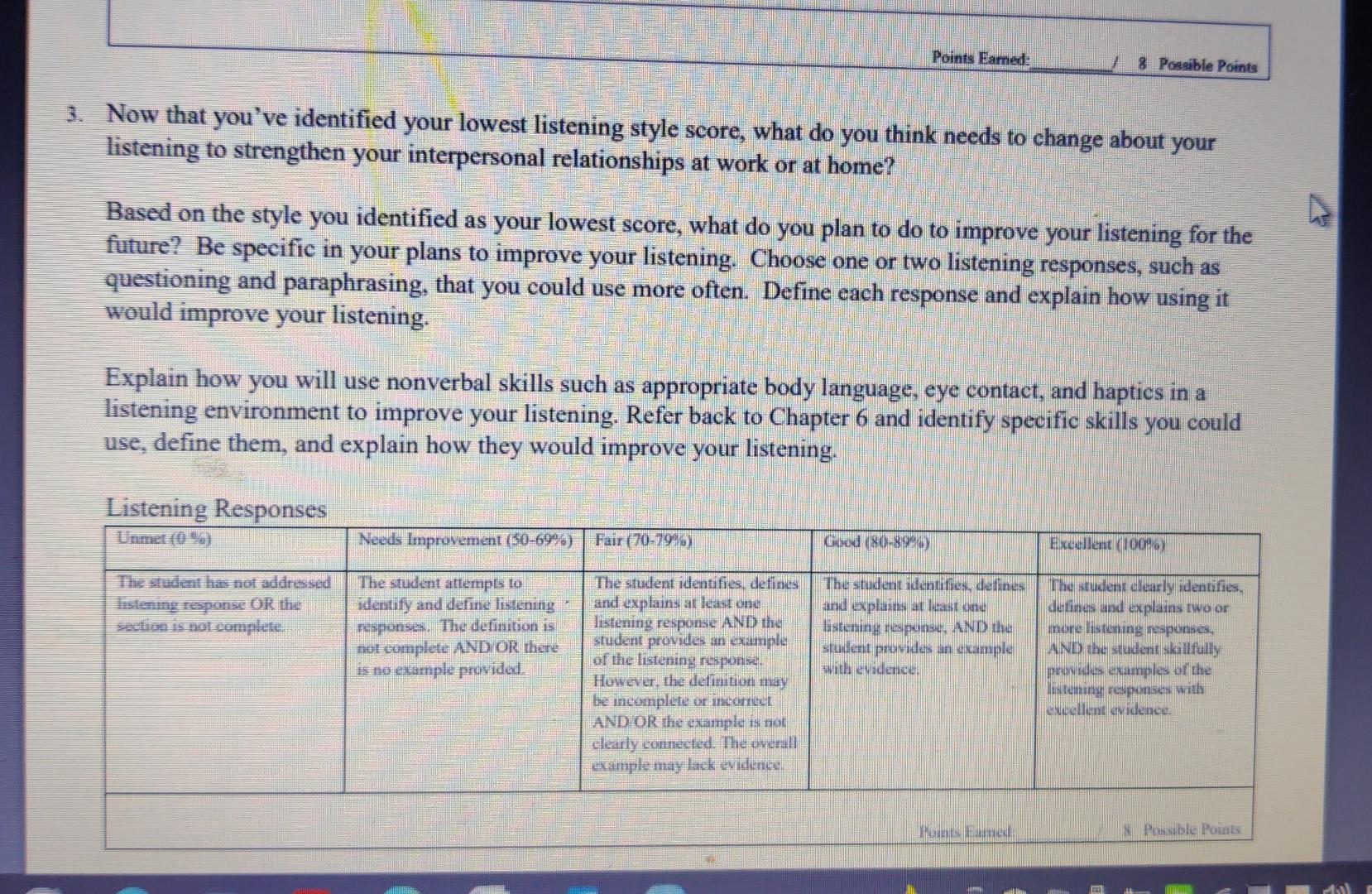
Writing Assignment 2: Listening Styles Assignment Directions: Spring 2019 The revised Listening Styles Profile (LSP-R) measures four constructs including relational listening, analytical listening, task-oriented listening and critical listening (Bodie, Worthington & Gearhart, 2013) styles are outlined in chapter 7 of your textbook. For this writing assignment, you are asked to complete the Listening Styles Profile (LSP-R) and then answer the following prompts. Take time to read each of the following and assess how each statement applies to you by marking your level of agreement/disagreement with each item. Do not think of any specific listening situation. The stronger you disagree with a statement the lower the number you will write in the far right column next to the statement. The stronger you agree with a statement, the higher the number you will write down. Your score for each item should reflect the following: Strongly Disagree = 1, Disagree -2, Somewhat Disagree --3, Unsure - 4. Somewhat Agree - 5, Agree - 6, Strongly Agree - 7. Calculate your scores for each of the four categories. Relational Listening When listening to others, it is important to understand the feelings of the speaker. When listening to others. I am mainly concerned with how they are feeling. I listen to understand the emotions and mood of the speaker. I listen primarily to build and maintain relationships with others. I enjoy listening to others because it allows me to connect with them. When listening to other, I focus on understanding the feelings behind words. Relational Listening Total Score Analytical Listening I wait until all the facts are presented before forming judgments and opinions. I tend to withhold judgment about another's ideas until I have heard everything they have to say. When listening to others. I attempt to withhold making an opinion until I've heard their entire message. When listening to others. I consider all sides of the issue before responding. I fully listen to what a person has to say before forming any opinions. To be fair to others, I fully listen to what they have to say before making judgments. Analytical Listening Total Score Task-Oriented Listening I am impaticnt with people who ramble on during conversations. I get frustrated when people get off topic during a conversation. When listening to others, I become impatient when they appear to be wasting time. I prefer speakers who quickly get to the point. I find it difficult to listen to people who take too long to get their ideas across When listening to others, I appreciate speakers who give brief, to the point presentations. Task-Oriented Listening Total Score Critical Listening When listening to others, I focus on any inconsistencies and/or errors in what's being said. loften catch errors in other speakers' logic. I tend to naturally notice errors in what other speakers' say. I have a talent for catching inconsistencies in what a speaker says. When listening to others, I notice contradictions in what they say. Good listeners catch discrepancies in what people say. Critical Listening Total Score *Bodie, G.D., Worthington, D. L, & Gearhart, C. G. (2013). The Revised Listening Styles Profile (LSP-R): Development and validation. Communication Quarterly. 61.72-90. doi: 10.1080/01463373.2012.720343 After you have totaled your scores for each category you will begin the writing assignment. Be sure to include a complete introduction to the paper that includes a thesis statement introducing the main ideas of the paper Organize the body of the paper into main ideas that fit with your thesis statement. 1. Discuss the importance of listening in interpersonal relationships. 2. Analyze your results from the Revised Listening Styles Profile; each listening style relational, task-oriented, critical, analytical) should be discussed in a complete paragraph. 3. Consider the responses that could increase your effectiveness as a listener and discuss nonverbal skills that will help you improve. Include a definitive conclusion that summarizes the key themes in the paper. Include proper in-text citations in either APA (see https:/ow.english.purdue.edu/ow/source/560/02) or MLA (see litt owl.english.purdue.edu/owresource 747/02 ) format these a . Include a definitive conclusion that summarizes the key themes in the paper. Include proper in-text citations in either APA (see https://owl.english.purdue.edu/ow/resource/560/02/) or MLA (see https://owl.english.purdue.edu/owl/resource/747/02/) format. Be certain that you include the textbook definitions of the concepts you use and that you cite these definitions correctly. A reference list (see https://owl.english.purdue.edu/owl/resource/560/05/) or works cited (see https://owl.english.purdue.edu/owl/resource/747/05/) should be included at the end of your paper. Your paper should be typed, approximately 3-4 pages long, and double spaced. The paper should also be proofread, and mistakes in grammar, spelling, sentence structure, formatting and other areas of paper mechanics should be kept to a minimum. e 1 In the first part of the paper, discuss the importance of listening in interpersonal communication. Define the terms listening and hearing. Explain how hearing and listening are different. Describe an example of each term. Listening vs. Hearing Unmet (0%) Needs Improvement (5069) Fair (70.7956) Good (80-893) Excellent (100) The student has not addressed the importance of listening AND OR it is not complete. The student attempts to address the importance of listening but fails to provide de SANDOR NAS DO explain or provide examples. The student may be developing ideas but the introduction of the paper needs improvement to meet minimum requirements. The student addresses the importance of listening and Identifies the differences between hearing and listening, However, the definitions are incomplete. not explained well or examples may not be provided OR serne of the information is addressed but the answer lacles evidence The student identifies and explains the importance of listening within Communication, AND the student explains how listening, and hearing are different hy defining eich tarm AND the explanation of listening and hearing is clear AND the student provides examples ter support his or her explanation. The student clearly identifies and explains the importance of listening within interpersonal communication, AND the student skillfully explains lewe listening md hearing are different by defining anh term AND the explanation of listening and hearing is clear and articulate AND student provides excellent examples a skillfully support his or her atanance. 3 / 5 90% Polnis med Fossade runs 2. In the next part of your paper, define each listening style, explain the listening style in your own words and discuss your results for each of the four listening styles. Each listening style should be a separate paragraph. In your discussion, provide your scores for each of the listening styles. Which styles did you score higher in? Which styles did you score lower in? Based on this data, what do you conclude about your listening? Task-Oriented Listening Unmet (0%) Needs Improvement (5069%) Fair (70-7996) Good (80-89%) Excellent (100%) The student has not addressed The listening style The student attempts to addrs. tbulsstale bu may ful to provide his or her score AND OR A ta compare thu seru. There is Tule to no discussions to the results of the UU. The student addresses the listening style AND provides the overall score. However the overall answer lacks ippert. The student identifies, defines The student clarly identifies, and explains the listening defines and explains the style, AND the student listening style. A the provides his or her seere for student provides his or her the listening style AND the seere for the listening style student discusses why he or AND the student clearly she believes they scored the discusses why he e she way they did AND the student believes they cured the way provides evidence to support they did AND the student his or her explanation. provides excellent evidence to skillfully support her er her explanation F Farned Pussile Patats Relational Listening Larut (U) xuellemt Nuodis Improvement 4 Points Eamed: 8 Possible Points 3. Now that you've identified your lowest listening style score, what do you think needs to change about your listening to strengthen your interpersonal relationships at work or at home? Based on the style you identified as your lowest score, what do you plan to do to improve your listening for the future? Be specific in your plans to improve your listening. Choose one or two listening responses, such as questioning and paraphrasing, that you could use more often. Define each response and explain how using would improve your listening. Explain how you will use nonverbal skills such as appropriate body language, eye contact, and haptics in a listening environment to improve your listening. Refer back to Chapter 6 and identify specific skills you could use, define them, and explain how they would improve your listening. Listening Responses Needs Improvement (50-69%) Fair (70-79%) Good (80-893) Excellent 100%) The student has not addressed listening response OR the Section is not complete. The student attempts to identify and define listening - responses. The definition is not complete AND OR there is no example provided. The student identius, definus and explains at least one listening response AND the student provides an example of the listening response. However, the definition may be ineumpletu or incorrect AND OR the example is not clearly connected. The overall Example may lack evidene "Thu student identifies, dutinus and explains at least one listening response, AND the student provides an example with evidence The student clearly identifies, delines and explains two or more listening responses, AND the student skillfully provides examples of the listemang responses with exuellene evidence Points med Puisible PointsStep by Step Solution
There are 3 Steps involved in it
1 Expert Approved Answer
Step: 1 Unlock

Question Has Been Solved by an Expert!
Get step-by-step solutions from verified subject matter experts
Step: 2 Unlock
Step: 3 Unlock
 Study Help