Question: COMPANY Case Target: From Expect More to Pay Less When you hear the term discount retail, two names that usually come to mind: Walmart and
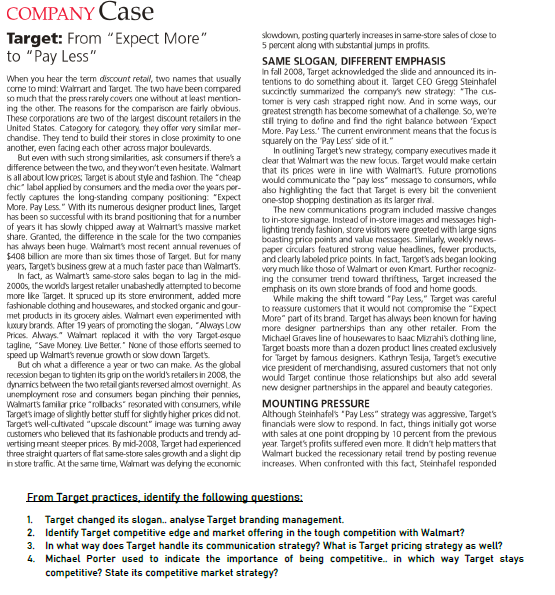
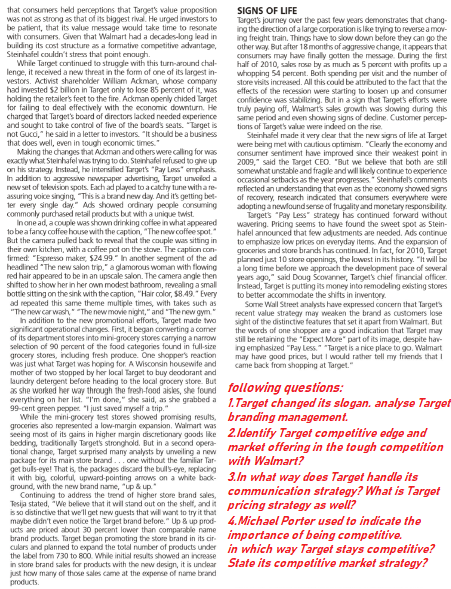
COMPANY Case Target: From "Expect More" to "Pay Less" When you hear the term discount retail, two names that usually come to mind: Walmart and Target. The two have been compared so much that the press rarely covers one without at least mention- ing the other. The reasons for the comparison are fairly obvious, These corporations are two of the largest discount retailers in the United States. Category for category, they offer very similar mer chandise. They tend to build their stores in close proximity to one another, even facing each other across major boulevards. But even with such strong similarities, ask consumers if there's a difference between the two, and they won't even hesitate Walmart is all about low prices Target is about style and fashion. The cheap chic label applied by consumers and the media over the years per fectly captures the long standing company positioning: "Expect More. Pay Less. With its numerous designer product lines, Target has been so successful with its brand positioning that for a number of years it has slowly chipped away at Walmart's massive market share. Granted, the difference in the scale for the two companies has always been huge Walmart's most recent annual revenues of $408 billion are more than six times those of Target. But for many years, Target's business grew at a much faster pace than Walmart's In fact, as Walmart's same store sales began to lag in the mid- 2000s, the world's largest retaller unabashedly attempted to become more like Target. It spruced up its store environment, added more fashionable dothing and housewares, and stocked organic and gour- met products in its grocery aisles, Walmart even experimented with luxury brands. After 19 years of promoting the slogan. "Always Low Prices. Always." Walmart replaced it with the very Target-esque tagline, Save Money Live Better None of those efforts seemed to speed up Walmart's revenue growth or slow down Targets. But oh what a difference a year or two can make. As the global recession began to tighten its grip on the world's retailers in 2008, the dynarric between the two retail giants reversed almost overnight. As unemployment rose and consumers bogan pinching their pennies, Walmarts familia price rolbacks" resonated with consumers, while Target's image of slightly better stuff for slightly higher prices did not Target's well-cultivated upscale discount" image was turning away customers who believed that its fashionable products and trendy ad- vertising meant steeper prices. By mid-2008, Target had experienced three straight quarters of fiat same-store sales growth and a slight dip in store traffic. At the same time, Walmart was defying the economic skowdown, posting quarterly increases in same-store sales of close to 5 percent along with substantial jumps in profits. SAME SLOGAN, DIFFERENT EMPHASIS In fall 2008, Target acknowledged the slide and announced its in- tentions to do something about it. Target CEO Gregg Steinhafel succinctly summarized the company's new strategy: "The CLS- tomer is very cash strapped right now. And in some ways, our greatest strength has become somewhat of a challenge. So, we're still trying to define and find the right balance betwoon 'Expect More. Pay Less.' The current environment means that the focus is squarely on the Pay Less' side of it." In outlining Target's new strategy, company executives made it dear that Walmart was the new focus. Target would make certain that its prices were in line with Walmart's Future promotions would communicate the "pay loss message to consumers, whilo also highlighting the fact that Target is every bit the convenient one-stop shopping destination as its larger rival The new communications program included massive changes to in-store signage. Instead of in-store images and messages high- lighting trendy fashion, store visitors were greeted with large signs boasting price points and value messages. Similarly, weekly news- paper circulars featured strong value headlines, fewer products, and clearly labeled price points. In fact, Target's ads began looking very much like those of Walmart or even Kmart. Further recogniz. ing the consumer trend toward thriftliness, Target Increased the emphasis on its own store brands of food and home goods. While making the shift toward "Pay Less," Target was careful to reassure customers that it would not compromise the "Expect More" part of its brand. Target has always been known for having more designer partnerships than any other retailer. From the Michael Graves line of housewares to Isaac Mizrahi's dothing line, Target boasts more than a dozen product lines created exclusively for Target by famous designers, Kathryn Tesija, Target's executive vice president of merchandising, assured customers that not only would Target continue those relationships but also add several new designer partnerships in the apparel and beauty categories MOUNTING PRESSURE Although Steinhafel's "Pay Less" strategy was aggressive. Target's financials were slow to respond. In fact, things initially got worse with sales at one point dropping by 10 percent from the previous year. Target's profits suffered even more. It didn't help matters that Walmart bucked the recessionary retail trend by posting revenue increases. When confronted with this fact, Steinhafel responded From Target practices, identify the following questions: 1. Target changed its slogan analyse Target branding management 2. Identify Target competitive edge and market offering in the tough competition with Walmart? 3. In what way does Target handle its communication strategy? What is Target pricing strategy as well? 4. Michael Porter used to indicate the importance of being competitive.. in which way Target stays competitive? State its competitive market strategy? that consumers held perceptions that Target's value proposition SIGNS OF LIFE was not as strong as that of its biggest rival. He urged investors to Target's journey over the past few years demonstrates that chang- be patient, that its value message would take time to resonate ing the direction of a large corporation is like trying to reverse a mov- with consumers. Given that Walmart had a decades-long lead in ing freight train. Things have to slow down before they can go the building its cost structure as a formative competitive advantage other way. But after 18 months of aggressive change, it appears that Steinhafe couldn't stress that point enough consumers may have finally gotten the message. During the first While Target continued to struggle with this turn-around chal- half of 2010, sales rose by as much as 5 percent with profits up a lenge, it received a new threat in the form of one of its largest in- whopping 54 percent. Both spending per visit and the number of vestors. Activist shareholder William Ackman, whose company Store visits increased. All this could be attributed to the fact that the had inwested S2 bilion in Target only to lose 85 percent of it, was effects of the recession were starting to loosen up and consumer holding the retailer's feet to the fire. Ackman openly chided Target confidence was stabilizing. But in a sign that Targets efforts were for failing to deal effectively with the economic downturn. He truly paying off, Walmart's sales growth was slowing during this charged that Target's board of directors lacked needed experience same period and even showing signs of dedine. Customer percep- and sought to take control of five of the board's seats. Target is tions of Targets value were indeed on the rise not Guco," he said in a letter to investors. It should be a business Steinhabe made it very dear that the new sigra of life at Target that does well, even in tough economic times. were being met with cautious optimism. "Clearly the economy and Making the changes that Adkman and others were calling for was consumer sentiment have improved since their weakest point in exactly what Steinhafel was trying to do Steinhafel refused to ge up 2009," said the Target CEO. "But we believe that both are still on his strategy. Instead, he intensified Target's "Payless emphasis somewhat unstable and fragile and will likely continue to experience In addition to aggressive newspaper accertising, Target unveiled a occasional setbacks as the year progresses Steinhafel's comments new set of television spots. Each ad played to a catchy tune withare reflected an understanding that even as the economy showed signs assuring voice singing. This is a brand new day. And it's getting bet of recovery, research indicated that consumers everywhere were ter every single day." Ads showed ordinary people consuming adopting a newfounderse af frugality and monetary responsibility commonly purchased retail products but with a unique twist Target's "Pay Less strategy has continued forward without In onead, a couple was shown drinking coffee in what appeared wavering. Pricing seems to have found the sweet spot as Stein- to be a fancy coffee house with the caption "The new coffee spot hafel announced that few adjustments are needed. Ads continue But the camera pulled back to reveal that the couple was sitting in to emphasize low prices on everyday items. And the expansion of their own kitchen with a coffee pot on the stove. The caption.com groceries and store brands has continued. In fact, for 2010, Target firmed "Espresso maker, 52499." In another segment of the ad plannad just 10 store openings, the lowest in its history. "It will be headlined "The new salon trip a glamorous woman with flowing a long time before we approach the development pace of several red hair appeared to be in an upscale salon. The camera angle then years ago," said Doug Scovarner, Target's chief financial offices shifted to show her in her own modest bathroom, revealing a smal instead. Target is putting its money into remodeling existing stores bottle sitting on the sink with the caption, "Hair color, 58.49. Every to better accommodate the shifts in inventory. ad repeated this same theme multiple times with takes such as Some Wall Street analysts have expressed concern that Target's "The new car wash The new movie night," and "The new gym." recent value strategy may weaken the brand as customers lose In addition to the new promotional efforts, Target made two sight of the distinctive features that set it apart from Walmart. But significant operational changes. First, it began corwerting a comer the words of one shopper are a good indication that Target may of its department stores into mini-grocery stores carrying a narrow still be retaining the "Expect More" part of its image, despite har selection of 90 percent of the food categories found in full-size ng emphasized "Payless Target is a nice place to go. Walmart grocery stores, including fresh produce. One shopper's reaction may have good prices, but I would rather tell my friends that I was just what Target was hoping for A Wisconsin housewife and came back from shopping at Target." mother of two stopped by her local Target to buy deodorant and Laundry detergent before heading to the local grocery store. But as she worked her way through the fresh food aisles, she found following questions: everything an her list. Im done," she said, as she grabbed a 1. Target changed its slogan, analyse Targer While the mini-grocery test stores showed promising results, branding management. secing most of its gaits in higher margin discretionary goods like 2. Identify Target competitive edge and bedding traditionally Targets stronghaid. But in a second opera market offering in the tough competition package for its main store brand.cne without the fornitar Tar with Walmart? get buls-eye! That is the packages discard the buils-eye, replacing it with big colorful, upward pointing arrows on a white back 3.In what way does Target handle its ground, with the new brand name, "up & up." Continuing to address the trend of higher store brand sales, communication strategy? What is Target Tesla stated, "We believe that it will stand out on the shelt, and it pricing strategy as well? maybe didn't even notice the Torget brand before." Up & up pred 4. Michael Porter used to indicate the cukurs and planned to expand the total number of products under in which way Target stays competitive? brand products. Target began promoting the store brand in its ir importance of being competitive. store brand sales for products with the new design, it is under State its competitive market strategy? just how many of of brand products









 Study Help