







Question: Compare and contrast theoretical material properties ( including atomic structure and bonding ) for the materials identified in activity 1a compared with values obtained through
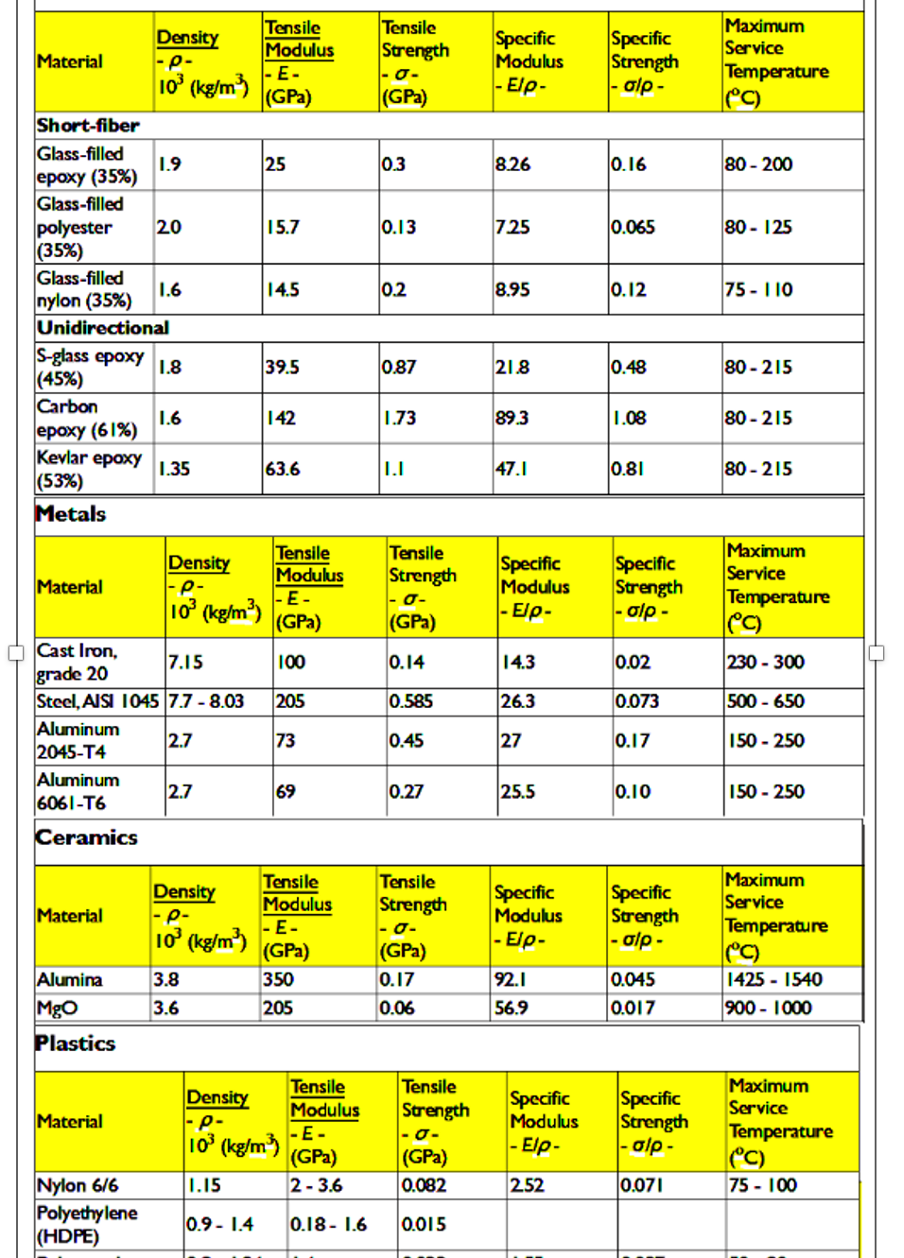 Compare and contrast theoretical material properties (including atomic structure and bonding) for the materials identified in activity 1a compared with values obtained through destructive and non-destructive test methods as provided in the table below. In particular assess the data for density, tensile strength, strength to weight ratio (specific modulus), and operating temperature range
-steel (1045)
-aluminium (T4)
-unidirectional S-glass-epoxy
-carbon-epoxy fibre
Short-fiber Metals Ceramics Plastics \begin{tabular}{|l|l|l|l|l|l|l|} \hline Material & Density103(kg2/m3) & TensileModulus & TensileStrengthGPa) & SpecificModulusGPa) & SpecificStrength/ & MaximumServiceTemperature(C) \\ \hline Nylon 6/6 & 1.15 & 23.6 & 0.082 & 252 & 0.071 & 75100 \\ \hline Polyethylene(HDPE) & 0.91.4 & 0.181.6 & 0.015 & & & \\ \hline \end{tabular} Short-fiber Metals Ceramics Plastics \begin{tabular}{|l|l|l|l|l|l|l|} \hline Material & Density103(kg2/m3) & TensileModulus & TensileStrengthGPa) & SpecificModulusGPa) & SpecificStrength/ & MaximumServiceTemperature(C) \\ \hline Nylon 6/6 & 1.15 & 23.6 & 0.082 & 252 & 0.071 & 75100 \\ \hline Polyethylene(HDPE) & 0.91.4 & 0.181.6 & 0.015 & & & \\ \hline \end{tabular}
Step by Step Solution
There are 3 Steps involved in it

Get step-by-step solutions from verified subject matter experts
 Study Help