







Question: Compare/contrast these forms. (Suggestion: At a minimum, name at least one advan- tage and disadvantage for each.) 3. It may be possible to reduce
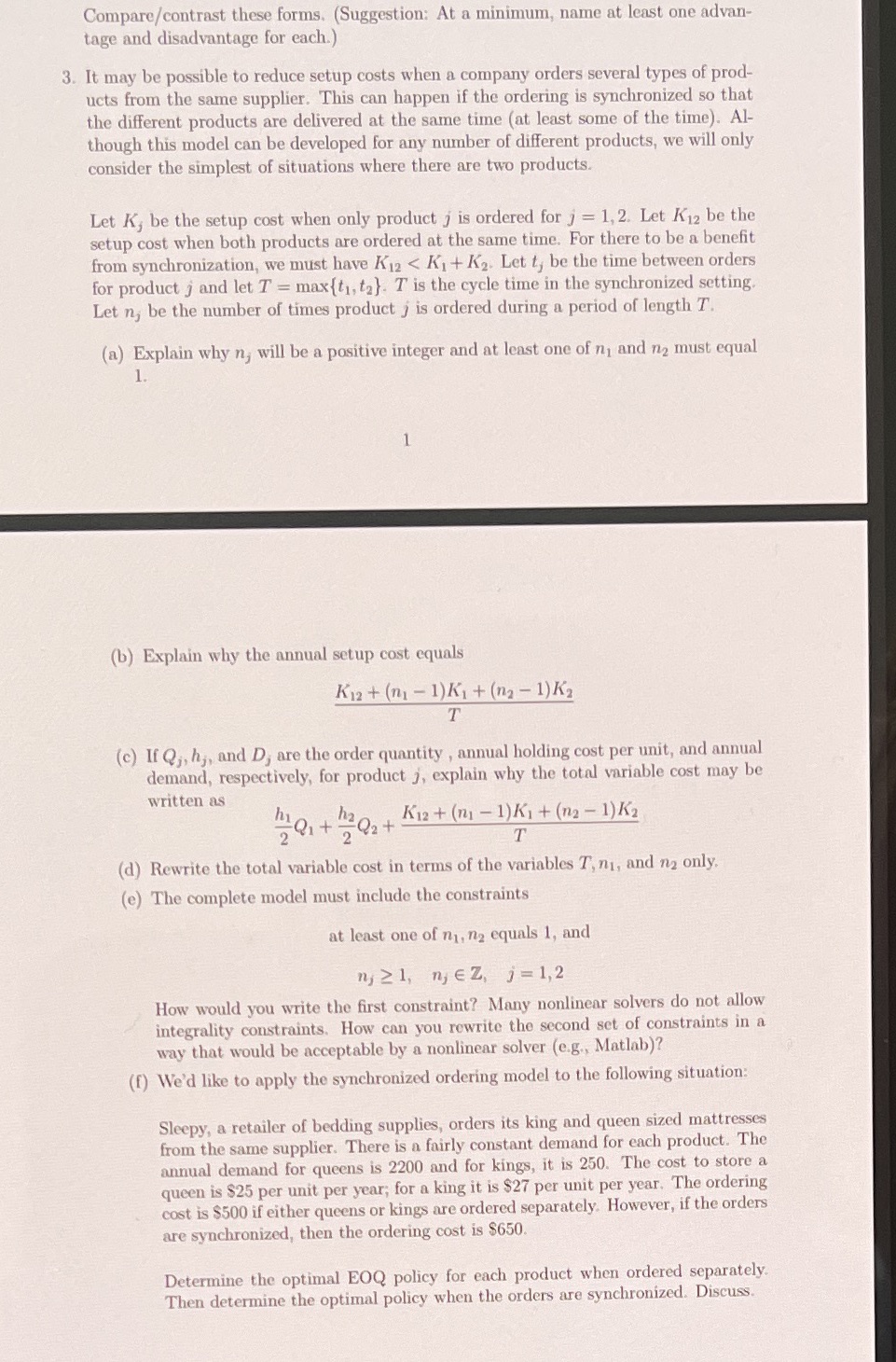
Compare/contrast these forms. (Suggestion: At a minimum, name at least one advan- tage and disadvantage for each.) 3. It may be possible to reduce setup costs when a company orders several types of prod- ucts from the same supplier. This can happen if the ordering is synchronized so that the different products are delivered at the same time (at least some of the time). Al- though this model can be developed for any number of different products, we will only consider the simplest of situations where there are two products. Let K, be the setup cost when only product j is ordered for j = 1,2. Let K12 be the setup cost when both products are ordered at the same time. For there to be a benefit from synchronization, we must have K12 < K+K. Let t, be the time between orders for product j and let T = max{t, ta). T is the cycle time in the synchronized setting. Let n, be the number of times product j is ordered during a period of length T. (a) Explain why n, will be a positive integer and at least one of n, and n must equal 1. (b) Explain why the annual setup cost equals K12+ ( - 1)K + (n-1) K T (c) If Q,, h,, and D, are the order quantity, annual holding cost per unit, and annual demand, respectively, for product j, explain why the total variable cost may be written as K12+ (-1)K + (n2-1) K T (d) Rewrite the total variable cost in terms of the variables T, n, and no only. (e) The complete model must include the constraints at least one of n, n equals 1, and n, 21, n, EZ, j = 1,2 How would you write the first constraint? Many nonlinear solvers do not allow integrality constraints. How can you rewrite the second set of constraints in a way that would be acceptable by a nonlinear solver (e.g., Matlab)? (f) We'd like to apply the synchronized ordering model to the following situation: + 2 + Sleepy, a retailer of bedding supplies, orders its king and queen sized mattresses from the same supplier. There is a fairly constant demand for each product. The annual demand for queens is 2200 and for kings, it is 250. The cost to store a queen is $25 per unit per year; for a king it is $27 per unit per year. The ordering cost is $500 if either queens or kings are ordered separately. However, if the orders are synchronized, then the ordering cost is $650. Determine the optimal EOQ policy for each product when ordered separately. Then determine the optimal policy when the orders are synchronized. Discuss.
Step by Step Solution
3.49 Rating (146 Votes )
There are 3 Steps involved in it
Okay lets break this down stepbystep a Explain why n and n will be positive integers and at least one of n and n must equal 1 The number of times each ... View full answer

Get step-by-step solutions from verified subject matter experts
 Study Help