



Question: Comparing 2 Population's Means (Platelet Count) For this discussion, we are going to reexamine that question, using the techniques of Chapter 9. The summary of
Comparing 2 Population's Means (Platelet Count)
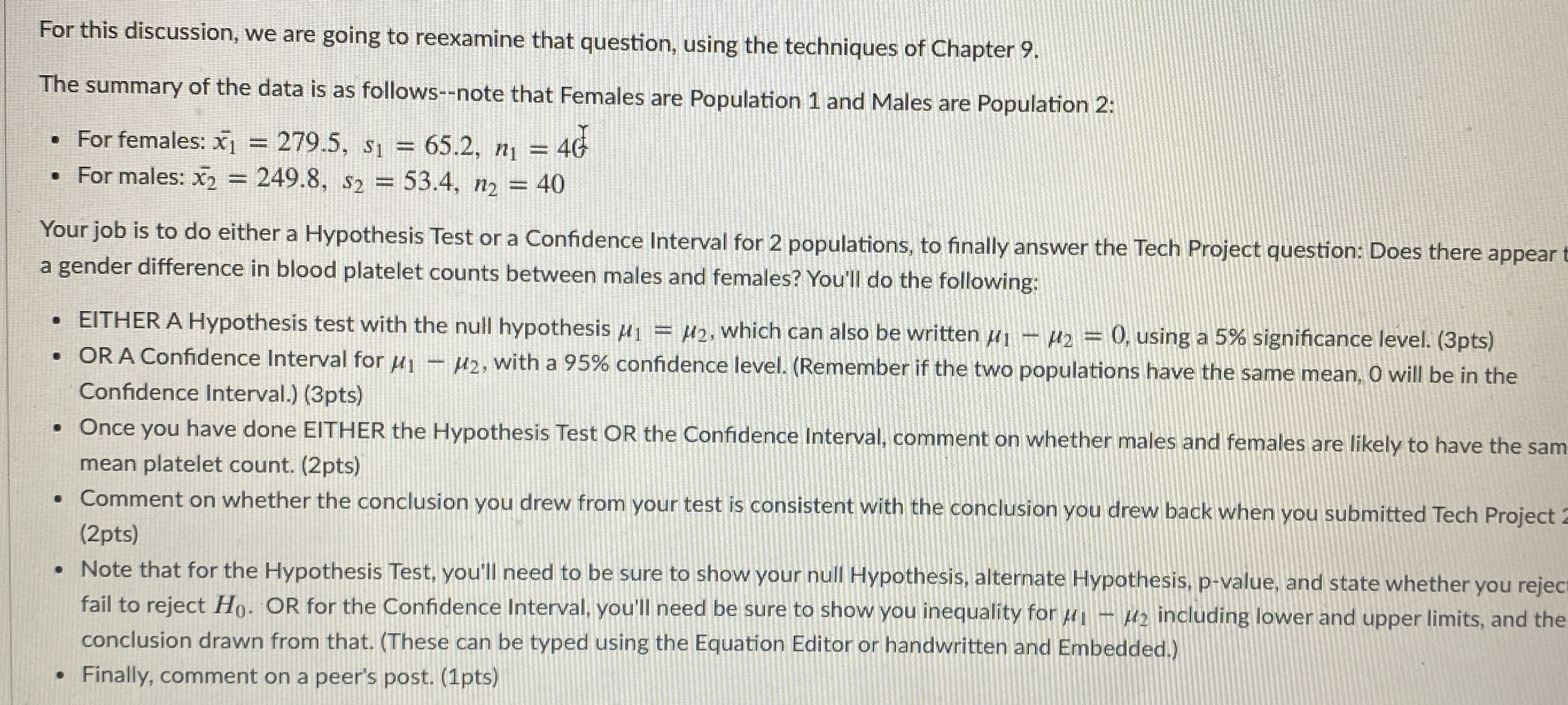
For this discussion, we are going to reexamine that question, using the techniques of Chapter 9. The summary of the data is as follows--note that Females are Population 1 and Males are Population 2: . For females: x1 = 279.5, s1 = 65.2, m - 46 . For males: X2 = 249.8, s2 = 53.4, n2 = 40 Your job is to do either a Hypothesis Test or a Confidence Interval for 2 populations, to finally answer the Tech Project question: Does there appear a gender difference in blood platelet counts between males and females? You'll do the following: . EITHER A Hypothesis test with the null hypothesis #1 = /2, which can also be written #1 - #2 = 0, using a 5% significance level. (3pts) . OR A Confidence Interval for #1 - /2, with a 95% confidence level. (Remember if the two populations have the same mean, O will be in the Confidence Interval.) (3pts) . Once you have done EITHER the Hypothesis Test OR the Confidence Interval, comment on whether males and females are likely to have the sam mean platelet count. (2pts) . Comment on whether the conclusion you drew from your test is consistent with the conclusion you drew back when you submitted Tech Project (2pts) . Note that for the Hypothesis Test, you'll need to be sure to show your null Hypothesis, alternate Hypothesis, p-value, and state whether you reject fail to reject Ho. OR for the Confidence Interval, you'll need be sure to show you inequality for #| - #2 including lower and upper limits, and the conclusion drawn from that. (These can be typed using the Equation Editor or handwritten and Embedded.) . Finally, comment on a peer's post. (1pts)
Step by Step Solution
There are 3 Steps involved in it

Get step-by-step solutions from verified subject matter experts