







Question: Comparing persistent vs. non-persistent HTTP Suppose a browser needs to download a single webpage. The webpage contains an HTML object of size 7 Kbits and
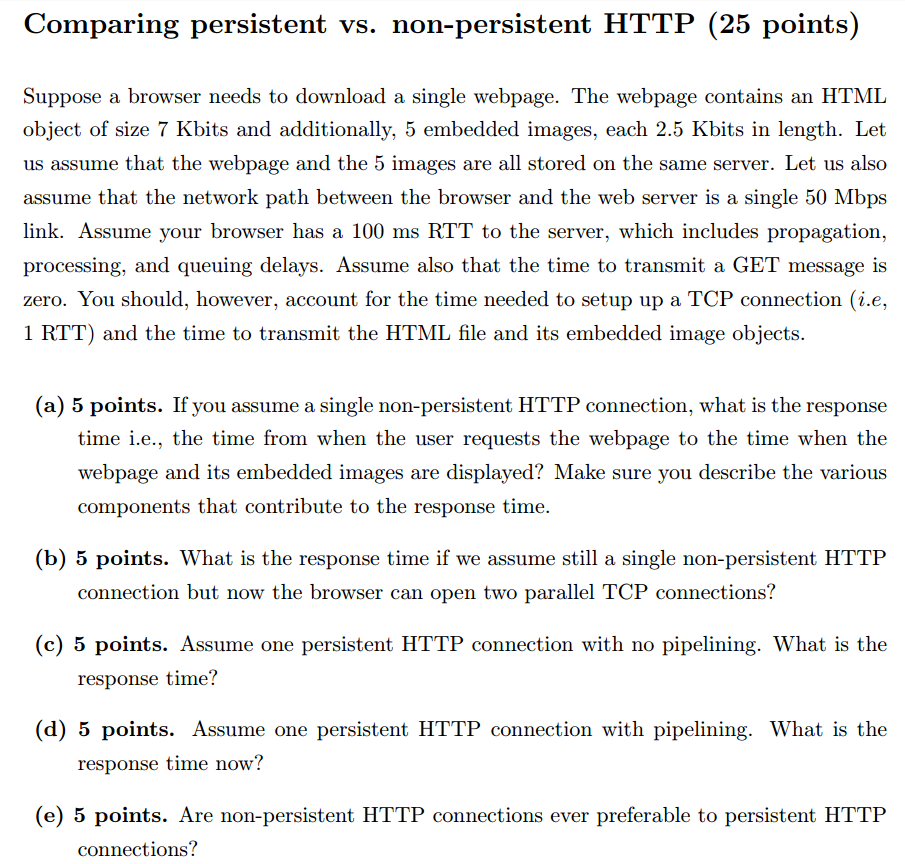
Comparing persistent vs. non-persistent HTTP Suppose a browser needs to download a single webpage. The webpage contains an HTML object of size 7 Kbits and additionally, 5 embedded images, each 2.5 Kbits in length. Let us assume that the webpage and the 5 images are all stored on the same server. Let us also assume that the network path between the browser and the web server is a single 50 Mbps link. Assume your browser has a 100 ms RTT to the server, which includes propagation, processing, and queuing delays. Assume also that the time to transmit a GET message is zero. You should, however, account for the time needed to setup up a TCP connection (i.e, 1 RTT) and the time to transmit the HTML file and its embedded image objects. (a) If you assume a single non-persistent HTTP connection, what is the response time i.e., the time from when the user requests the webpage to the time when the webpage and its embedded images are displayed? Make sure you describe the various components that contribute to the response time. (b) What is the response time if we assume still a single non-persistent HTTP connection but now the browser can open two parallel TCP connections? (c) Assume one persistent HTTP connection with no pipelining. What is the response time? (d) Assume one persistent HTTP connection with pipelining. What is the response time now? (e) Are non-persistent HTTP connections ever preferable to persistent HTTP connections
Step by Step Solution
There are 3 Steps involved in it

Get step-by-step solutions from verified subject matter experts
 Study Help