



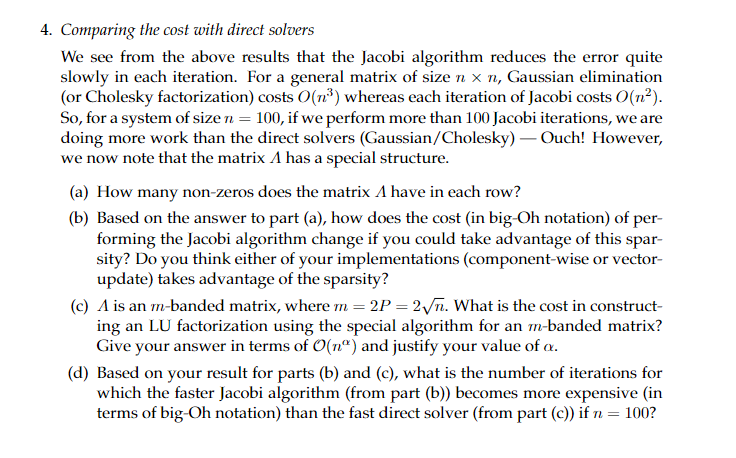
Question: Comparing the cost with direct solvers We see from the above results that the Jacobi algorithm reduces the error quite slowly in each iteration. For
Comparing the cost with direct solvers
We see from the above results that the Jacobi algorithm reduces the error quite
slowly in each iteration. For a general matrix of size Gaussian elimination
or Cholesky factorization costs whereas each iteration of Jacobi costs
So for a system of size if we perform more than Jacobi iterations, we are
doing more work than the direct solvers GaussianCholesky Ouch! However,
we now note that the matrix A has a special structure.
a How many nonzeros does the matrix A have in each row?
b Based on the answer to part a how does the cost in bigOh notation of per
forming the Jacobi algorithm change if you could take advantage of this spar
sity? Do you think either of your implementations componentwise or vector
update takes advantage of the sparsity?
c is an banded matrix, where What is the cost in construct
ing an LU factorization using the special algorithm for an banded matrix?
Give your answer in terms of and justify your value of
d Based on your result for parts b and c what is the number of iterations for
which the faster Jacobi algorithm from part b becomes more expensive in
terms of bigOh notation than the fast direct solver from part c if
Step by Step Solution
There are 3 Steps involved in it
1 Expert Approved Answer
Step: 1 Unlock

Question Has Been Solved by an Expert!
Get step-by-step solutions from verified subject matter experts
Step: 2 Unlock
Step: 3 Unlock