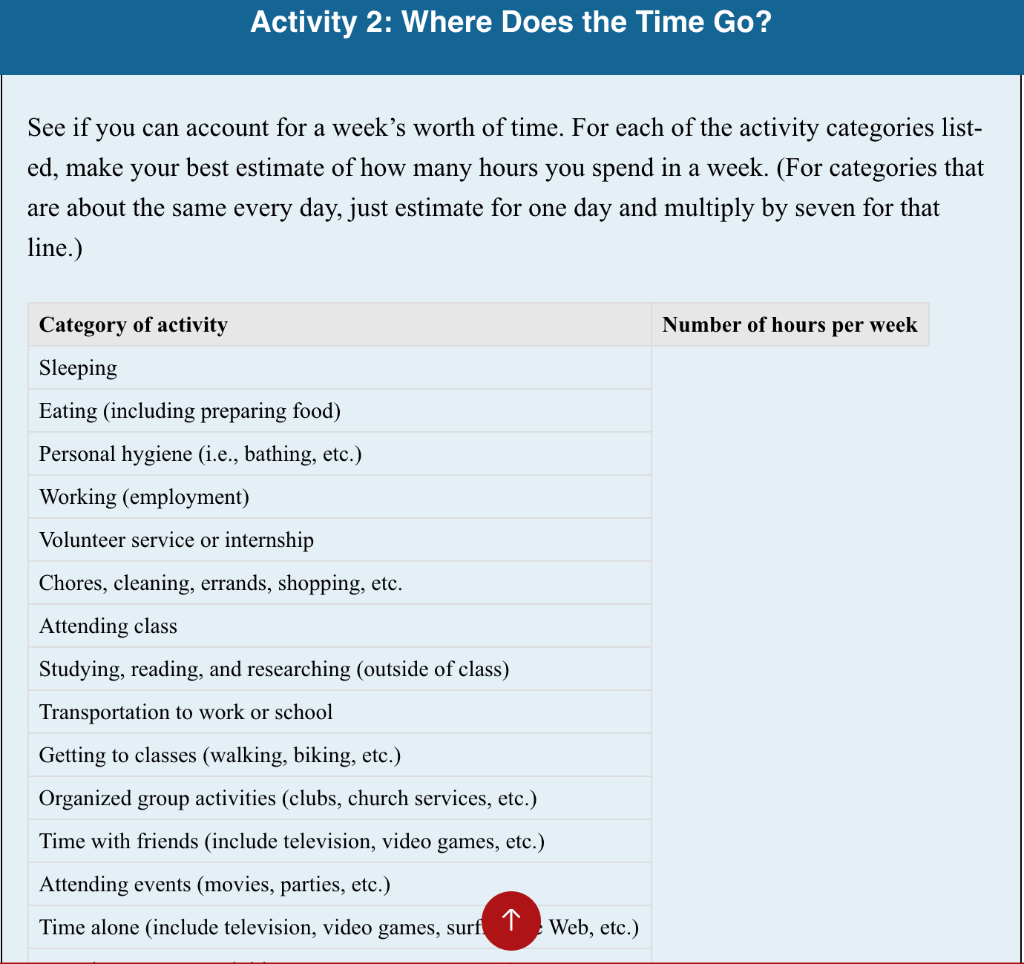
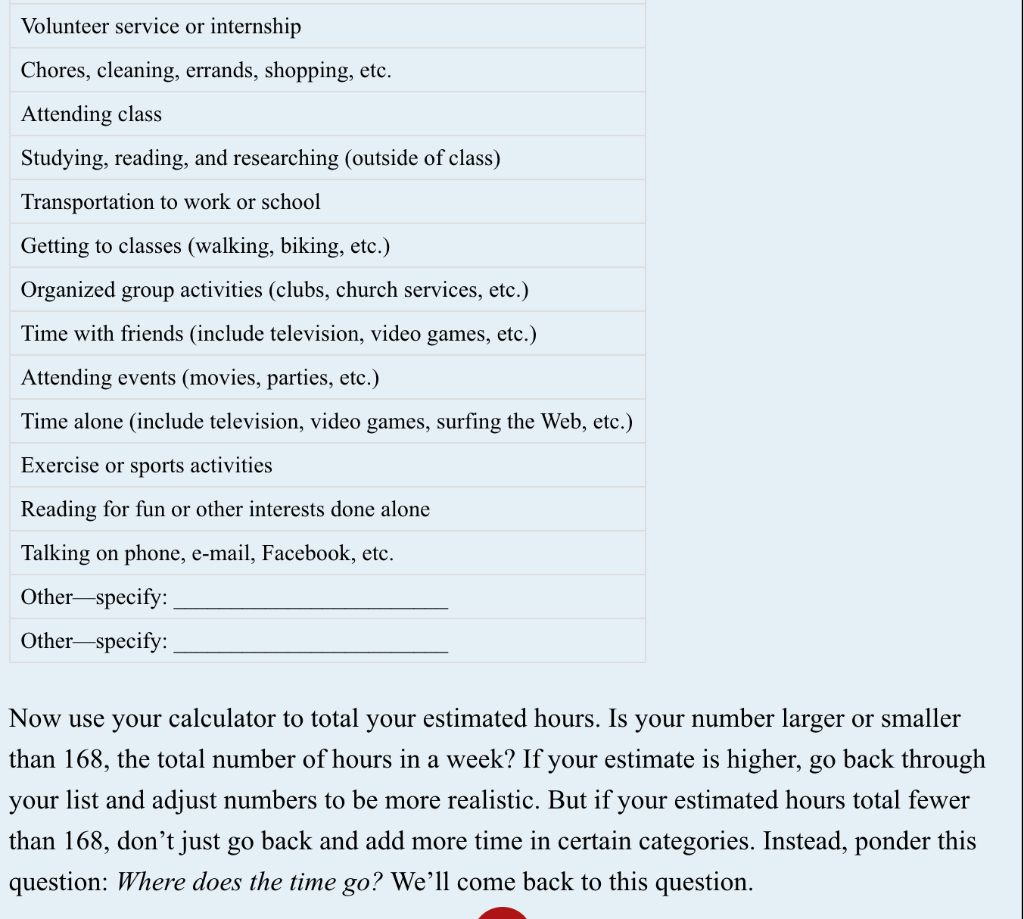
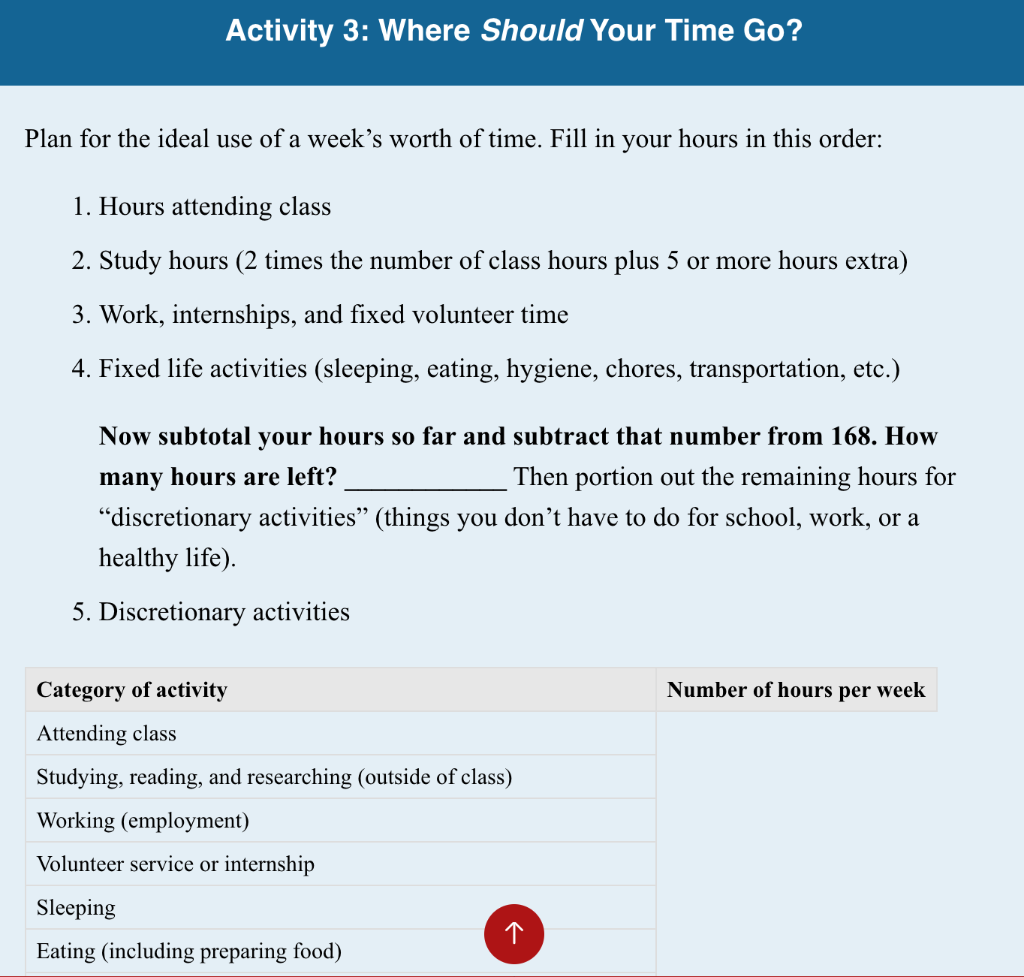
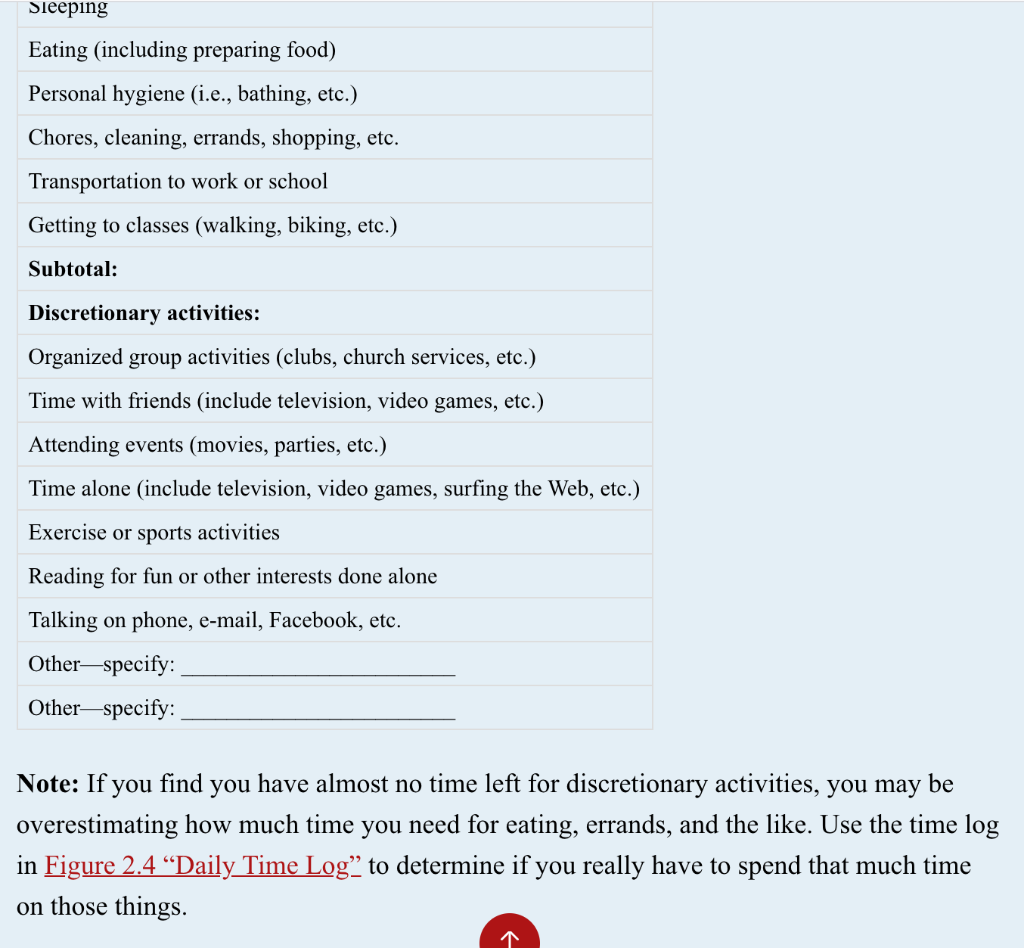
 Complete Activity 2 and Activity 3 in Chapter 2 of the textbook, and then address the following questions:
- Compare the results of your personal time allocation to your ideal time allocation. Are you close to your ideal allocation? If not, what factors are affecting your use of time?
- Based on what youve read this week, what strategies can you use to more effectively manage your time? Be sure to identify at least three time management strategies, and describe how you will apply them.
Activity 2: Where Does the Time Go? See if you can account for a week's worth of time. For each of the activity categories list- ed, make your best estimate of how many hours you spend in a week. (For categories that are about the same every day, just estimate for one day and multiply by seven for that line.) Category of activity Number of hours per week Sleeping Eating (including preparing food) Personal hygiene (i.e., bathing, etc.) Working (employment) Volunteer service or internship Chores, cleaning, errands, shopping, etc. Attending class Studying, reading, and researching (outside of class) Transportation to work or school Getting to classes (walking, biking, etc.) Organized group activities (clubs, church services, etc.) Time with friends (include television, video games, etc.) Attending events (movies, parties, etc.) C Time alone (include television, video games, surf Web, etc.) Volunteer service or internship Chores, cleaning, errands, shopping, etc. Attending class Studying, reading, and researching (outside of class) Transportation to work or school Getting to classes (walking, biking, etc.) Organized group activities (clubs, church services, etc.) Time with friends (include television, video games, etc.) Attending events (movies, parties, etc.) Time alone (include television, video games, surfing the Web, etc.) Exercise or sports activities Reading for fun or other interests done alone Talking on phone, e-mail, Facebook, etc. Other-specify: Other-specify: Now use your calculator to total your estimated hours. Is your number larger or smaller than 168, the total number of hours in a week? If your estimate is higher, go back through your list and adjust numbers to be more realistic. But if your estimated hours total fewer than 168, don't just go back and add more time in certain categories. Instead, ponder this question: Where does the time go? We'll come back to this question. Activity 3: Where Should Your Time Go? Plan for the ideal use of a week's worth of time. Fill in your hours in this order: 1. Hours attending class 2. Study hours (2 times the number of class hours plus 5 or more hours extra) 3. Work, internships, and fixed volunteer time 4. Fixed life activities (sleeping, eating, hygiene, chores, transportation, etc.) Now subtotal your hours so far and subtract that number from 168. How many hours are left? Then portion out the remaining hours for discretionary activities (things you don't have to do for school, work, or a healthy life). 5. Discretionary activities Number of hours per week Category of activity Attending class Studying, reading, and researching (outside of class) Working (employment) Volunteer service or internship Sleeping Eating (including preparing food) Sleeping Eating (including preparing food) Personal hygiene (i.e., bathing, etc.) Chores, cleaning, errands, shopping, etc. Transportation to work or school Getting to classes (walking, biking, etc.) Subtotal: Discretionary activities: Organized group activities (clubs, church services, etc.) Time with friends (include television, video games, etc.) Attending events (movies, parties, etc.) Time alone (include television, video games, surfing the Web, etc.) Exercise or sports activities Reading for fun or other interests done alone Talking on phone, e-mail, Facebook, etc. Otherspecify: Otherspecify: Note: If you find you have almost no time left for discretionary activities, you may be overestimating how much time you need for eating, errands, and the like. Use the time log in Figure 2.4 Daily Time Log to determine if you really have to spend that much time on those things




