







Question: complete answer with all parts needed P (A or B) = P(A) + P(B) - P(A and B) P(A and B) = P(A) * P(B|A)
complete answer with all parts needed
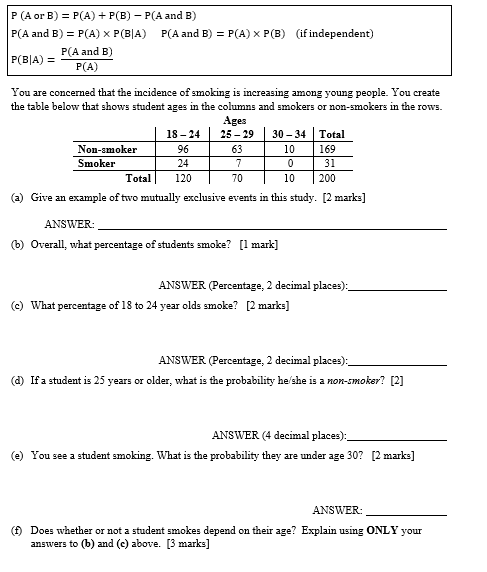
P (A or B) = P(A) + P(B) - P(A and B) P(A and B) = P(A) * P(B|A) P(A and B) = P(A) x P(B) (ifindependent) P(A and B) P(B|A) = P(A) You are concerned that the incidence of smoking is increasing among young people. You create the table below that shows student ages in the columns and smokers or non-smokers in the rows. Ages 18 - 24 15 - 29 30 -34 Total Non-smoker 96 63 10 169 Smoker 24 31 Total 120 70 10 200 (a) Give an example of two mutually exclusive events in this study. [2 marks] ANSWER: (b) Overall, what percentage of students smoke? [1 mark] ANSWER (Percentage, 2 decimal places): (c) What percentage of 18 to 24 year olds smoke? [2 marks] ANSWER (Percentage, 2 decimal place:): (d) If a student is 25 years or older, what is the probability he/she is a mom-smoker? [2] ANSWER (4 decimal places): (e) You see a student smoking. What is the probability they are under age 30? [2 marks] ANSWER: (f) Does whether or not a student smokes depend on their age? Explain using ONLY your answers to (b) and (c) above. [3 marks]
Step by Step Solution
There are 3 Steps involved in it

Get step-by-step solutions from verified subject matter experts
 Study Help