Question: Complete Part D, E, and F only. Please try your best. Will give excellent ratings if you just attempt :) 5. (30 points) The Nerdstrum
Complete Part D, E, and F only. Please try your best. Will give excellent ratings if you just attempt :)
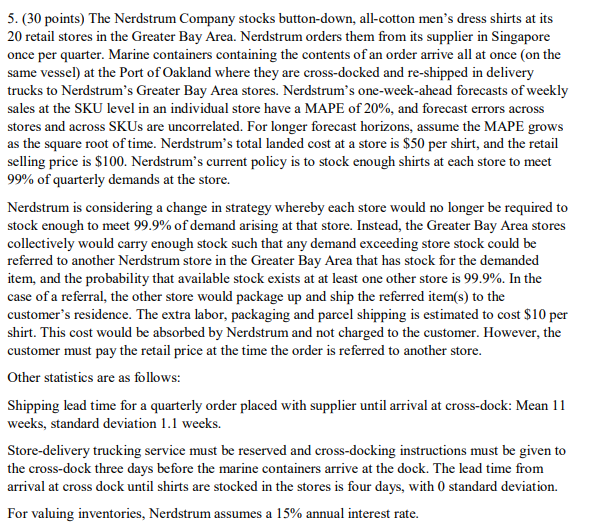
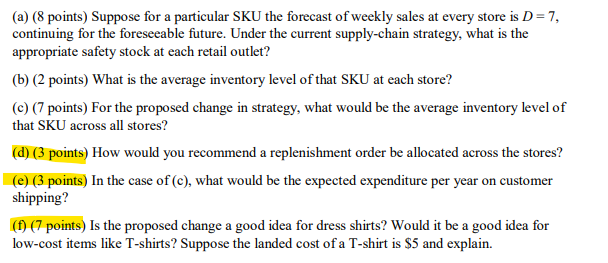
5. (30 points) The Nerdstrum Company stocks button-down, all-cotton men's dress shirts at its 20 retail stores in the Greater Bay Area. Nerdstrum orders them from its supplier in Singapore once per quarter. Marine containers containing the contents of an order arrive all at once (on the same vessel) at the Port of Oakland where they are cross-docked and re-shipped in delivery trucks to Nerdstrum's Greater Bay Area stores. Nerdstrum's one-week-ahead forecasts of weekly sales at the SKU level in an individual store have a MAPE of 20%, and forecast errors across stores and across SKUs are uncorrelated. For longer forecast horizons, assume the MAPE grows as the square root of time. Nerdstrum's total landed cost at a store is $50 per shirt, and the retail selling price is $100. Nerdstrum's current policy is to stock enough shirts at each store to meet 99% of quarterly demands at the store. Nerdstrum is considering a change in strategy whereby each store would no longer be required to stock enough to meet 99.9% of demand arising at that store. Instead, the Greater Bay Area stores collectively would carry enough stock such that any demand exceeding store stock could be referred to another Nerdstrum store in the Greater Bay Area that has stock for the demanded item, and the probability that available stock exists at at least one other store is 99.9%. In the case of a referral, the other store would package up and ship the referred item(s) to the customer's residence. The extra labor, packaging and parcel shipping is estimated to cost $10 per shirt. This cost would be absorbed by Nerdstrum and not charged to the customer. However, the customer must pay the retail price at the time the order is referred to another store. Other statistics are as follows: Shipping lead time for a quarterly order placed with supplier until arrival at cross-dock: Mean 11 weeks, standard deviation 1.1 weeks. Store-delivery trucking service must be reserved and cross-docking instructions must be given to the cross-dock three days before the marine containers arrive at the dock. The lead time from arrival at cross dock until shirts are stocked in the stores is four days, with standard deviation. For valuing inventories, Nerdstrum assumes a 15% annual interest rate. (a) (8 points) Suppose for a particular SKU the forecast of weekly sales at every store is D=7, continuing for the foreseeable future. Under the current supply-chain strategy, what is the appropriate safety stock at each retail outlet? (b) (2 points) What is the average inventory level of that SKU at each store? (c) (7 points) For the proposed change in strategy, what would be the average inventory level of that SKU across all stores? (d) (3 points) How would you recommend a replenishment order be allocated across the stores? (e) (3 points) In the case of (c), what would be the expected expenditure per year on customer shipping? (1) (7 points) Is the proposed change a good idea for dress shirts? Would it be a good idea for low-cost items like T-shirts? Suppose the landed cost of a T-shirt is $5 and explain




