







Question: Complete the Assessing Team Performance questionnaire in the chapter on Working in Groups and Teams. Think as you are a student how might you change
Complete the "Assessing Team Performance" questionnaire in the chapter on Working in Groups and Teams. Think as you are a student how might you change your behavior? Be sure your recommendations are grounded in theories from the text. you recommend change for online versus face-to-face teams?
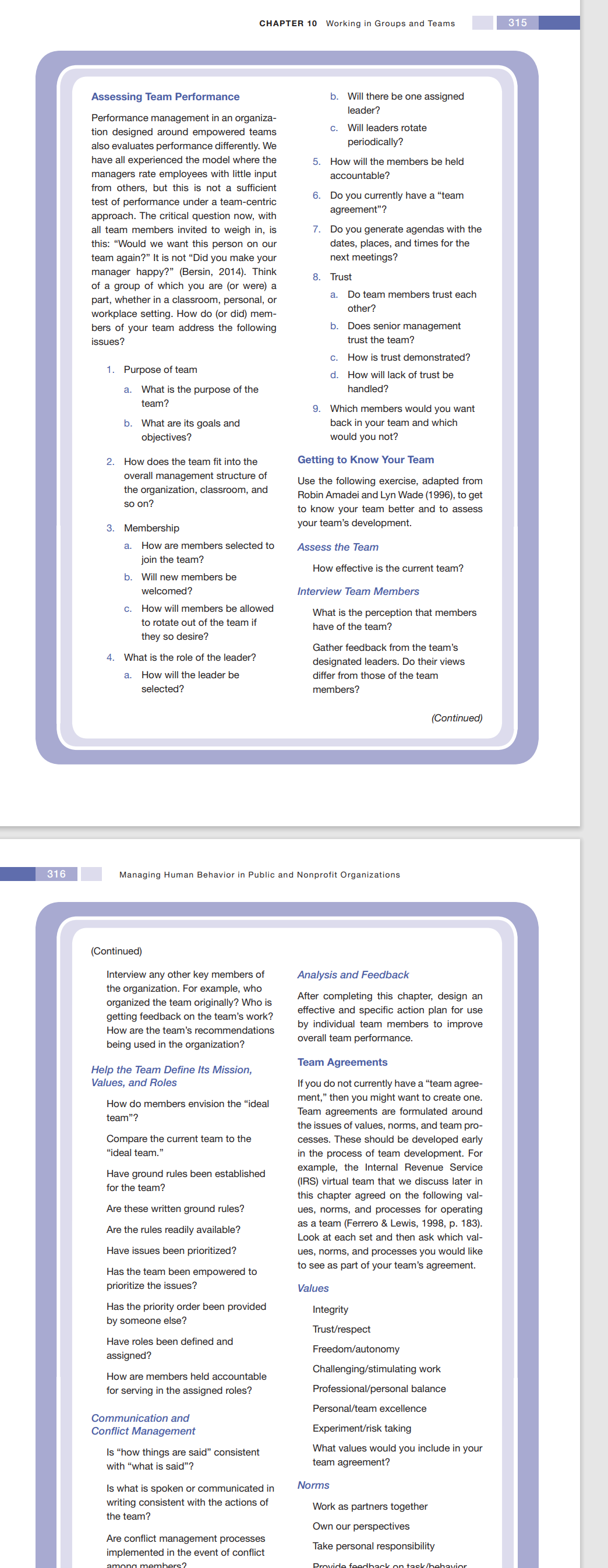
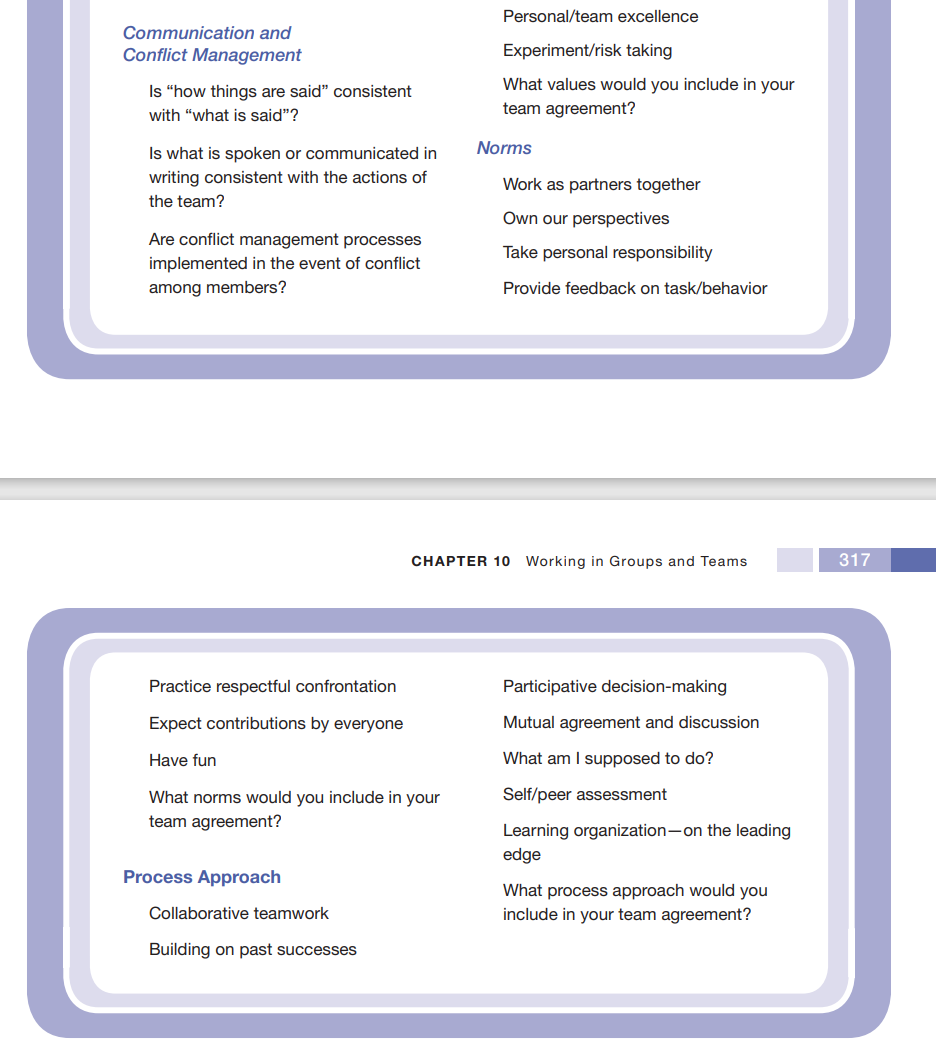
CHAPTER 10 Working in Groups and Teams Assessing Team Performance Performance management in an organiza- tion designed around empowered teams also evaluates performance differently. We have all experienced the model where the managers rate employees with little input from others, but this is not a sufficient test of performance under a team-centric approach. The critical question now, with all team members invited to weigh in, is this: \"Would we want this person on our team again?\" It is not \"Did you make your manager happy?\" (Bersin, 2014). Think of a group of which you are (or were) a part, whether in a classroom, personal, or workplace setting. How do (or did) mem- bers of your team address the following issues? 1. Purpose of team a. What is the purpose of the team? What are its goals and objectives? How does the team fit into the overall management structure of the organization, classroom, and soon? Membership a. How are members selected to join the team? Will new members be welcomed? How will members be allowed to rotate out of the team if they so desire? What is the role of the leader? a. How will the leader be selected? Will there be one assigned leader? Will leaders rotate periodically? How will the members be held accountable? Do you currently have a \"team agreement? Do you generate agendas with the dates, places, and times for the next mestings? Trust a. Do team members trust each other? Does senior management trust the team? How is trust demonstrated? How will lack of trust be handled? Which members would you want back in your team and which would you not? Getting to Know Your Team Use the following exercise, adapted from Robin Amadei and Lyn Wade (1996), to get to know your team better and to assess your team's development. Assess the Team How effective is the current team? Interview Team Members What is the perception that members have of the team? Gather feedback from the team's designated leaders. Do their views differ from those of the team members? (Continued) Managing Human Behavior in Public and Nonprofit Organizations (Continued) Interview any other key members of the organization. For example, who organized the team originally? Who is getting feedback on the team's work? How are the team's recommendations being used in the organization? Help the Team Define Its Mission, Values, and Roles How do members envision the \"ideal team? Compare the current team to the \"ideal team.\" Have ground rules been established for the team? Are these written ground rules? Are the rules readily available? Have issues been prioritized? Has the team been empowered to prioritize the issues? Has the priority order been provided by someone else? Have roles been defined and assigned? How are members held accountable for serving in the assigned roles? 'Communication and Conflict Management Is \"how things are said\" consistent with \"what is said\"? Is what is spoken or communicated in writing consistent with the actions of the team? Are conflict management processes implemented in the event of conflict amann memhars? Analysis and Feedback After completing this chapter, design an effective and specific action plan for use by individual team members to improve overall team performance. Team Agreements If you do not currently have a \"team agree- ment,\" then you might want to create one. Team agreements are formulated around the issues of values, norms, and team pro- cesses. These should be developed early in the process of team development. For example, the Internal Revenue Service (IRS) virtual team that we discuss later in this chapter agreed on the following val- ues, norms, and processes for operating as a team (Ferrero & Lewis, 1998, p. 183). Look at each set and then ask which val- ues, norms, and processes you would like to see as part of your team's agreement. Values Integrity Trust/respect Freedom/autonomy Challenging/stimulating work Professional/personal balance Personal/team excellence Experiment/risk taking What values would you include in your team agreement? Norms Work as partners together Own our perspectives Take personal responsibility Pravida faadhark an tack/hahavinr Communication and Conflict Management Is *how things are said\" consistent with \"what is said\"? Is what is spoken or communicated in writing consistent with the actions of the team? Are conflict management processes implemented in the event of conflict among members? Personal/team excellence Experiment/risk taking What values would you include in your team agreement? Norms Work as partners together Own our perspectives Take personal responsibility Provide feedback on task/behavior CHAPTER 10 Working in Groups and Teams 317 Practice respectful confrontation Expect contributions by everyone Have fun What norms would you include in your team agreement? Process Approach Collaborative teamwork Building on past successes Participative decision-making Mutual agreement and discussion What am | supposed to do? Self/peer assessment Learning organizationon the leading edge What process approach would you include in your team agreement
Step by Step Solution
There are 3 Steps involved in it

Get step-by-step solutions from verified subject matter experts
 Study Help