







Question: Complete the assignment below in an Excel le. There is a quiz for Case Study 3 to check your work. Turn in your nal submission
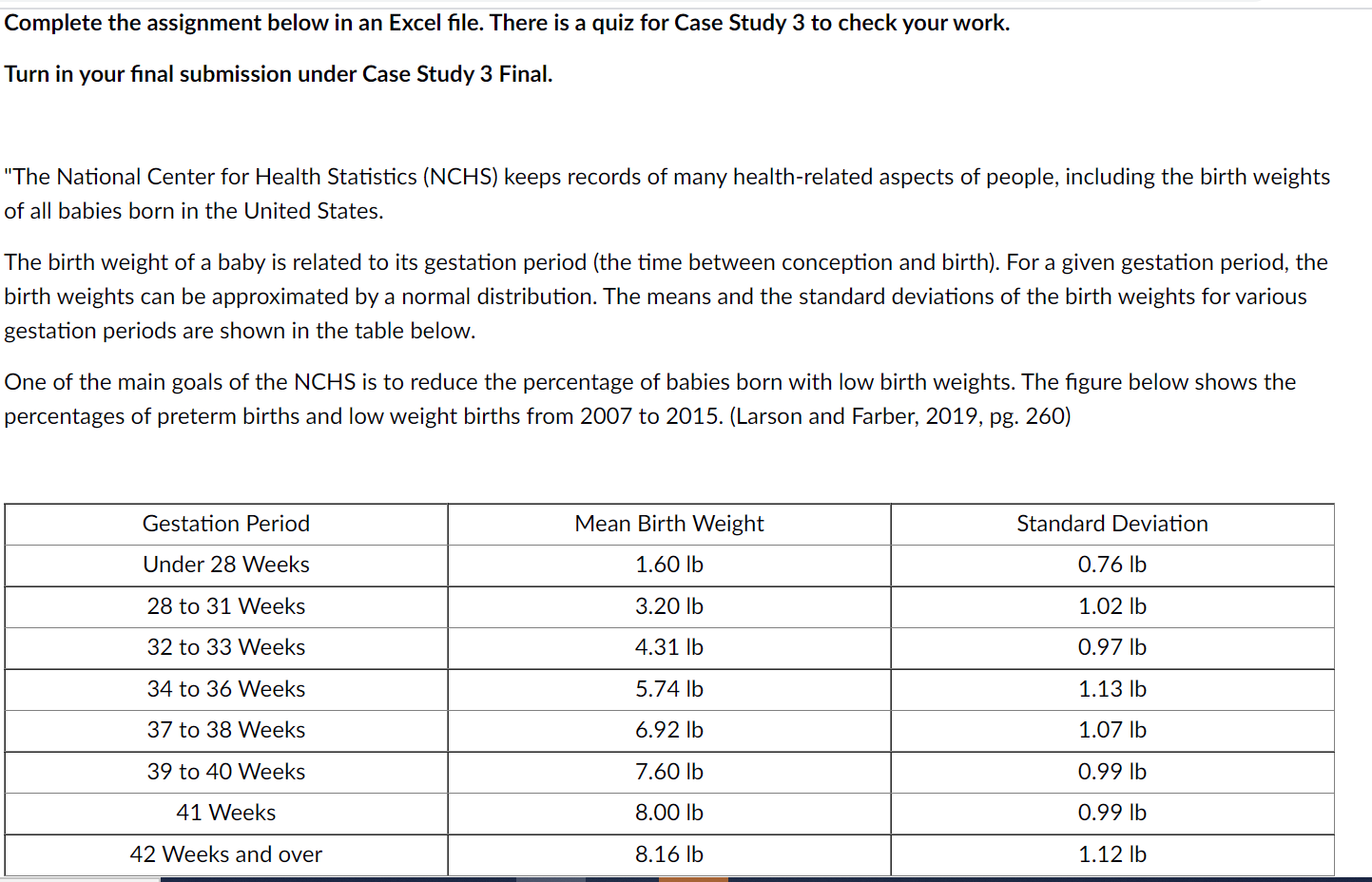
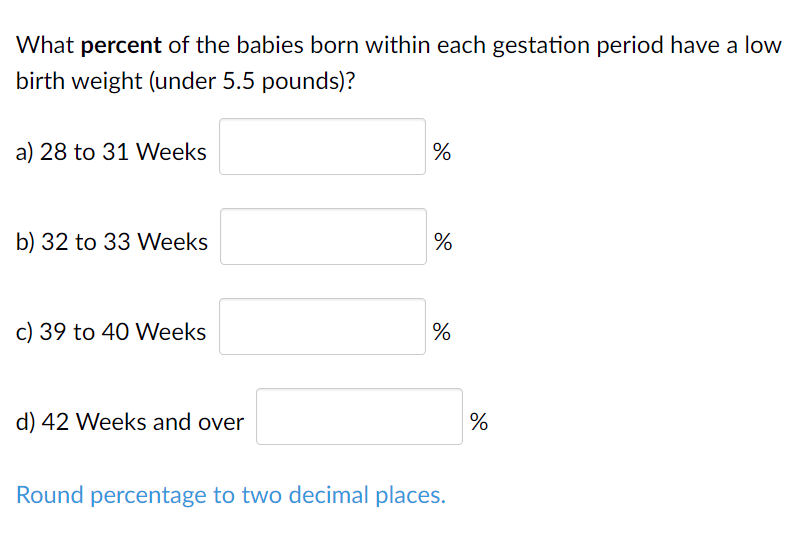
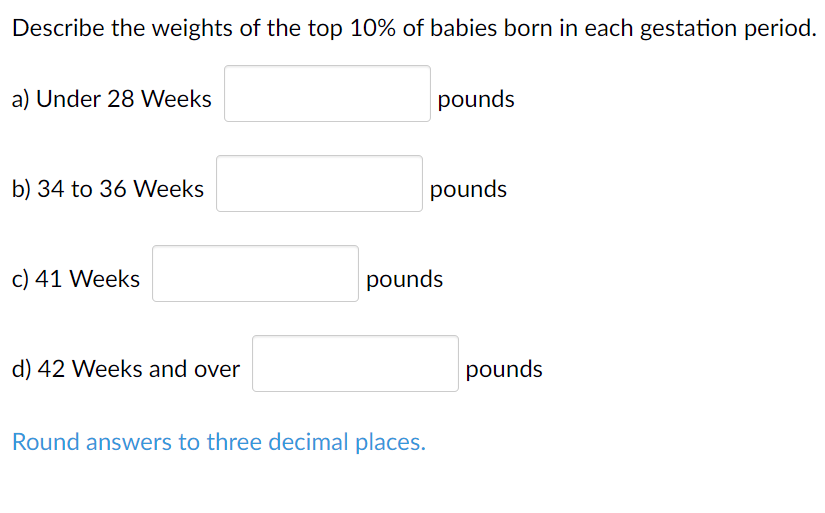
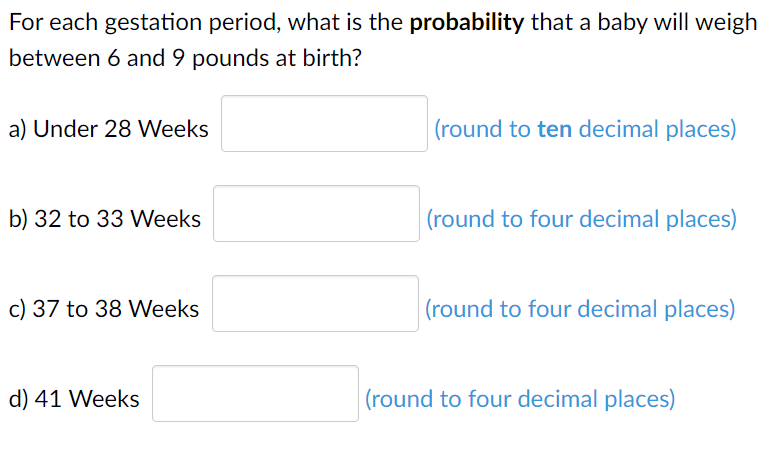
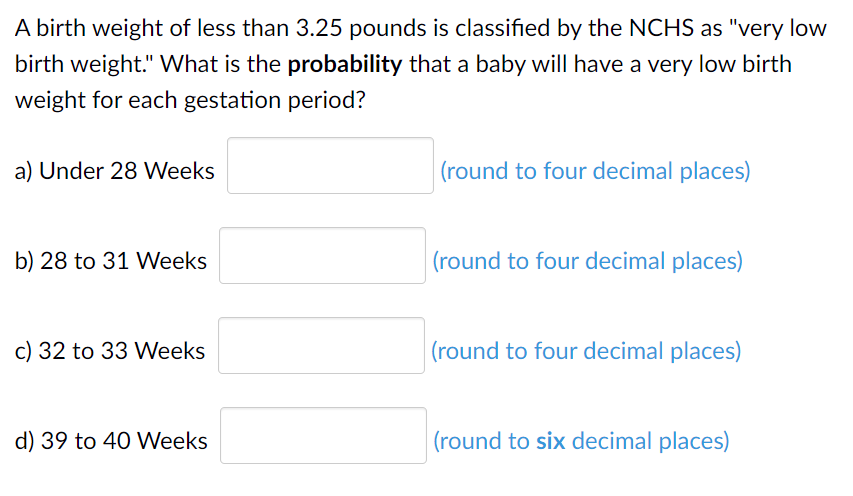
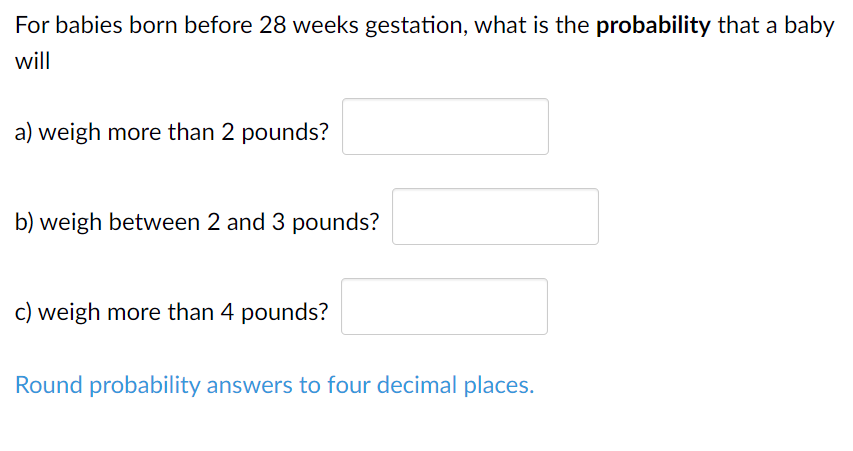
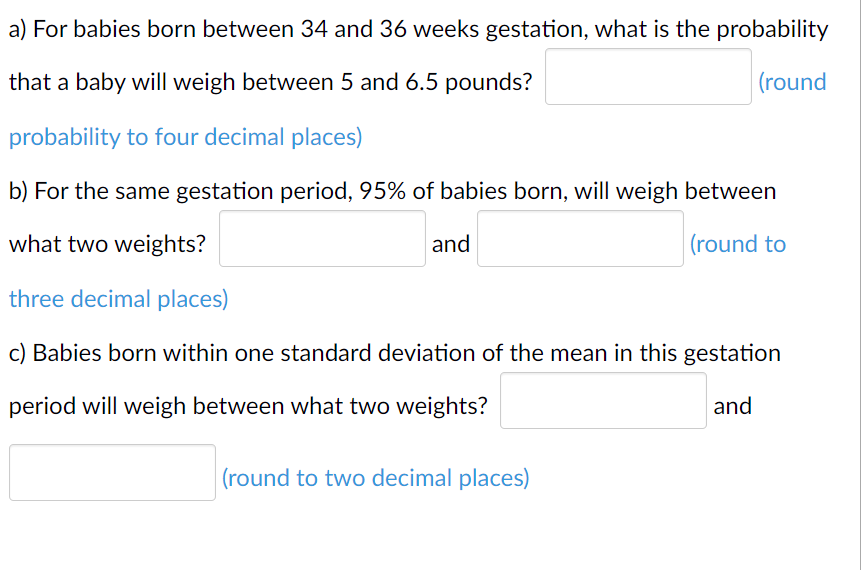
Complete the assignment below in an Excel le. There is a quiz for Case Study 3 to check your work. Turn in your nal submission under Case Study 3 Final. "The National Center for Health Statistics (NCHS) keeps records of many health-related aspects of people, including the birth weights of all babies born in the United States. The birth weight of a baby is related to its gestation period (the time between conception and birth). For a given gestation period. the birth weights can be approximated by a normal distribution. The means and the standard deviations of the birth weights for various gestation periods are shown in the table below. One of the main goals of the NCHS is to reduce the percentage of babies born with low birth weights. The gure below shows the percentages of preterm births and low weight births from 2007 to 2015. {Larson and Farber, 2019, pg. 260) Gestation Period Mean Birth Weight Standard Deviation Under 28 Weeks 1.60 lb 0.76 lb 28 to 31 Weeks 3.20 lb 1.02 lb 32 to 33 Weeks 4.31 lb 0.97 lb 34 to 36 Weeks 5.74 lb 1.13 lb 37 to 38 Weeks 6.92 lb 1.07 lb 39 to 40 Weeks 7.60 lb 0.99 lb 41 Weeks 8.00 lb 0.99 lb 42 Weeks and over 8.16 lb 1.12 lb What percent of the babies born within each gestation period have a low birth weight (under 5.5 pounds)? a} 28 to 31 Weeks % b) 32 to 33 Weeks % c) 39 to 40 Weeks % d} 42 Weeks and over % Round percentage to two decimal places. Describe the weights of the top 10% of babies born in each gestation period. a} Under 28 Weeks pounds b) 34 to 36 Weeks pounds c) 41 Weeks pounds d} 42 Weeks and over pounds Round answers to three decimal places. For each gestation period, what is the probability that a baby will weigh between 6 and 9 pounds at birth? a) Under 28 Weeks ' ' {round to ten decimal places} b) 32 to 33 Weeks ' ' (round to four decimal places) c) 37 to 38 Weeks ' ' (round to four decimal places) d) 41 Weeks ' ' (round to four decimal places) A birth weight of less than 3.25 pounds is classied by the NCHS as "very low birth weight." What is the probability that a baby will have a very low birth weight for each gestation period? 3) Under 28 Weeks {round to four decimal places) b) 28 to 31 Weeks (round to four decimal places) c) 32 to 33 Weeks (round to four decimal places) d) 39 to 40 Weeks {round to six decimal places) For babies born before 28 weeks gestation, what is the probability that a baby will a} weigh more than 2 pounds? b) weigh between 2 and 3 pounds? c) weigh more than 4 pounds? Round probability answers to four decimal places. a} For babies born between 34 and 36 weeks gestation, what is the probability that a baby will weigh between 5 and 6.5 pounds? {round probability to four decimal places) b) For the same gestation period, 95% of babies born, will weigh between what two weights? and (round to three decimal places) c) Babies born within one standard deviation of the mean in this gestation period will weigh between what two weights? and (round to two decimal places}
Step by Step Solution
There are 3 Steps involved in it

Get step-by-step solutions from verified subject matter experts
 Study Help