







Question: Complete the diagram outlined. Specifically, indicate the reactants (and conditions) you would use to produce the indicated substances from Ca(OH)2. Cao Caco, |, ), CaCl,
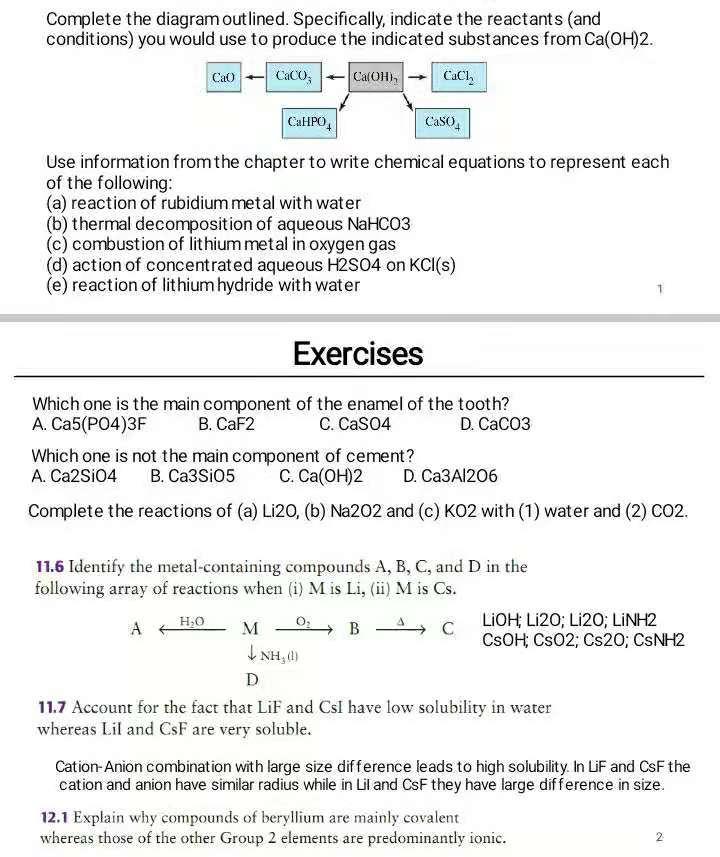
Complete the diagram outlined. Specifically, indicate the reactants (and conditions) you would use to produce the indicated substances from Ca(OH)2. Cao Caco, |, ), CaCl, CaHPO CaSO4 Use information from the chapter to write chemical equations to represent each of the following: (a) reaction of rubidium metal with water (b) thermal decomposition of aqueous NaHCO3 (c) combustion of lithium metal in oxygen gas (d) action of concentrated aqueous H2SO4 on KCl(s) (e) reaction of lithium hydride with water 1 Exercises Which one is the main component of the enamel of the tooth? A. Ca5(PO4)3F B. CaF2 C. CaSO4 D. CaCO3 Which one is not the main component of cement? A. Ca2Si04 B. Ca3Si05 C. Ca(OH)2 D. Ca3A1206 Complete the reactions of (a) Li20, (b) Na2O2 and (c) KO2 with (1) water and (2) CO2. 11.6 Identify the metal-containing compounds A, B, C, and D in the following array of reactions when (i) Mis Li, (i) M is Cs. A HO M B LIOH, Li20; Li20; LINH2 CSOH CSO2; Cs20; CsNH2 NH, 11.7 Account for the fact that Lif and CsI have low solubility in water whereas Lil and CsF are very soluble. Cation-Anion combination with large size difference leads to high solubility. In LF and Csf the cation and anion have similar radius while in Lil and CsF they have large difference in size. 12.1 Explain why compounds of beryllium are mainly covalent whereas those of the other Group 2 elements are predominantly ionic. 2
Step by Step Solution
There are 3 Steps involved in it

Get step-by-step solutions from verified subject matter experts
 Study Help