Question: Complete the exercise (attached) , assessing your communication style in management. Discuss what your style is and how your scores reflect your communication style as
Complete the exercise (attached) , assessing your communication style in management. Discuss what your style is and how your scores reflect your communication style as you know about yourself. Do you think this can be a good tool of assessing managers communication style?
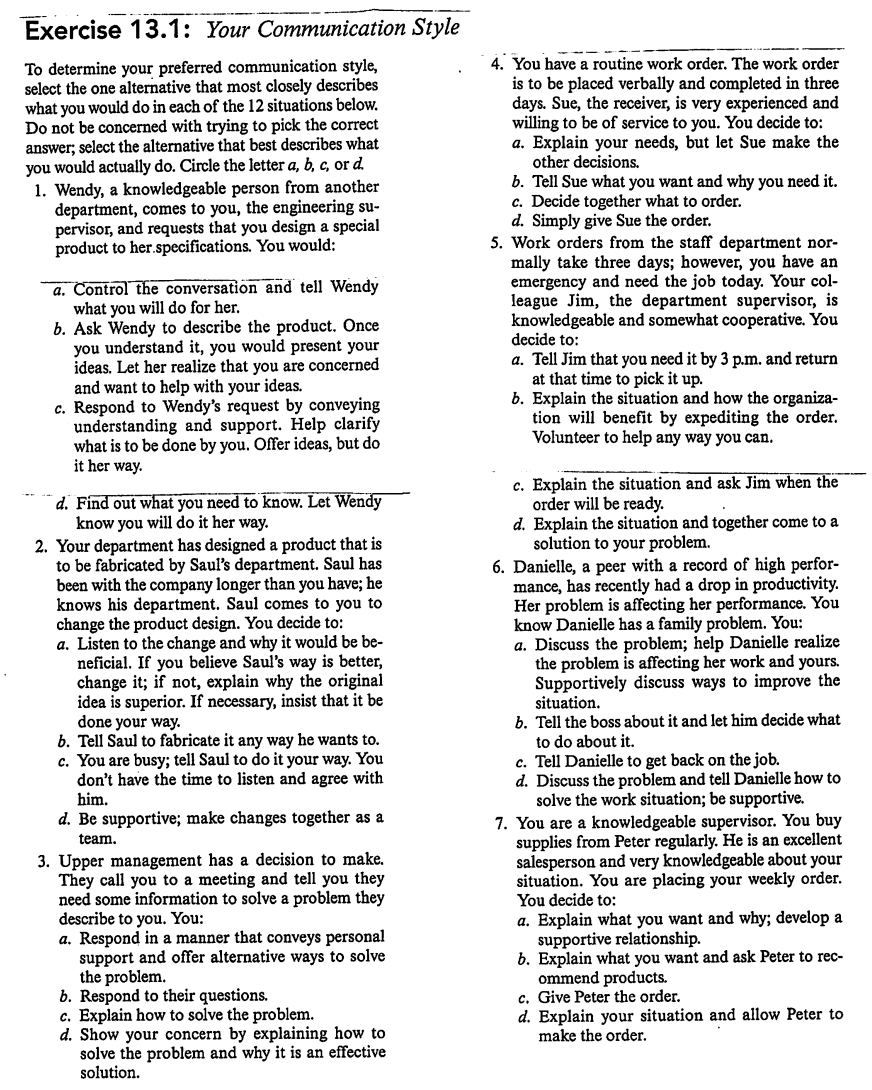
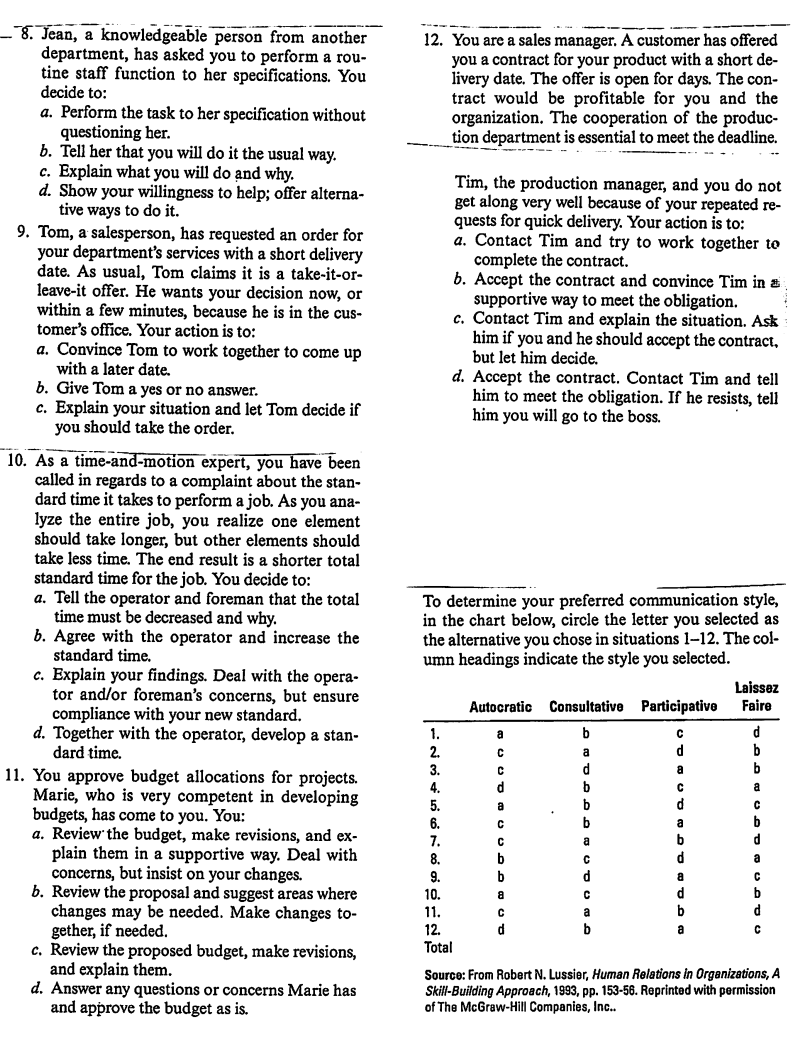
Exercise 13.1: Your Communication Style To determine your preferred communication style, select the one alternative that most closely describes what you would do in each of the 12 situations below. Do not be concerned with trying to pick the correct answer, select the alternative that best describes what you would actually do. Circle the letter a, b, c, or d. 1. Wendy, a knowledgeable person from another department, comes to you, the engineering su- pervisor, and requests that you design a special product to her specifications. You would: 4. You have a routine work order. The work order is to be placed verbally and completed in three days. Sue, the receiver, is very experienced and willing to be of service to you. You decide to: a. Explain your needs, but let Sue make the other decisions. b. Tell Sue what you want and why you need it. c. Decide together what to order. d. Simply give Sue the order. 5. Work orders from the staff department nor- mally take three days; however, you have an emergency and need the job today. Your col- league Jim, the department supervisor, is knowledgeable and somewhat cooperative. You decide to: a. Tell Jim that you need it by 3p.m. and return at that time to pick it up. b. Explain the situation and how the organiza- tion will benefit by expediting the order. Volunteer to help any way you can. a. Control the conversation and tell Wendy what you will do for her. b. Ask Wendy to describe the product. Once you understand it, you would present your ideas. Let her realize that you are concerned and want to help with your ideas. c. Respond to Wendy's request by conveying understanding and support. Help clarify what is to be done by you. Offer ideas, but do it her way d. Find out what you need to know. Let Wendy know you will do it her way. 2. Your department has designed a product that is to be fabricated by Saul's department. Saul has been with the company longer than you have; he knows his department. Saul comes to you to change the product design. You decide to: a. Listen to the change and why it would be be- neficial. If you believe Saul's way is better, change it; if not, explain why the original idea is superior. If necessary, insist that it be done your way. b. Tell Saul to fabricate it any way he wants to. c. You are busy; tell Saul to do it your way. You don't have the time to listen and agree with him. d. Be supportive; make changes together as a team. 3. Upper management has a decision to make. They call you to a meeting and tell you they need some information to solve a problem they describe to you. You: a. Respond in a manner that conveys personal support and offer alternative ways to solve the problem. b. Respond to their questions. c. Explain how to solve the problem. d. Show your concern by explaining how to solve the problem and why it is an effective solution. c. Explain the situation and ask Jim when the order will be ready. d. Explain the situation and together come to a solution to your problem. 6. Danielle, a peer with a record of high perfor- mance, has recently had a drop in productivity. Her problem is affecting her performance. You know Danielle has a family problem. You: a. Discuss the problem; help Danielle realize the problem is affecting her work and yours. Supportively discuss ways to improve the situation. b. Tell the boss about it and let him decide what to do about it. c. Tell Danielle to get back on the job. d. Discuss the problem and tell Danielle how to solve the work situation; be supportive. 7. You are a knowledgeable supervisor. You buy supplies from Peter regularly. He is an excellent salesperson and very knowledgeable about your situation. You are placing your weekly order. You decide to: a. Explain what you want and why; develop a supportive relationship. b. Explain what you want and ask Peter to rec- ommend products. c. Give Peter the order. d. Explain your situation and allow Peter to make the order. 12. You are a sales manager. A customer has offered you a contract for your product with a short de- livery date. The offer is open for days. The con- tract would be profitable for you and the organization. The cooperation of the produc- tion department is essential to meet the deadline. Tim, the production manager, and you do not get along very well because of your repeated re- quests for quick delivery. Your action is to: a. Contact Tim and try to work together to complete the contract. b. Accept the contract and convince Tim in a supportive way to meet the obligation. c. Contact Tim and explain the situation. Ask him if you and he should accept the contract, but let him decide. d. Accept the contract. Contact Tim and tell him to meet the obligation. If he resists, tell him you will go to the boss. -8. Jean, a knowledgeable person from another department, has asked you to perform a rou- tine staff function to her specifications. You decide to: a. Perform the task to her specification without questioning her. b. Tell her that you will do it the usual way. c. Explain what you will do and why. d. Show your willingness to help; offer alterna- tive ways to do it. 9. Tom, a salesperson, has requested an order for your department's services with a short delivery date. As usual, Tom claims it is a take-it-or- leave-it offer. He wants your decision now, or within a few minutes, because he is in the cus- tomer's office. Your action is to: a. Convince Tom to work together to come up with a later date. b. Give Tom a yes or no answer. c. Explain your situation and let Tom decide if you should take the order. 10. As a time-and-motion expert, you have been called in regards to a complaint about the stan- dard time it takes to perform a job. As you ana- lyze the entire job, you realize one element should take longer, but other elements should take less time. The end result is a shorter total standard time for the job. You decide to: a. Tell the operator and foreman that the total time must be decreased and why. b. Agree with the operator and increase the standard time. c. Explain your findings. Deal with the opera- tor and/or foreman's concerns, but ensure compliance with your new standard. d. Together with the operator, develop a stan- dard time. 11. You approve budget allocations for projects. Marie, who is very competent in developing budgets, has come to you. You: a. Review the budget, make revisions, and ex- plain them in a supportive way. Deal with concerns, but insist on your changes. b. Review the proposal and suggest areas where changes may be needed. Make changes to- gether, if needed. c. Review the proposed budget, make revisions, and explain them. d. Answer any questions or concerns Marie has and approve the budget as is. To determine your preferred communication style, in the chart below, circle the letter you selected as the alternative you chose in situations 1-12. The col- umn headings indicate the style you selected. Laissez Autocratic Consultative Participative Faire a d C d a d d b b a a b b b C d a 1. 2. 3. 4. 5. 6. 7. 8. 9. 10. 11. 12. Total a d a d b b d d a Source: From Robert N. Lussier, Human Relations in Organizations, A Skill-Building Approach, 1993, pp. 153-56. Reprinted with permission of The McGraw-Hill Companies, Inc









 Study Help