







Question: Complete the following program: Please finish Programming Exercise #5 in Chapter 12 of the textbook 1. Create all the classes as shown in the figure
Complete the following program:
Please finish Programming Exercise #5 in Chapter 12 of the textbook
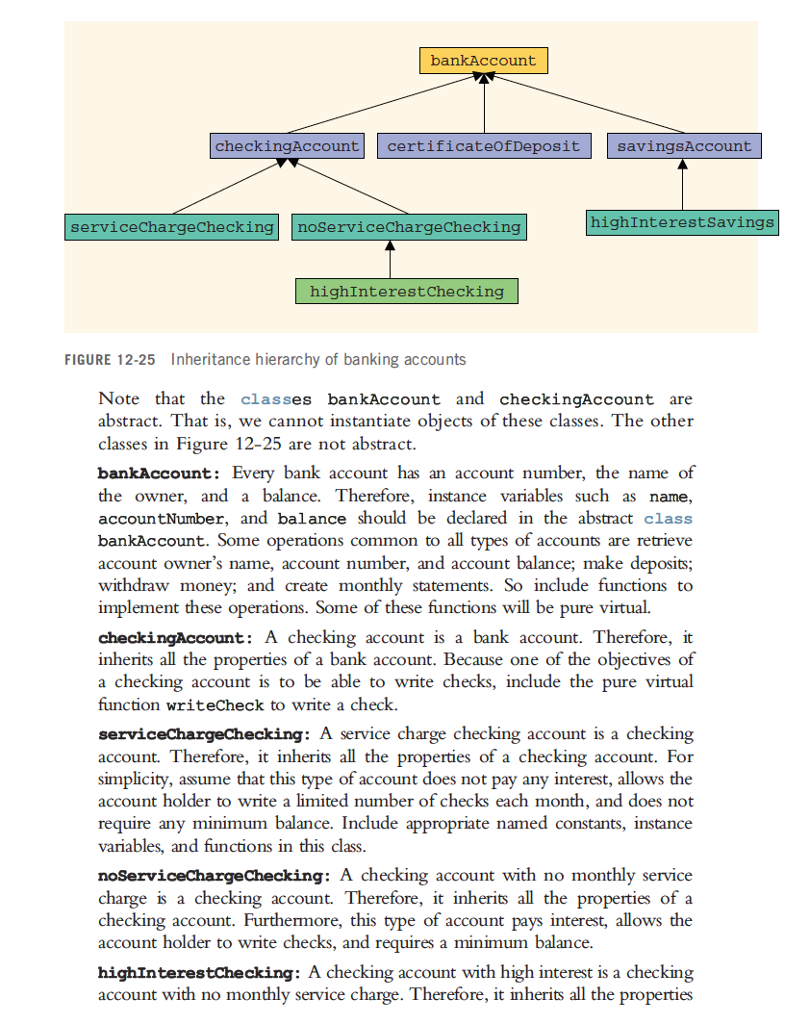
1. Create all the classes as shown in the figure
2. Make bankAccount class and checkingAccount class to be abstract class
3. The function to create monthly statements in bankAccount class should be pure virtual function
4. The function to write checks in checkingAccount class should be pure virtual function
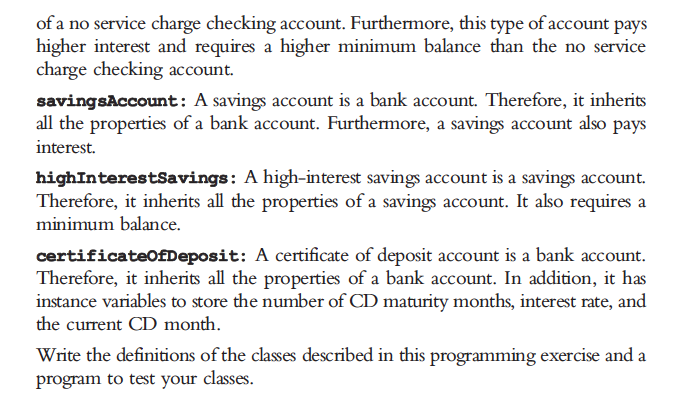
5. Set the default interest rate for highInterestChecking, highInterestSaving and CD to be 5%, the default interest rate for savingsAccount to be 3%, and the default interest rate for noServiceChargeChecking to be 2%
6. Set the default minimum balance for highInterestChecking to be $5000, the default minimum balance of highInterestSaving to be $2500, and the default minimum balance for noServiceChargeChecking to be $1000
7. Set the monthly service charge for the serviceChargeChecking to be $10, set the monthly maximum number of checks allowed for serviceChargeChecking to be 5, and set the service charge when the number of checks exceed the maximum number of checks allowed to be $5
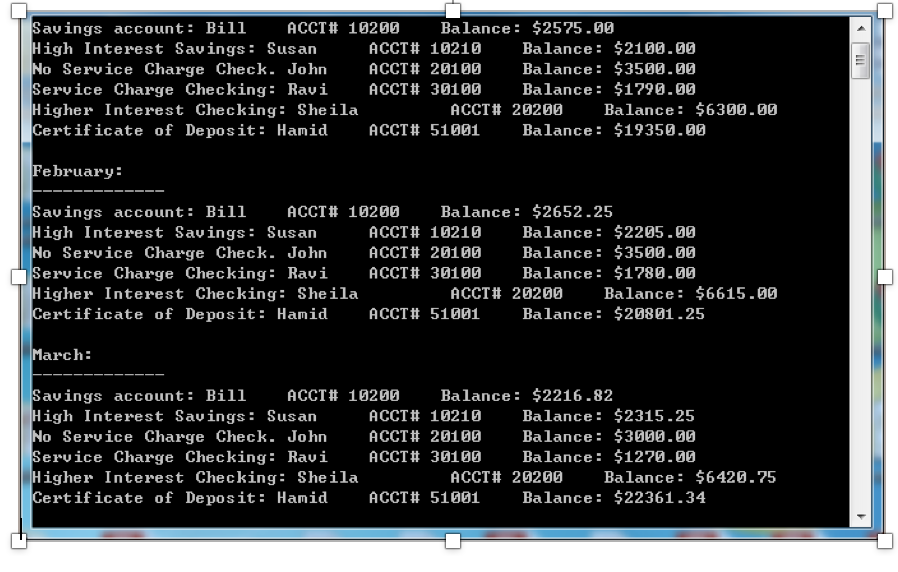
As an example, a sample run would look similar to the following:
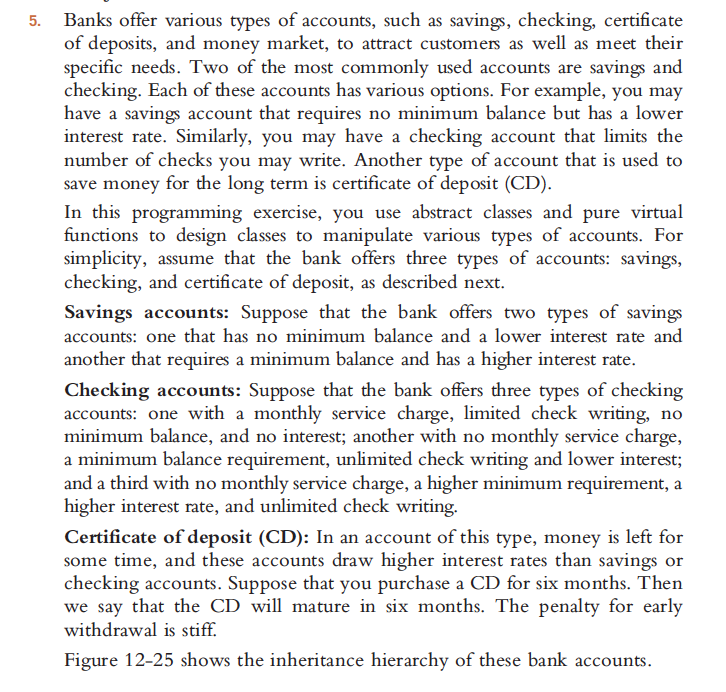
5. Banks offer various types of accounts, such as savings, checking, certificate of deposits, and money market, to attract customers as well as meet their specific needs. Two of the most commonly used accounts are savings and checking. Each of these accounts has various options. For example, you may have a savings account that requires no minimum balance but has a lower interest rate. Similarly, you may have a checking account that limits the number of checks you may write. Another type of account that is used to save money for the long term is certificate of deposit (CD) In this programming exercise, you use abstract classes and pure virtual functions to design classes to manipulate various types of accounts. For simplicity, assume that the bank offers three types of accounts: savings, checking, and certificate of deposit, as described next Savings accounts: Suppose that the bank offers two types of savings accounts: one that has no minimum balance and a lower interest rate and another that requires a minimum balance and has a higher interest rate Checking accounts: Suppose that the bank offers three types of checking accounts: one with a monthly service charge, limited check writing, no minimum balance, and no interest; another with no monthly service charge, a minimum balance requirement, unlimited check writing and lower interest; and a third with no monthly service charge, a higher minimum requirement, a higher interest rate, and unlimited check writing. Certificate of deposit (CD): In an account of this type, money is left for some time, and these accounts draw higher interest rates than savings or checking accounts. Suppose that you purchase a CD for six months. Then we say that the CD will mature in six months. The penalty for early withdrawal is stiff Figure 12-25 shows the inheritance hierarchy of these bank accounts
Step by Step Solution
There are 3 Steps involved in it

Get step-by-step solutions from verified subject matter experts
 Study Help