







Question: Complete the following table by identifying the Big-O worst case efficiency class of the operation when performed on each data structure as implemented by the
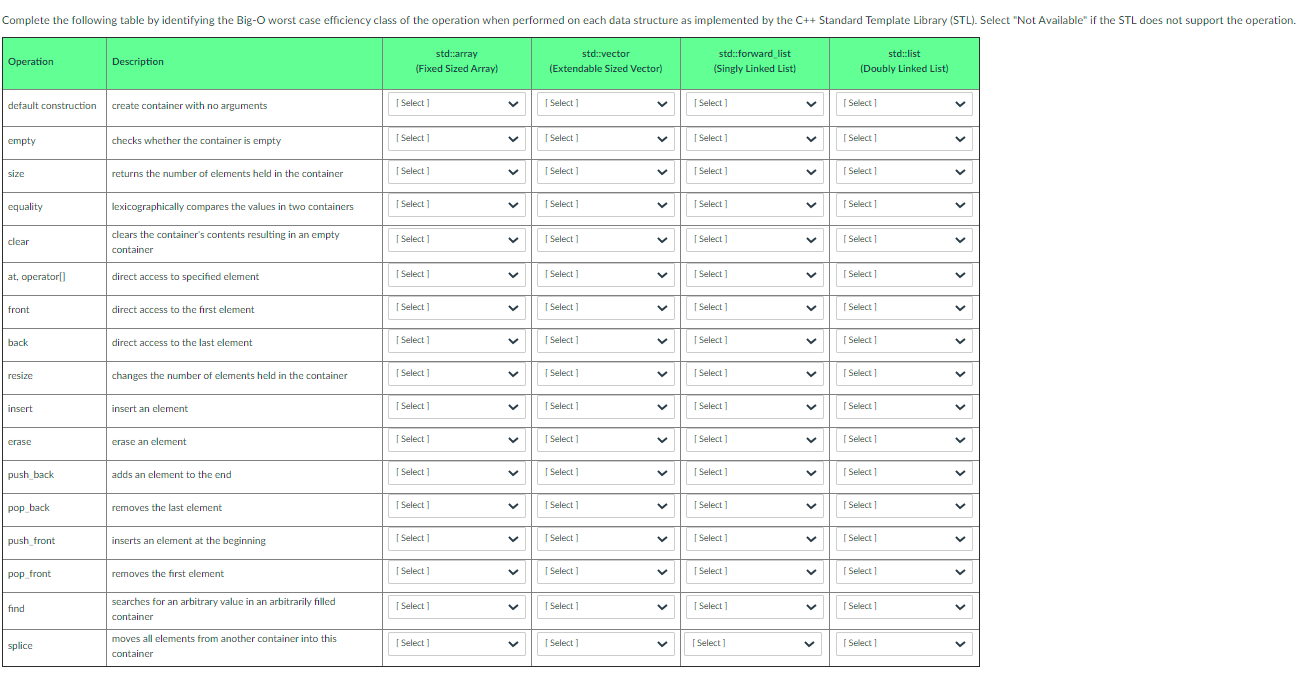
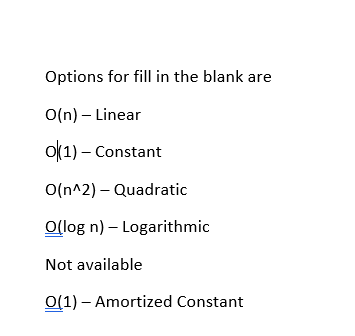
Complete the following table by identifying the Big-O worst case efficiency class of the operation when performed on each data structure as implemented by the C++ Standard Template Library (STL). Select "Not Available" if the STL does not support the operation. Operation Description std::array (Fixed Sized Array) std::vector (Extendable Sized Vector) std::forward list (Singly Linked List) std::list (Doubly Linked List) default construction create container with no arguments Select 1 Select 1 Select [ Select empty checks whether the container is empty Select Select ] Select 1 [Select 1 size returns the number of elements held in the container Select 1 Select 1 Select [ Select equality lexicographically compares the values in two containers Select 1 Select Select 1 Select clear clears the container's contents resulting in an empty container Select] Select Select 1 [ Select 1 V at, operator direct access to specified element Select 1 Select 1 Select 1 Select 1 front direct access to the first element Select Select 1 [ Select Select back direct access to the last element Select V Select Select ] [ Select 1 resize changes the number of elements held in the container Select Select] Select Select 1 insert Select 1 V insert an clement Select Select Select 1 erase erase an element Select 1 Select Select 1 [ Select push back adds an element to the end Select 1 Select Select 1 [ Select Select Select Select pop back Select removes the last element push_front inserts an element at the beginning Select V Select] Select ] Select 1 removes the first clement Select pop_front Select ! Select Select 1 find searches for an arbitrary value in an arbitrarily filled container Select 1 Select 1 Select [Select 1 splice moves all elements from another container into this container Select Select 1 Select Select Options for fill in the blank are O(n) - Linear 0|(1) - Constant O(n^2) - Quadratic Odlog n) - Logarithmic Not available 0(1) - Amortized Constant Complete the following table by identifying the Big-O worst case efficiency class of the operation when performed on each data structure as implemented by the C++ Standard Template Library (STL). Select "Not Available" if the STL does not support the operation. Operation Description std::array (Fixed Sized Array) std::vector (Extendable Sized Vector) std::forward list (Singly Linked List) std::list (Doubly Linked List) default construction create container with no arguments Select 1 Select 1 Select [ Select empty checks whether the container is empty Select Select ] Select 1 [Select 1 size returns the number of elements held in the container Select 1 Select 1 Select [ Select equality lexicographically compares the values in two containers Select 1 Select Select 1 Select clear clears the container's contents resulting in an empty container Select] Select Select 1 [ Select 1 V at, operator direct access to specified element Select 1 Select 1 Select 1 Select 1 front direct access to the first element Select Select 1 [ Select Select back direct access to the last element Select V Select Select ] [ Select 1 resize changes the number of elements held in the container Select Select] Select Select 1 insert Select 1 V insert an clement Select Select Select 1 erase erase an element Select 1 Select Select 1 [ Select push back adds an element to the end Select 1 Select Select 1 [ Select Select Select Select pop back Select removes the last element push_front inserts an element at the beginning Select V Select] Select ] Select 1 removes the first clement Select pop_front Select ! Select Select 1 find searches for an arbitrary value in an arbitrarily filled container Select 1 Select 1 Select [Select 1 splice moves all elements from another container into this container Select Select 1 Select Select Options for fill in the blank are O(n) - Linear 0|(1) - Constant O(n^2) - Quadratic Odlog n) - Logarithmic Not available 0(1) - Amortized Constant
Step by Step Solution
There are 3 Steps involved in it

Get step-by-step solutions from verified subject matter experts
 Study Help