Question: Complete the following table by selecting the appropriate values for N, PV and PMT. Then use your financial calculator to solve for the rate of
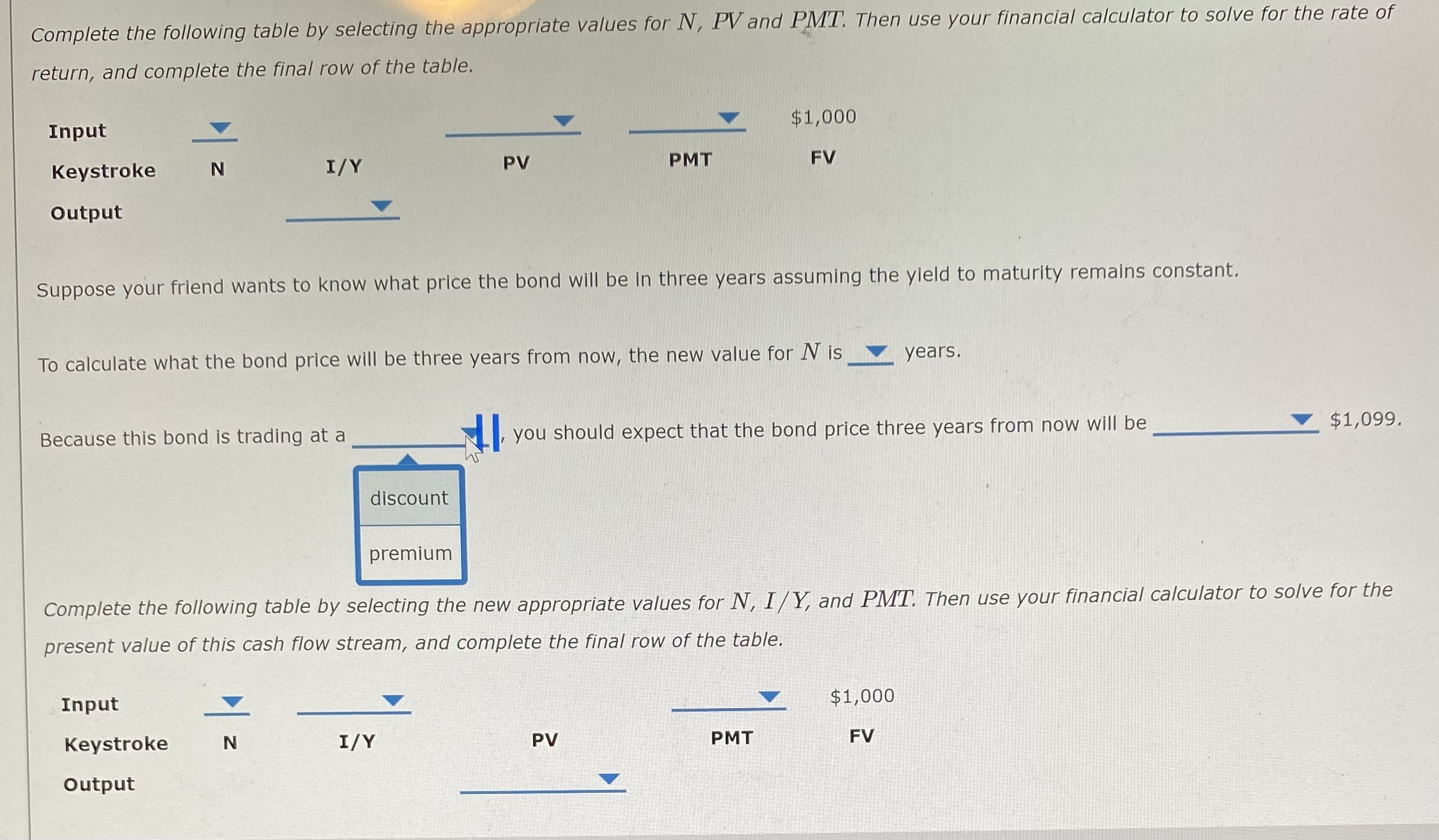
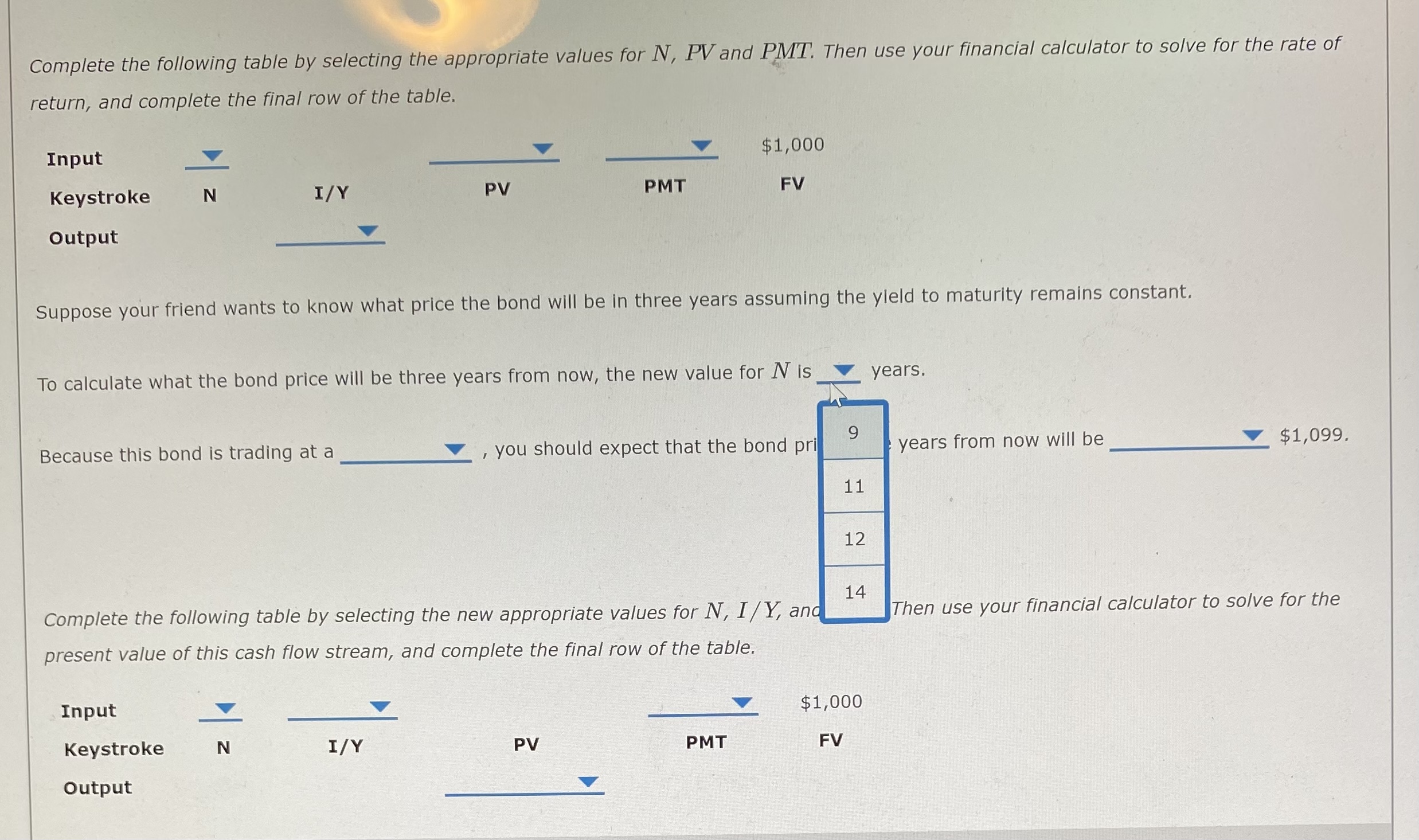
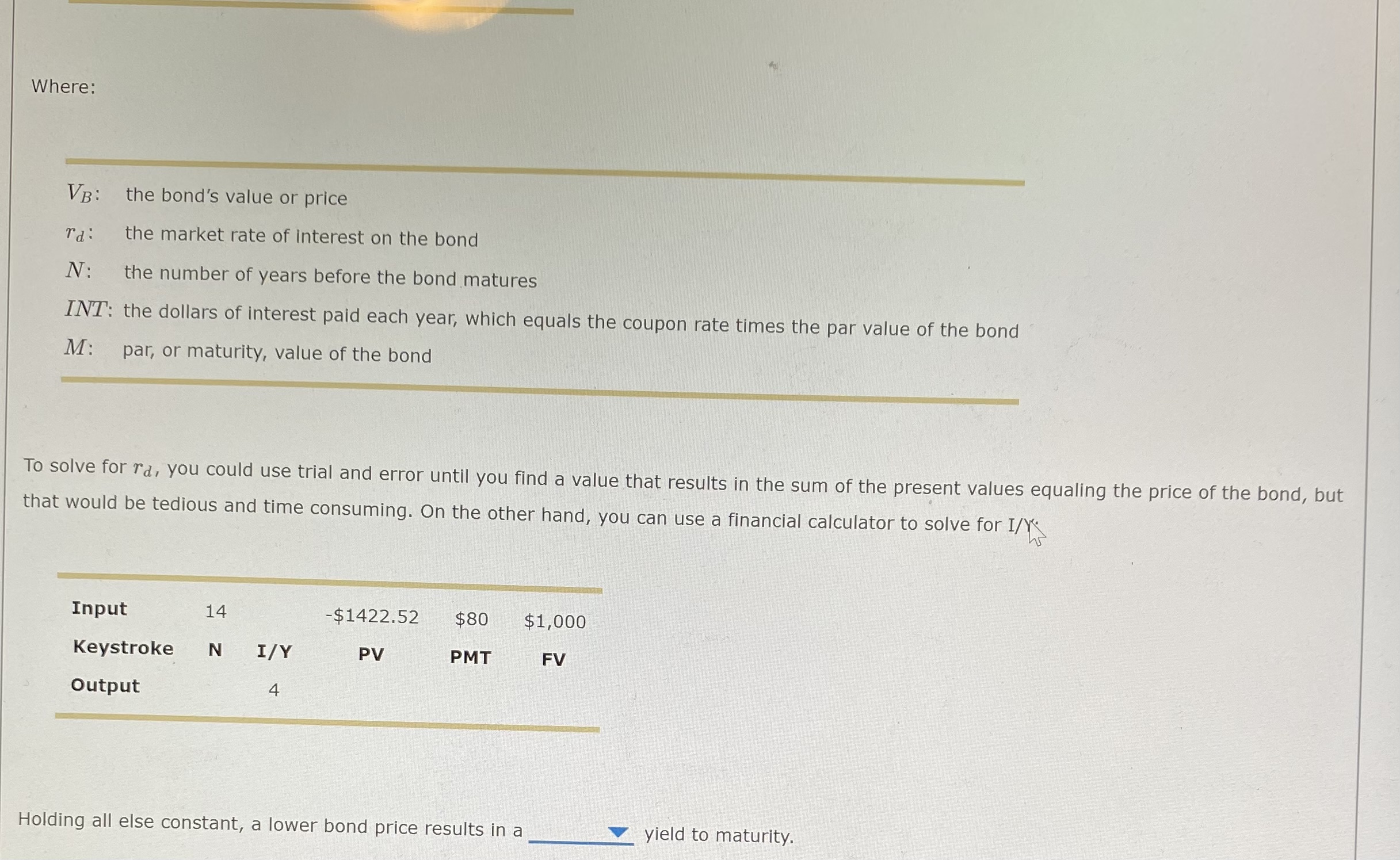
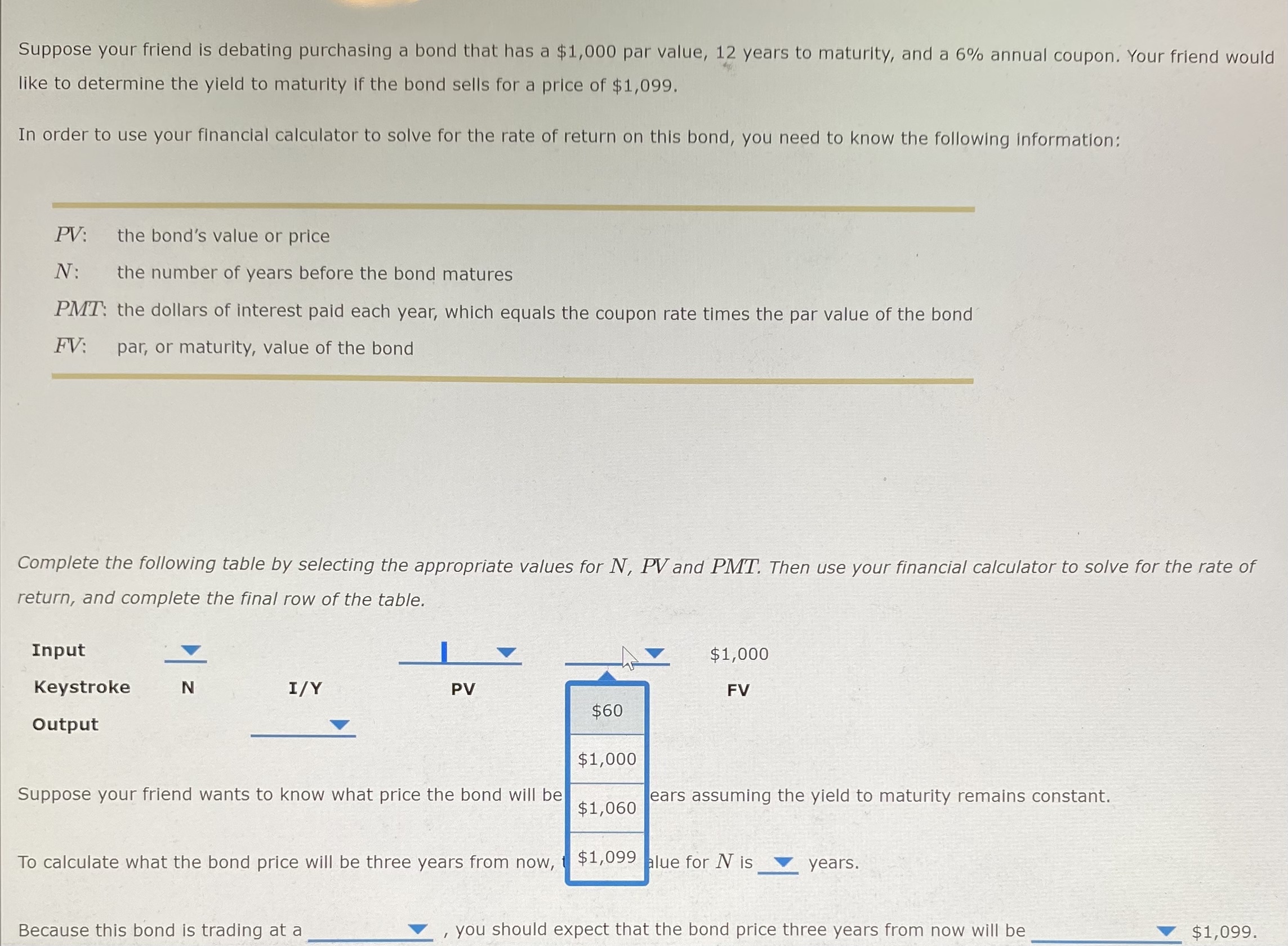
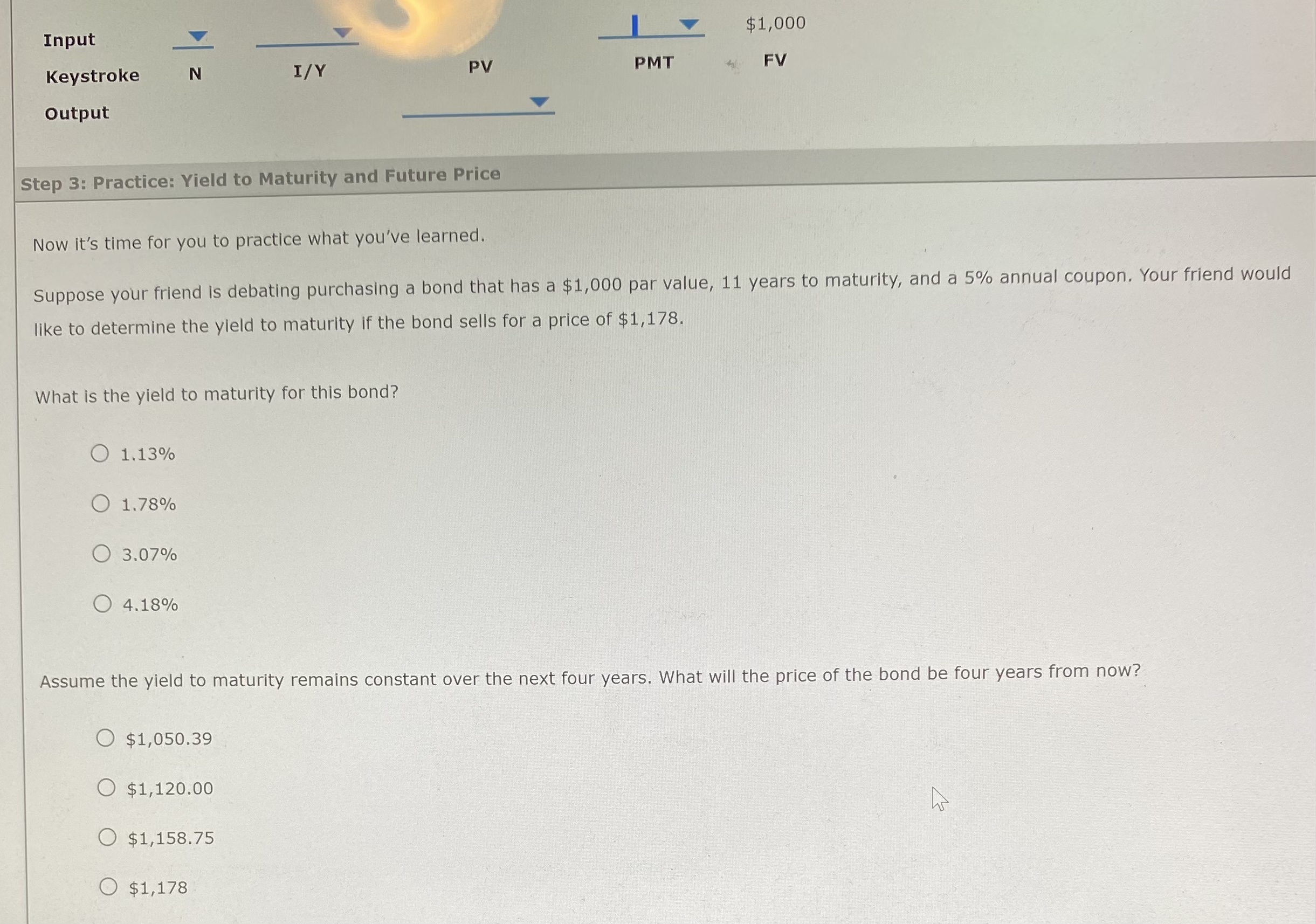
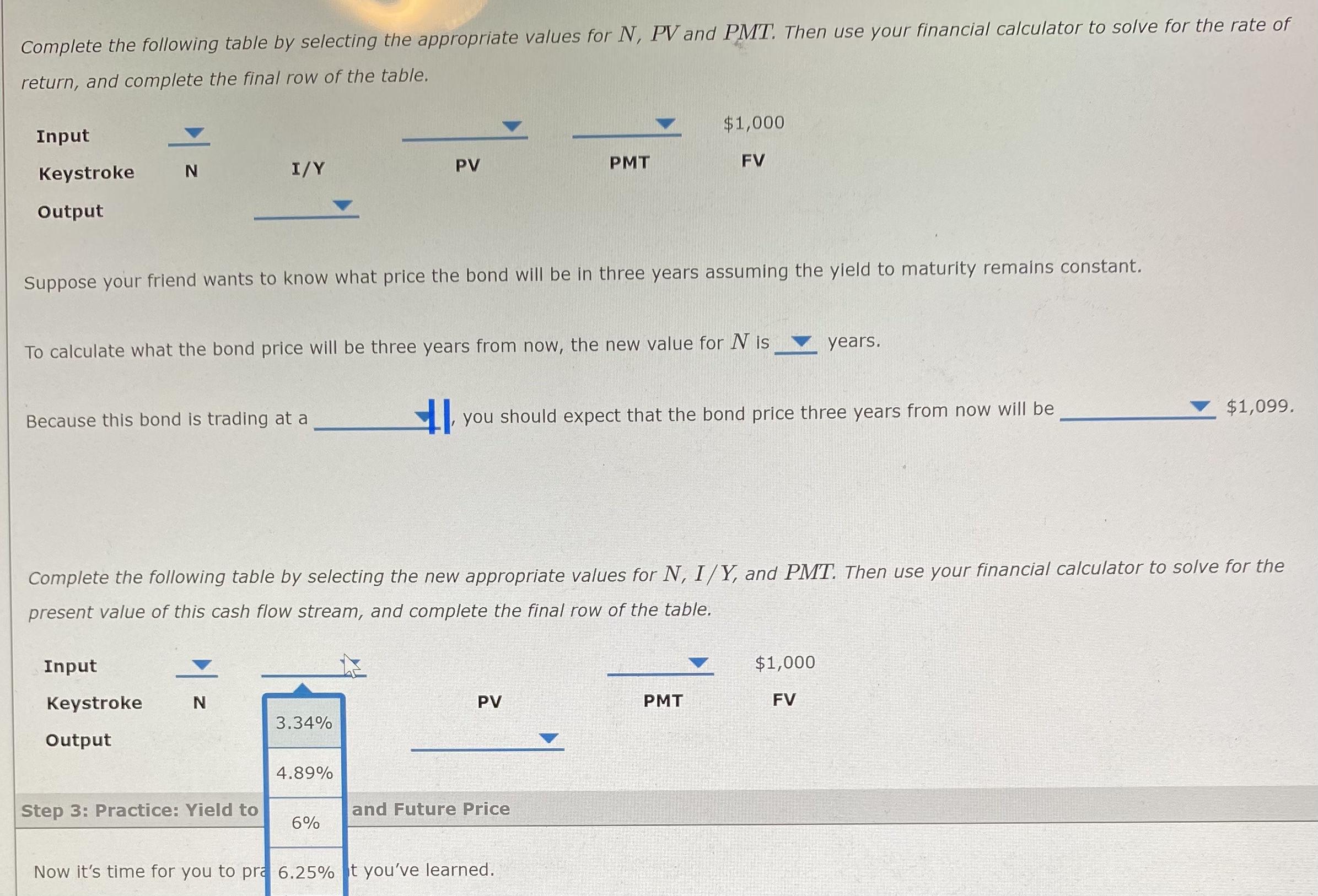
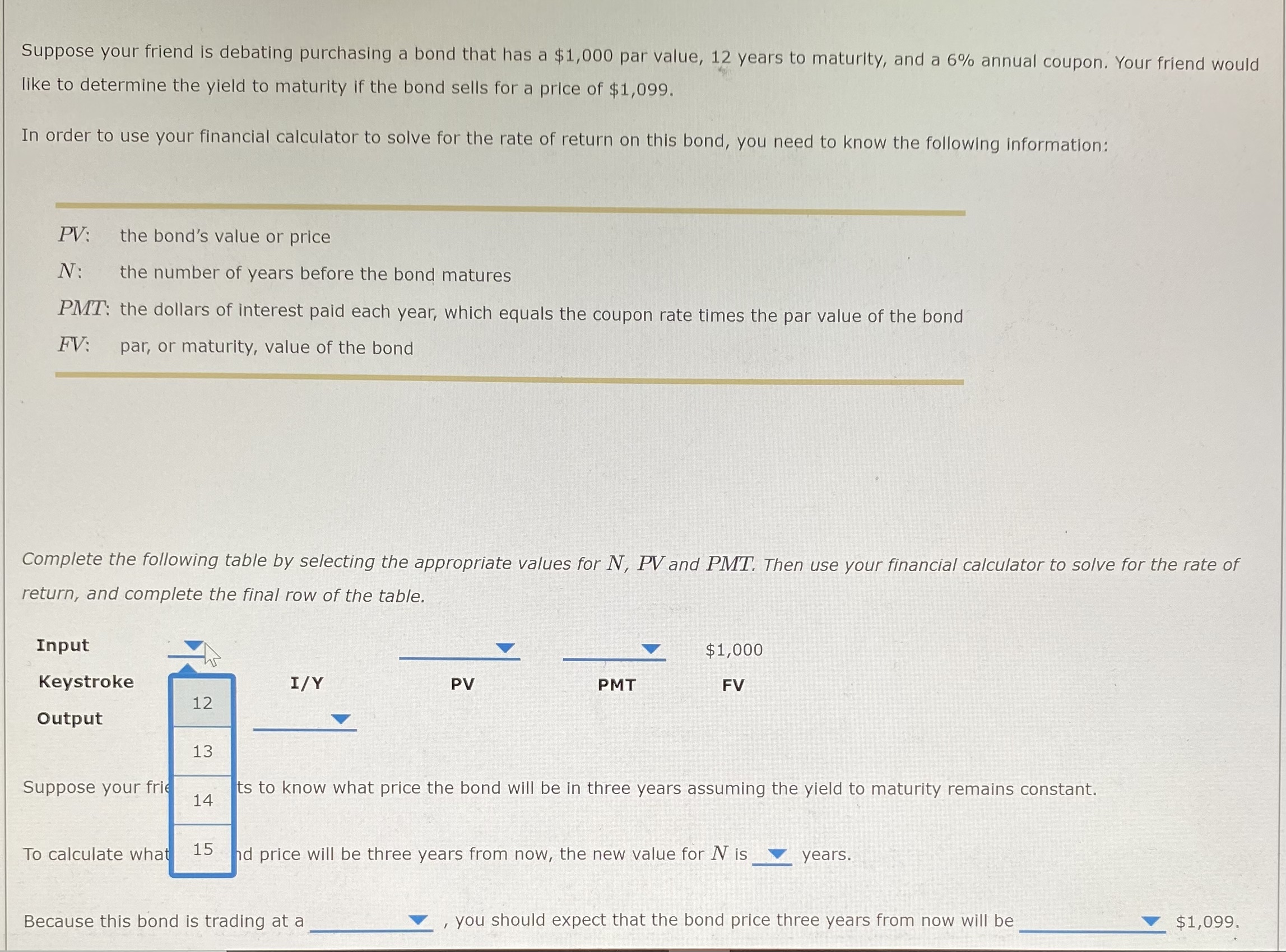
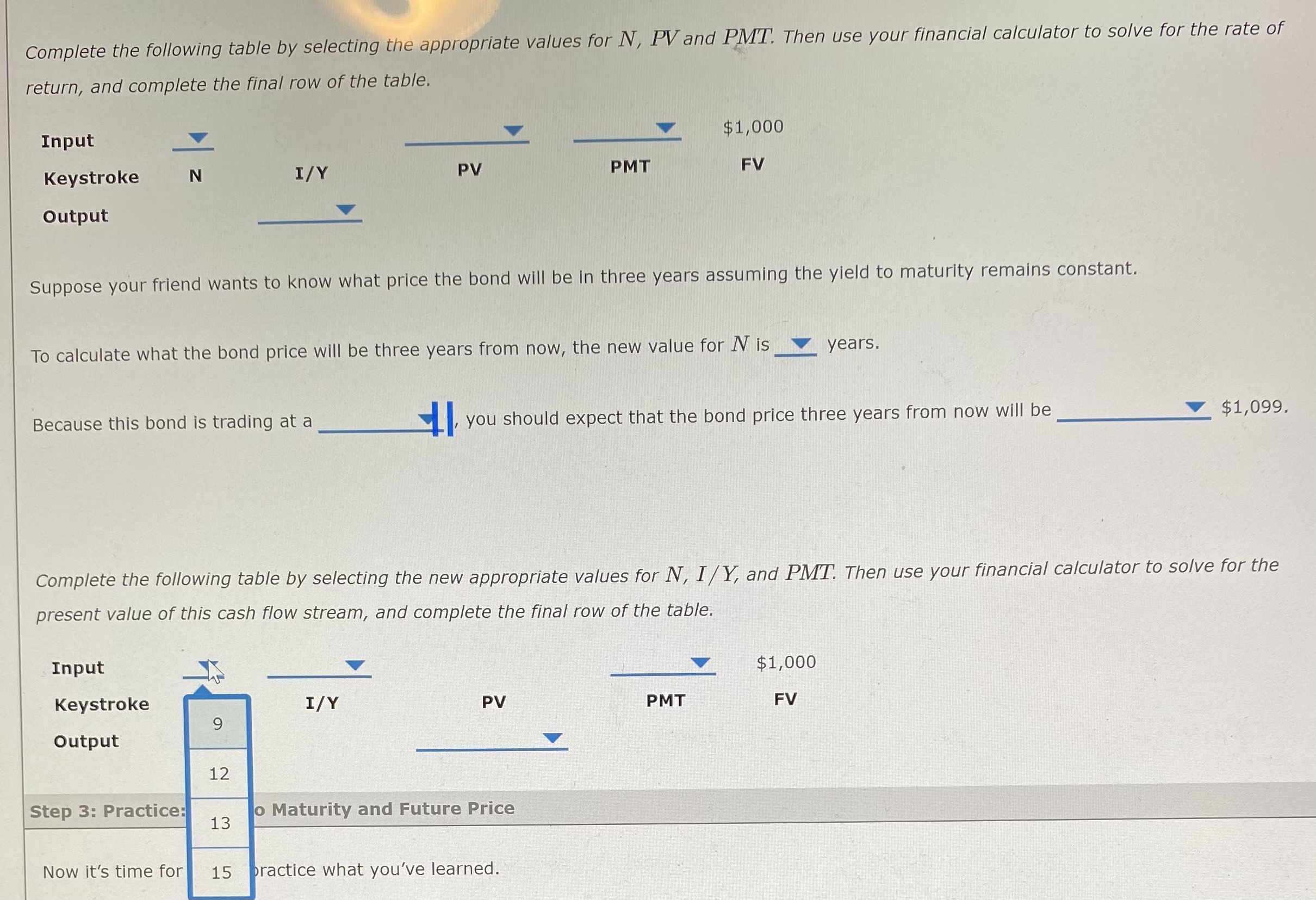
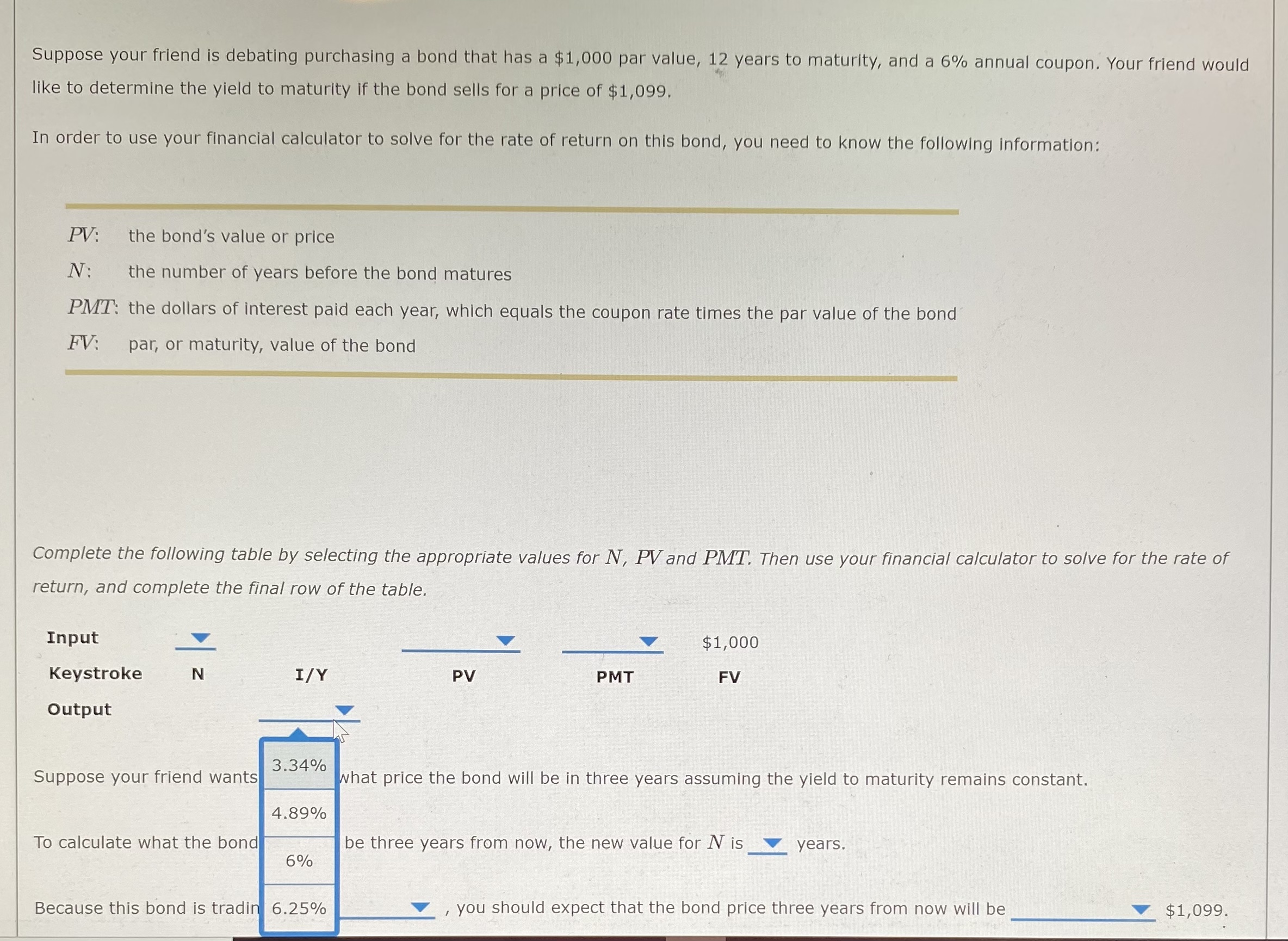
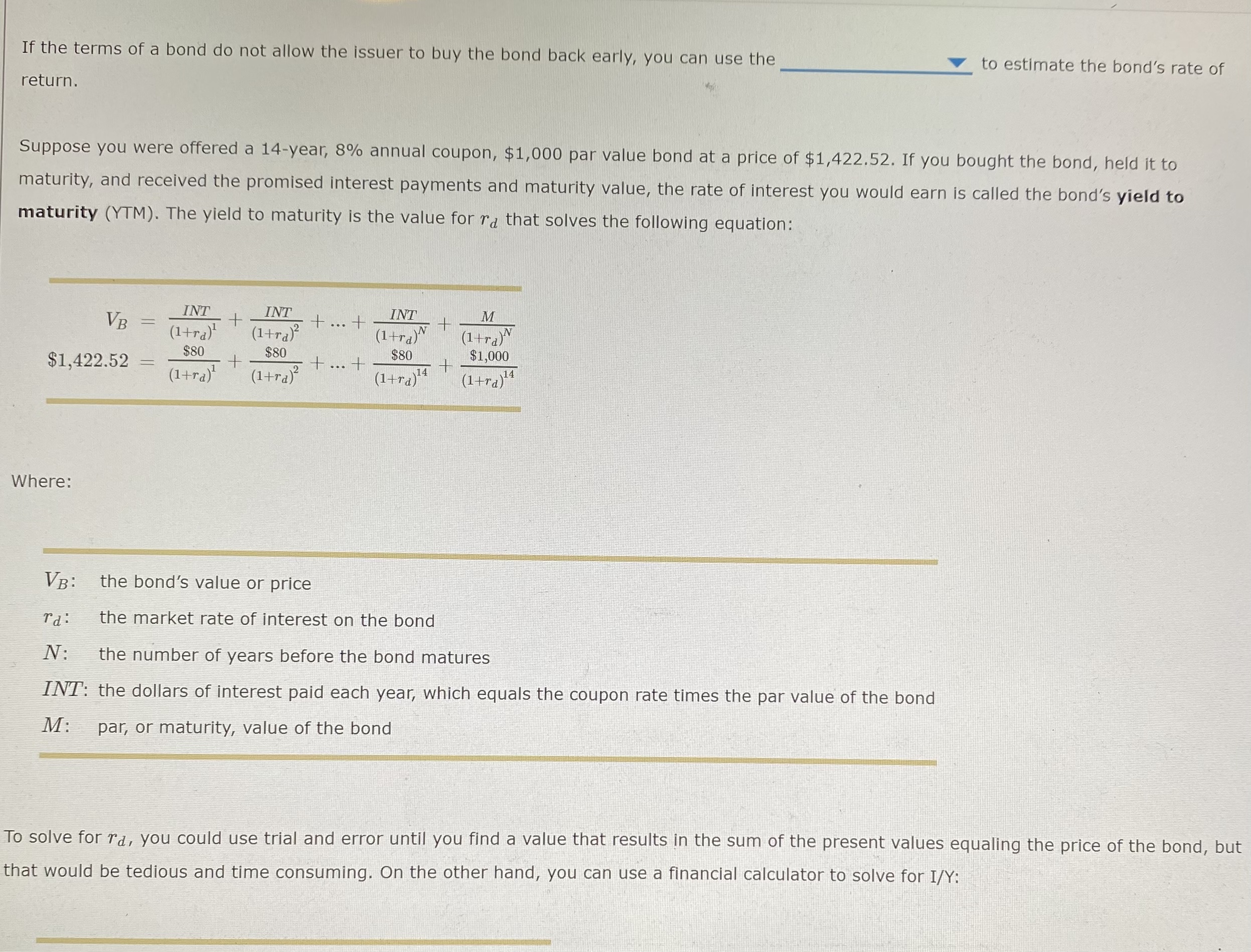
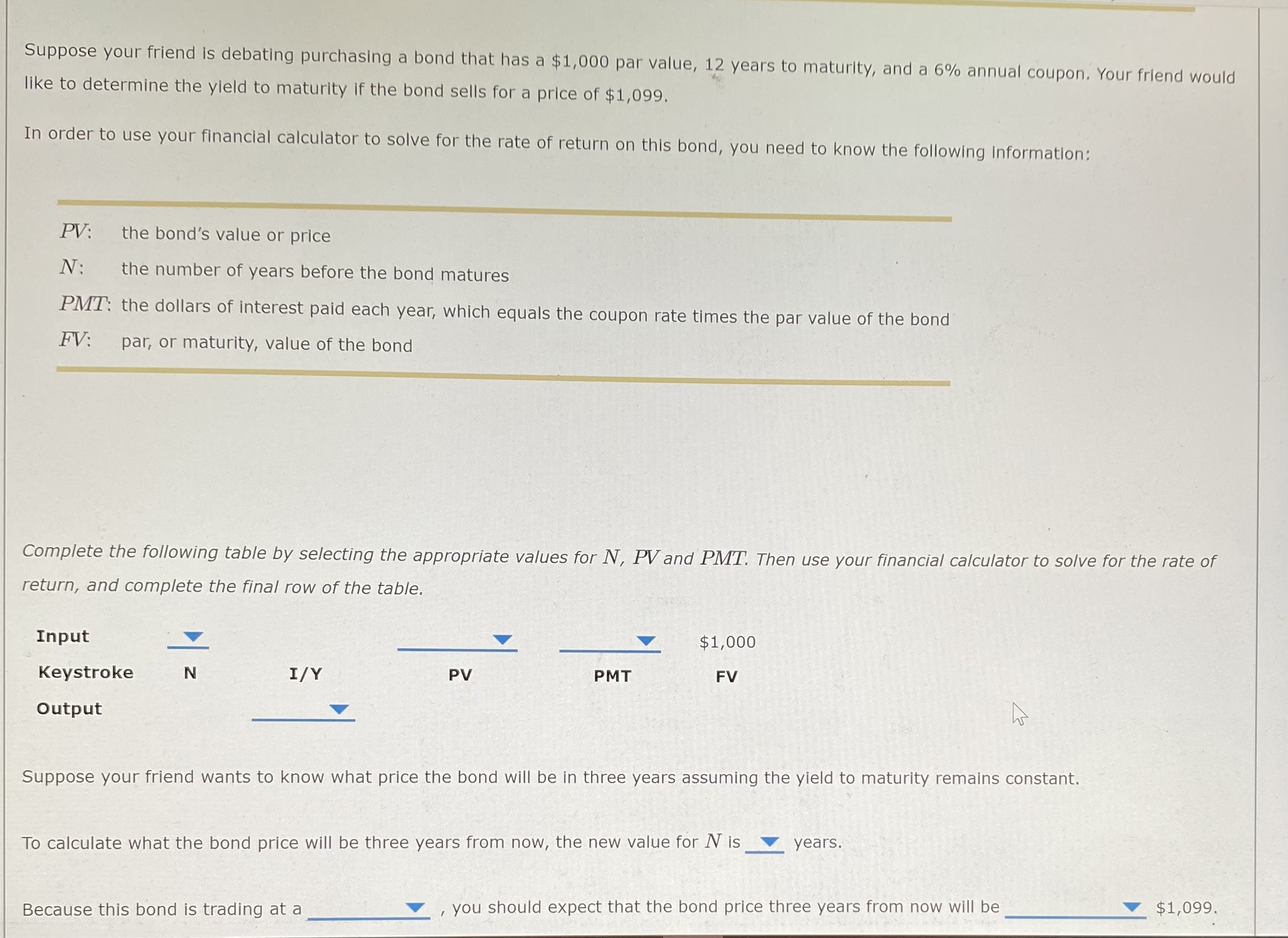
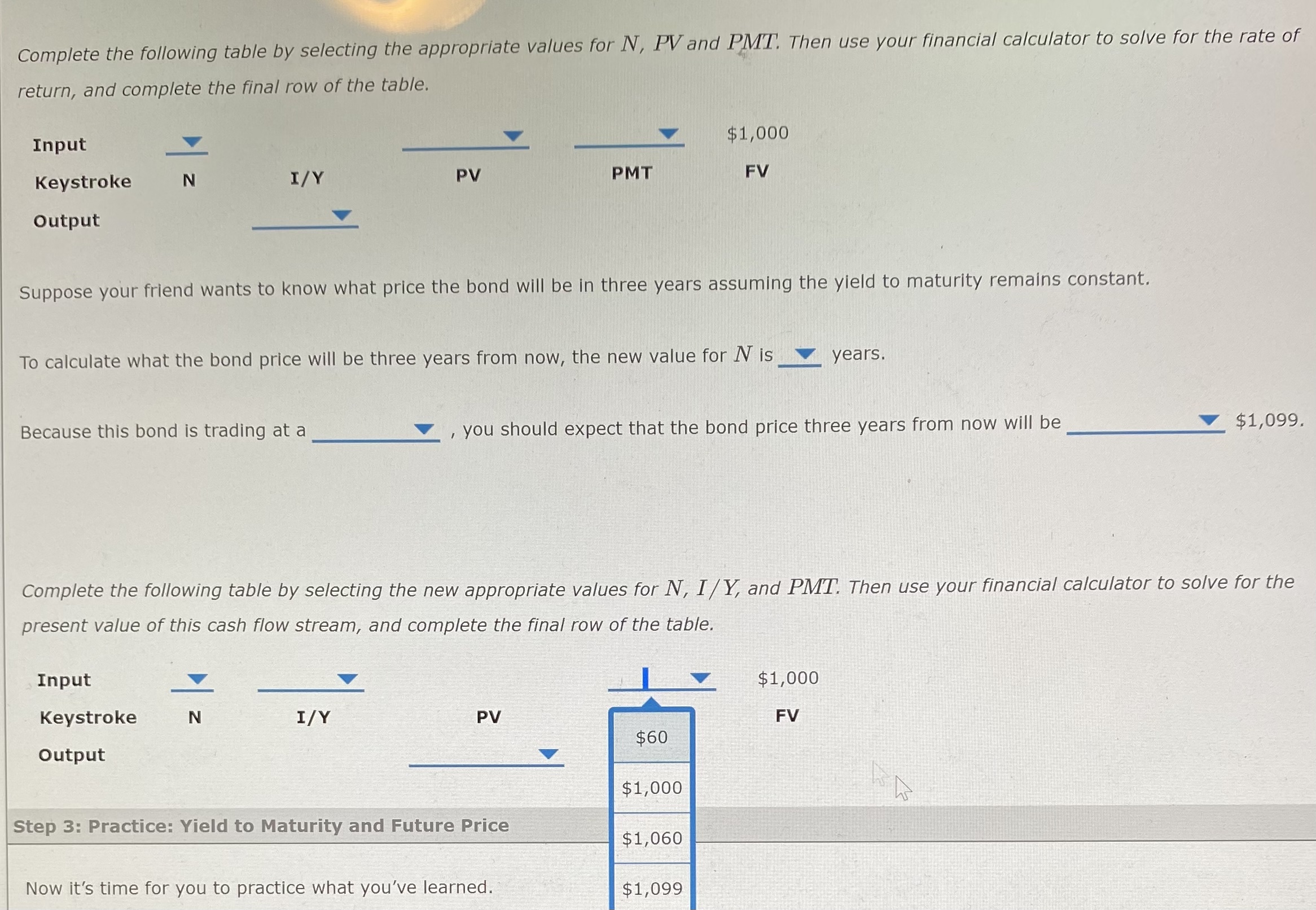
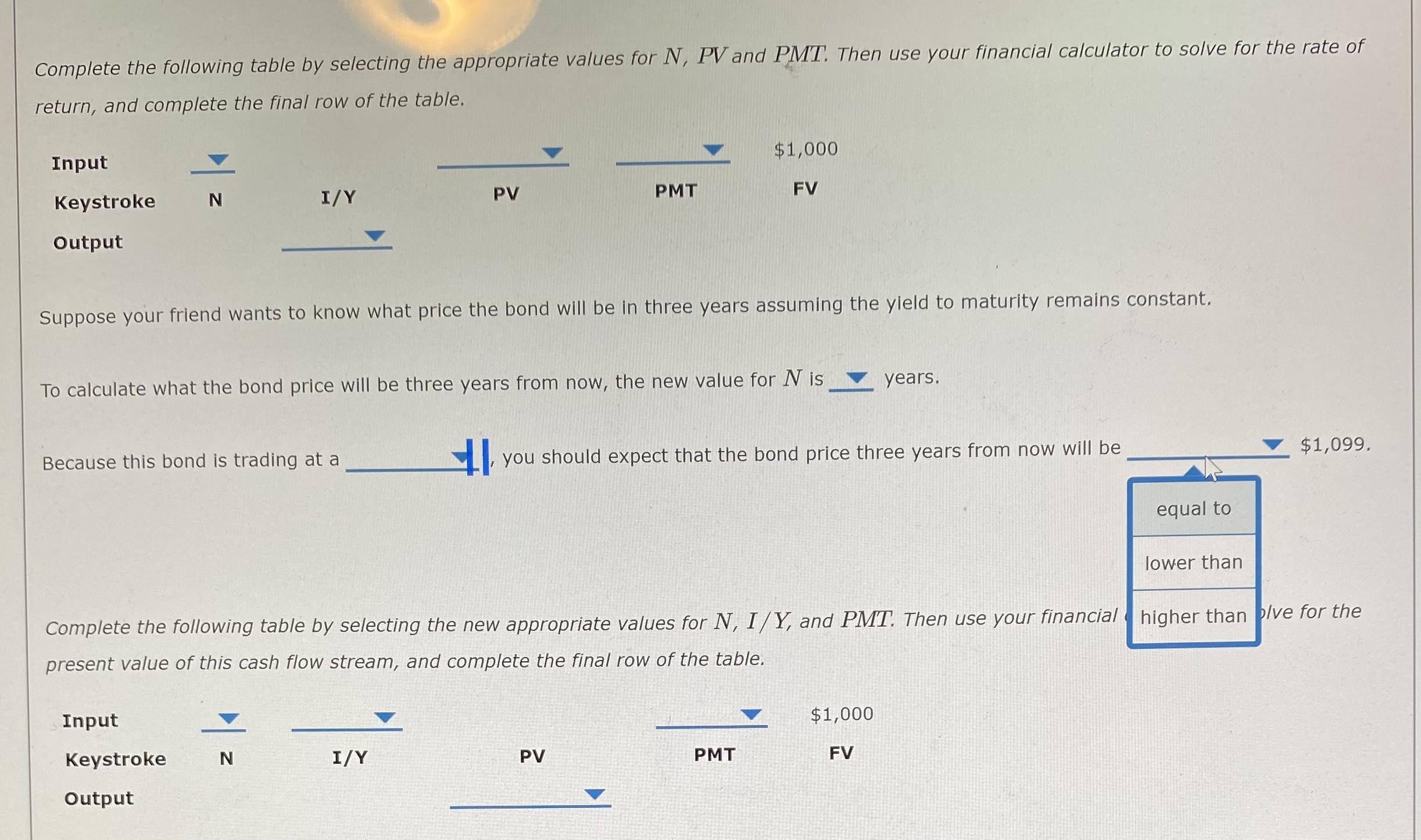
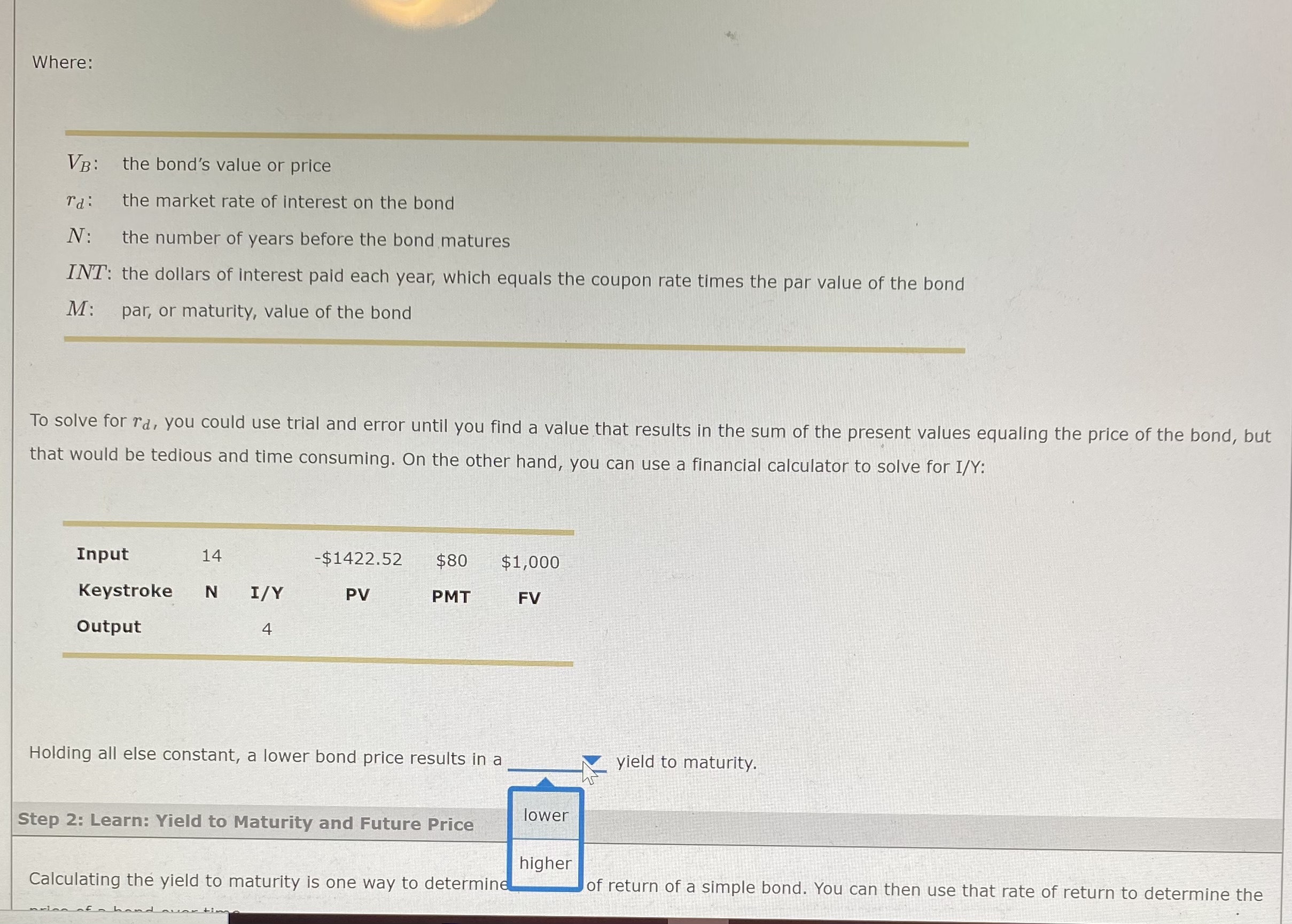
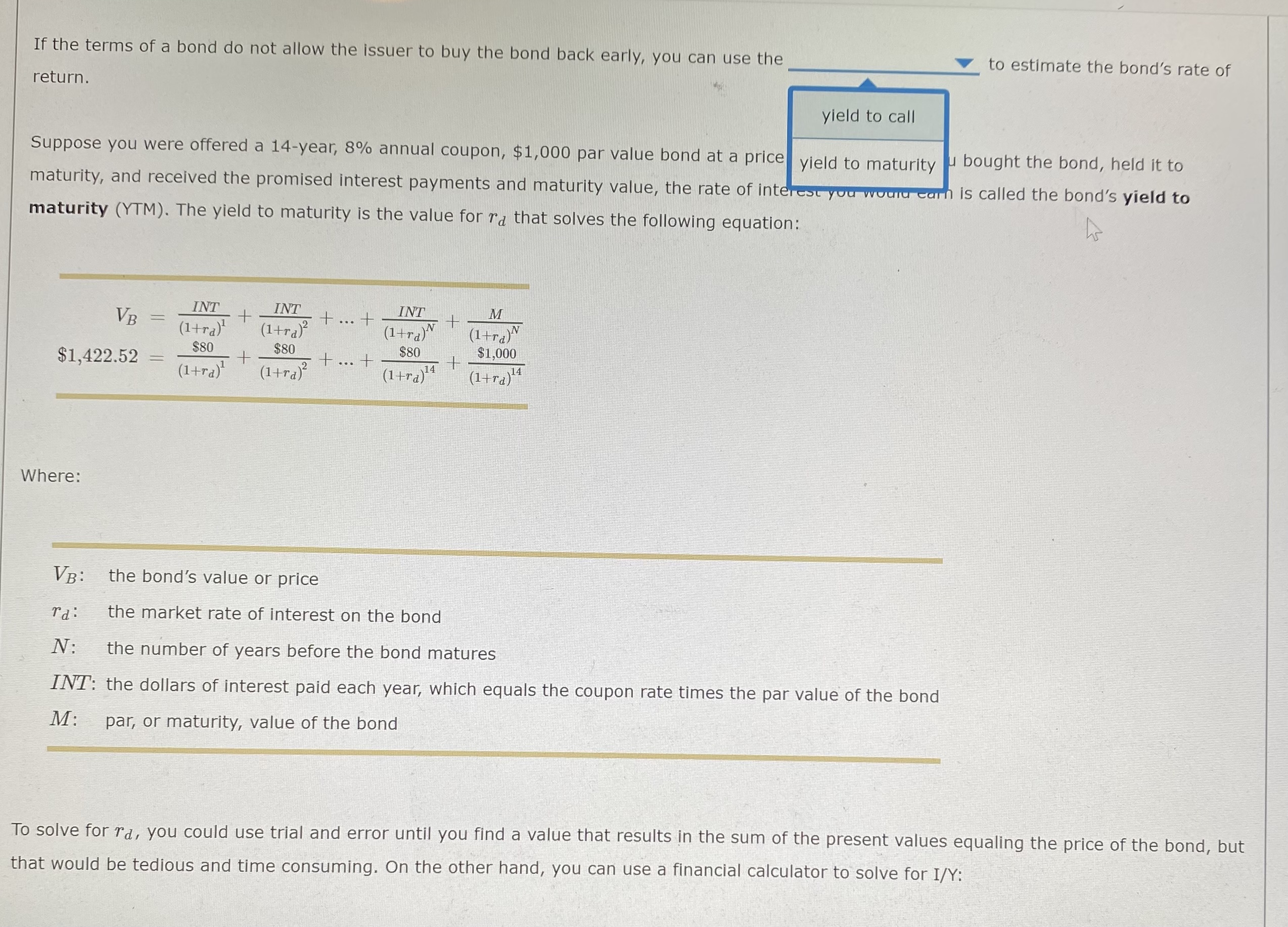
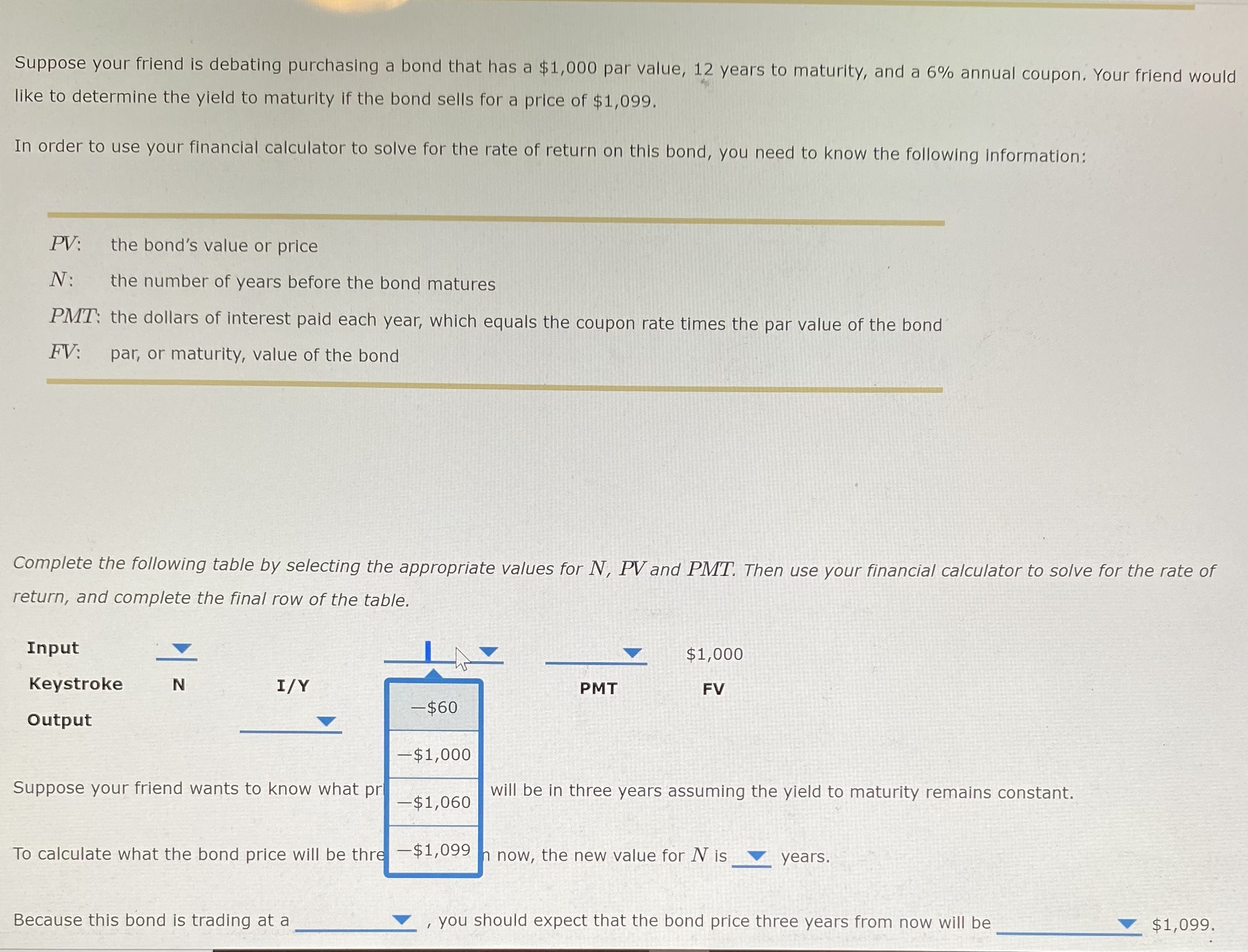
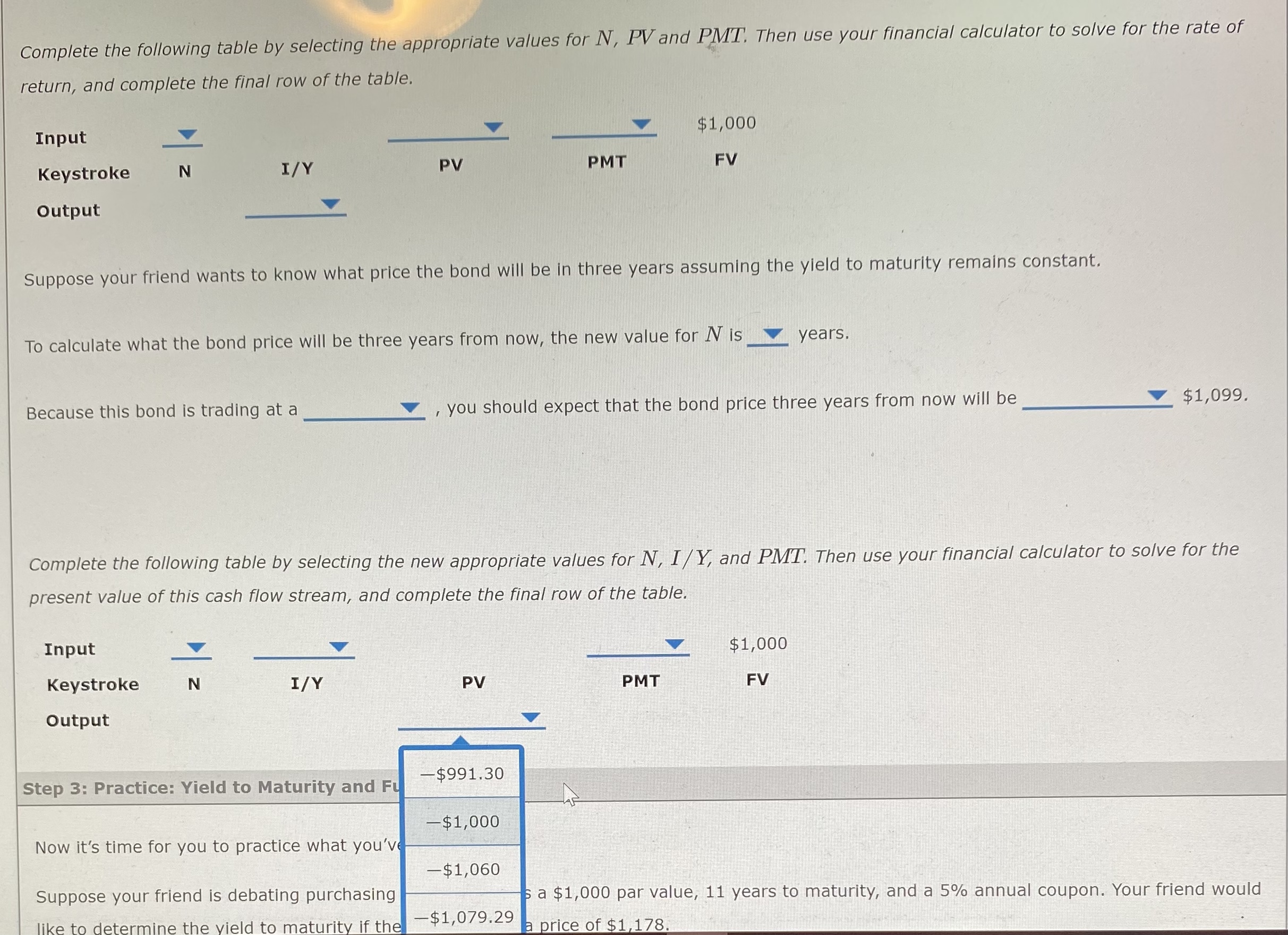
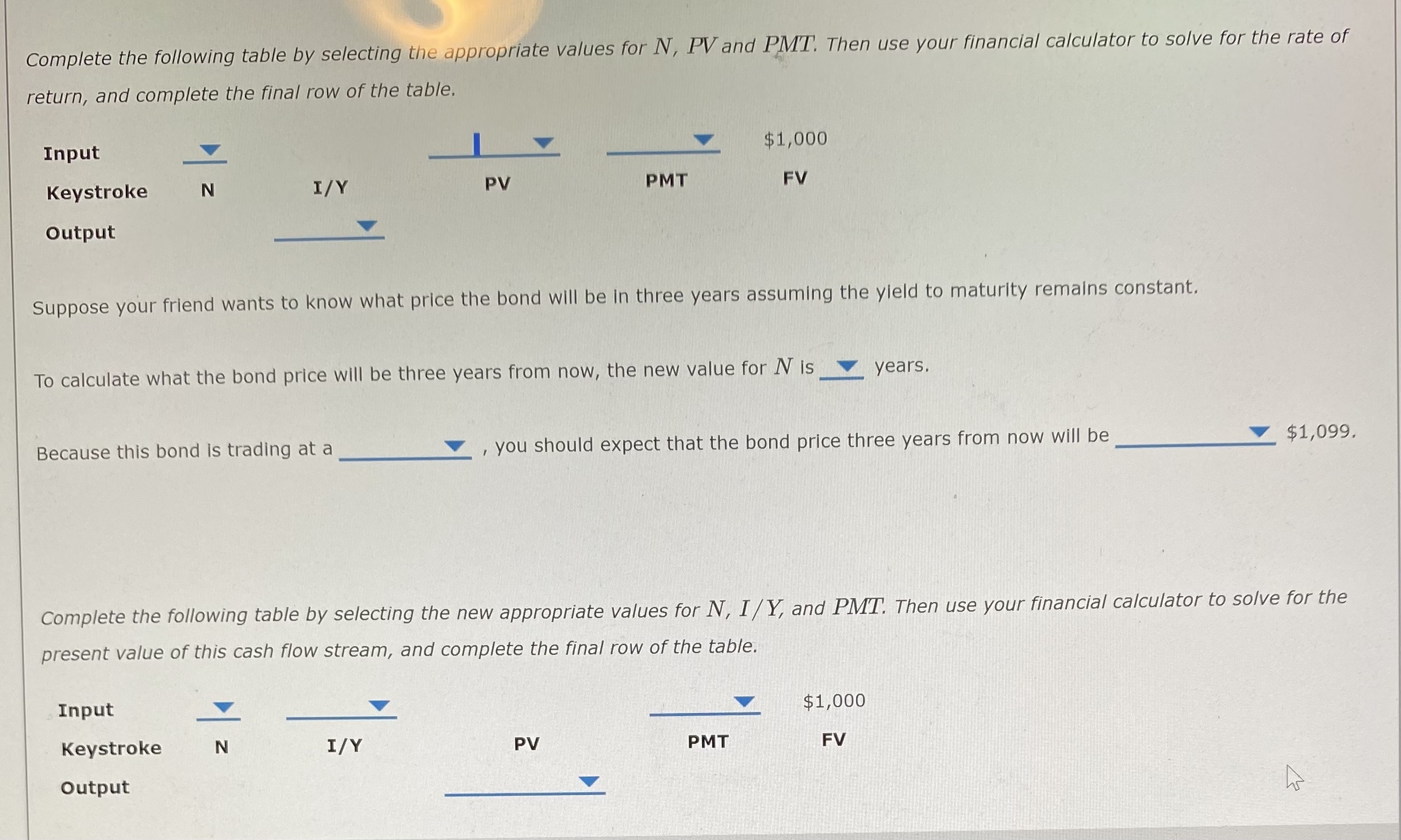
Complete the following table by selecting the appropriate values for N, PV and PMT. Then use your financial calculator to solve for the rate of return, and complete the final row of the table. Input $1,000 Keystroke N I/Y PV PMT FV Output Suppose your friend wants to know what price the bond will be in three years assuming the yield to maturity remains constant. To calculate what the bond price will be three years from now, the new value for N is years. Because this bond is trading at a you should expect that the bond price three years from now will be V $1,099. discount premium Complete the following table by selecting the new appropriate values for N, I/ Y, and PMT. Then use your financial calculator to solve for the present value of this cash flow stream, and complete the final row of the table. Input $1,000 Keystroke N I/Y PV PMT FV OutputComplete the following table by selecting the appropriate values for N, PV and PMT. Then use your financial calculator to solve for the rate of return, and complete the final row of the table. Input $1,000 Keystroke N I/Y PV PMT FV Output Suppose your friend wants to know what price the bond will be in three years assuming the yield to maturity remains constant. To calculate what the bond price will be three years from now, the new value for N is years. Because this bond is trading at a 9 , you should expect that the bond pri years from now will be $1,099. 11 12 14 Complete the following table by selecting the new appropriate values for N, I / Y, and Then use your financial calculator to solve for the present value of this cash flow stream, and complete the final row of the table. Input $1,000 Keystroke N I/Y PV PMT FV OutputWhere: VB: the bond's value or price rd: the market rate of interest on the bond N: the number of years before the bond matures INT: the dollars of interest paid each year, which equals the coupon rate times the par value of the bond M: par, or maturity, value of the bond To solve for ra, you could use trial and error until you find a value that results in the sum of the present values equaling the price of the bond, but that would be tedious and time consuming. On the other hand, you can use a financial calculator to solve for I/Y Input 14 -$1422.52 $80 $1,000 Keystroke N I/Y PV PMT FV Output 4 Holding all else constant, a lower bond price results in a yield to maturity.Suppose your friend is debating purchasing a bond that has a $1,000 par value, 12 years to maturity, and a 6% annual coupon. Your friend would like to determine the yield to maturity if the bond sells for a price of $1,099. In order to use your financial calculator to solve for the rate of return on this bond, you need to know the following information: PV: the bond's value or price N: the number of years before the bond matures PMT: the dollars of interest paid each year, which equals the coupon rate times the par value of the bond FV: par, or maturity, value of the bond Complete the following table by selecting the appropriate values for N, PV and PMT. Then use your financial calculator to solve for the rate of return, and complete the final row of the table. Input $1,000 Keystroke N I/Y PV FV $60 Output $1,000 Suppose your friend wants to know what price the bond will be $1,060 ears assuming the yield to maturity remains constant. To calculate what the bond price will be three years from now, $1,099 alue for N is years. Because this bond is trading at a , you should expect that the bond price three years from now will be $1,099Input $1,000 Keystroke N I/Y PV PMT FV Output Step 3: Practice: Yield to Maturity and Future Price Now it's time for you to practice what you've learned. Suppose your friend is debating purchasing a bond that has a $1,000 par value, 11 years to maturity, and a 5% annual coupon. Your friend would like to determine the yield to maturity if the bond sells for a price of $1, 178. What is the yield to maturity for this bond? O 1.13% O 1.78% O 3.07% O 4.18% Assume the yield to maturity remains constant over the next four years. What will the price of the bond be four years from now? $1,050.39 $1,120.00 $1,158.75 $1,178Complete the following table by selecting the appropriate values for N, PV and PMT. Then use your financial calculator to solve for the rate of return, and complete the final row of the table. Input $1,000 Keystroke N I/Y PV PMT FV Output Suppose your friend wants to know what price the bond will be in three years assuming the yield to maturity remains constant. To calculate what the bond price will be three years from now, the new value for N is years. Because this bond is trading at a you should expect that the bond price three years from now will be $1,099. Complete the following table by selecting the new appropriate values for N, I/ Y, and PMT. Then use your financial calculator to solve for the present value of this cash flow stream, and complete the final row of the table. Input $1,000 Keystroke N PV PMT FV 3.34% Output 4.89% Step 3: Practice: Yield to and Future Price 6% Now it's time for you to pra 6.25% it you've learned.Suppose your friend is debating purchasing a bond that has a $1,000 par value, 12 years to maturity, and a 6% annual coupon. Your friend would like to determine the yield to maturity if the bond sells for a price of $1,099. In order to use your financial calculator to solve for the rate of return on this bond, you need to know the following Information: PV: the bond's value or price N: the number of years before the bond matures PMT: the dollars of interest paid each year, which equals the coupon rate times the par value of the bond FV: par, or maturity, value of the bond Complete the following table by selecting the appropriate values for N, PV and PMT. Then use your financial calculator to solve for the rate of return, and complete the final row of the table. Input $1,000 Keystroke I/Y PV PMT FV 12 Output 13 Suppose your frie ts to know what price the bond will be in three years assuming the yield to maturity remains constant. 14 To calculate what 15 nd price will be three years from now, the new value for NV is _years. Because this bond is trading at a , you should expect that the bond price three years from now will be V $1,099.Complete the following table by selecting the appropriate values for N, PV and PMT. Then use your financial calculator to solve for the rate of return, and complete the final row of the table. Input $1,000 Keystroke N I/Y PV PMT FV Output Suppose your friend wants to know what price the bond will be in three years assuming the yield to maturity remains constant. To calculate what the bond price will be three years from now, the new value for N is_ years. Because this bond is trading at a you should expect that the bond price three years from now will be $1,099. Complete the following table by selecting the new appropriate values for N, I/ Y, and PMT. Then use your financial calculator to solve for the present value of this cash flow stream, and complete the final row of the table. Input $1,000 Keystroke I/Y PV PMT FV 9 Output 12 Step 3: Practice: 13 o Maturity and Future Price Now it's time for 15 practice what you've learned.Suppose your friend is debating purchasing a bond that has a $1,000 par value, 12 years to maturity, and a 6% annual coupon. Your friend would like to determine the yield to maturity if the bond sells for a price of $1,099. In order to use your financial calculator to solve for the rate of return on this bond, you need to know the following Information: PV: the bond's value or price N: the number of years before the bond matures PMT: the dollars of interest paid each year, which equals the coupon rate times the par value of the bond FV: par, or maturity, value of the bond Complete the following table by selecting the appropriate values for N, PV and PMT. Then use your financial calculator to solve for the rate of return, and complete the final row of the table. Input $1,000 Keystroke N I/Y PV PMT FV Output 3.34% Suppose your friend wants what price the bond will be in three years assuming the yield to maturity remains constant. 4.89% To calculate what the bond be three years from now, the new value for N is years. 6% Because this bond is tradin 6.25% , you should expect that the bond price three years from now will be $1,099.If the terms of a bond do not allow the issuer to buy the bond back early, you can use the to estimate the bond's rate of return. Suppose you were offered a 14-year, 8% annual coupon, $1,000 par value bond at a price of $1,422.52. If you bought the bond, held it to maturity, and received the promised interest payments and maturity value, the rate of interest you would earn is called the bond's yield to maturity (YTM). The yield to maturity is the value for Ta that solves the following equation: VB NT INT +... + INT (1 +ra) (1 +ra)2 1+rd) 1 4ra)N $80 $1,422.52 $80 $80 $1,000 .. + (1+ra) (1+ra) (1+ra) 4 (1+ra)14 Where: VB: the bond's value or price rd: the market rate of interest on the bond N: the number of years before the bond matures INT: the dollars of interest paid each year, which equals the coupon rate times the par value of the bond M: par, or maturity, value of the bond To solve for ra, you could use trial and error until you find a value that results in the sum of the present values equaling the price of the bond, but that would be tedious and time consuming. On the other hand, you can use a financial calculator to solve for I/Y:Suppose your friend is debating purchasing a bond that has a $1,000 par value, 12 years to maturity, and a 6% annual coupon. Your friend would like to determine the yield to maturity if the bond sells for a price of $1,099. In order to use your financial calculator to solve for the rate of return on this bond, you need to know the following Information: PV: the bond's value or price N: the number of years before the bond matures PMT: the dollars of interest paid each year, which equals the coupon rate times the par value of the bond FV: par, or maturity, value of the bond Complete the following table by selecting the appropriate values for N, PV and PMT. Then use your financial calculator to solve for the rate of return, and complete the final row of the table. Input $1,000 Keystroke N I/Y PV PMT FV Output Suppose your friend wants to know what price the bond will be in three years assuming the yield to maturity remains constant. To calculate what the bond price will be three years from now, the new value for N is _years. , you should expect that the bond price three years from now will be $1,099. Because this bond is trading at aComplete the following table by selecting the appropriate values for N, PV and PMT. Then use your financial calculator to solve for the rate of return, and complete the final row of the table. Input $1,000 Keystroke N I/ Y PV PMT FV Output Suppose your friend wants to know what price the bond will be in three years assuming the yield to maturity remains constant. To calculate what the bond price will be three years from now, the new value for NV is years. Because this bond is trading at a , you should expect that the bond price three years from now will be $1,099. Complete the following table by selecting the new appropriate values for N, I / Y, and PMT. Then use your financial calculator to solve for the present value of this cash flow stream, and complete the final row of the table. Input $1,000 Keystroke N I/Y PV FV Output $60 $1,000 Step 3: Practice: Yield to Maturity and Future Price $1,060 Now it's time for you to practice what you've learned. $1,099Complete the following table by selecting the appropriate values for N, PV and PMT. Then use your financial calculator to solve for the rate of return, and complete the final row of the table. Input $1,000 Keystroke N I/Y PV PMT FV Output Suppose your friend wants to know what price the bond will be in three years assuming the yield to maturity remains constant. To calculate what the bond price will be three years from now, the new value for NV is _years. Because this bond is trading at a you should expect that the bond price three years from now will be $1,099. equal to lower than Complete the following table by selecting the new appropriate values for N, I / Y, and PMT. Then use your financial , higher than plve for the present value of this cash flow stream, and complete the final row of the table. Input $1,000 Keystroke N I/Y PV PMT FV OutputWhere : VB: the bond's value or price "d: the market rate of interest on the bond N: the number of years before the bond matures INT: the dollars of interest paid each year, which equals the coupon rate times the par value of the bond M: par, or maturity, value of the bond To solve for ra, you could use trial and error until you find a value that results in the sum of the present values equaling the price of the bond, but that would be tedious and time consuming. On the other hand, you can use a financial calculator to solve for I/Y: Input 14 $1422.52 $80 $1,000 Keystroke N I/Y PV PMT FV Output 4 Holding all else constant, a lower bond price results in a yield to maturity. Step 2: Learn: Yield to Maturity and Future Price lower higher Calculating the yield to maturity is one way to determine of return of a simple bond. You can then use that rate of return to determine theIf the terms of a bond do not allow the issuer to buy the bond back early, you can use the to estimate the bond's rate of return. yield to call Suppose you were offered a 14-year, 8% annual coupon, $1,000 par value bond at a price yield to maturity u bought the bond, held it to maturity, and received the promised interest payments and maturity value, the rate of interest you would earn is called the bond's yield to maturity (YTM). The yield to maturity is the value for Ta that solves the following equation: INT VB = + INT + ... + INT (1 +ra) (1 +ra) 1 +ra ) $80 $80 $1,422.52 $80 $1,000 +... + (1+ra) 1+rd) 1tra) (1+ra) 14 Where: VB: the bond's value or price rd : the market rate of interest on the bond N: the number of years before the bond matures INT: the dollars of interest paid each year, which equals the coupon rate times the par value of the bond M: par, or maturity, value of the bond To solve for ra, you could use trial and error until you find a value that results in the sum of the present values equaling the price of the bond, but that would be tedious and time consuming. On the other hand, you can use a financial calculator to solve for I/Y:Suppose your friend is debating purchasing a bond that has a $1,000 par value, 12 years to maturity, and a 6% annual coupon. Your friend would like to determine the yield to maturity if the bond sells for a price of $1,099. In order to use your financial calculator to solve for the rate of return on this bond, you need to know the following information: PV: the bond's value or price N: the number of years before the bond matures PMT: the dollars of interest paid each year, which equals the coupon rate times the par value of the bond FV: par, or maturity, value of the bond Complete the following table by selecting the appropriate values for N, PV and PMT. Then use your financial calculator to solve for the rate of return, and complete the final row of the table. Input $1,000 Keystroke N I/Y PMT FV -$60 Output -$1,000 Suppose your friend wants to know what pr will be in three years assuming the yield to maturity remains constant. -$1,060 To calculate what the bond price will be thre -$1,099 now, the new value for N is years. Because this bond is trading at a , you should expect that the bond price three years from now will be $1,099.Complete the following table by selecting the appropriate values for N, PV and PMT. Then use your financial calculator to solve for the rate of return, and complete the final row of the table. Input $1,000 Keystroke N I/Y PV PMT FV Output Suppose your friend wants to know what price the bond will be in three years assuming the yield to maturity remains constant. To calculate what the bond price will be three years from now, the new value for NV is years. Because this bond is trading at a , you should expect that the bond price three years from now will be $1,099. Complete the following table by selecting the new appropriate values for N, I / Y, and PMT. Then use your financial calculator to solve for the present value of this cash flow stream, and complete the final row of the table. Input $1,000 Keystroke N I/Y PV PMT FV Output Step 3: Practice: Yield to Maturity and Fu -$991.30 -$1,000 Now it's time for you to practice what you've -$1,060 Suppose your friend is debating purchasing s a $1,000 par value, 11 years to maturity, and a 5% annual coupon. Your friend would maturity if the -$1,079.29 a price of $1,178.Complete the following table by selecting the appropriate values for N, PV and PMT. Then use your financial calculator to solve for the rate of return, and complete the final row of the table. Input $1,000 Keystroke N I/Y PV PMT FV Output Suppose your friend wants to know what price the bond will be in three years assuming the yield to maturity remains constant. To calculate what the bond price will be three years from now, the new value for N is years. Because this bond is trading at a , you should expect that the bond price three years from now will be $1,099. Complete the following table by selecting the new appropriate values for N, I/ Y, and PMT. Then use your financial calculator to solve for the present value of this cash flow stream, and complete the final row of the table. Input $1,000 Keystroke N I/Y PV PMT FV Output
Step by Step Solution
There are 3 Steps involved in it
1 Expert Approved Answer
Step: 1 Unlock
Question Has Been Solved by an Expert!
Get step-by-step solutions from verified subject matter experts
Step: 2 Unlock
Step: 3 Unlock
Students Have Also Explored These Related Finance Questions!









 Study Help