



Question: Complete the following tabulation for each situation. In Situations A and B (prices rising), assume the following: beginning inventory, 300 units at $11=$3,300; purchases, 400
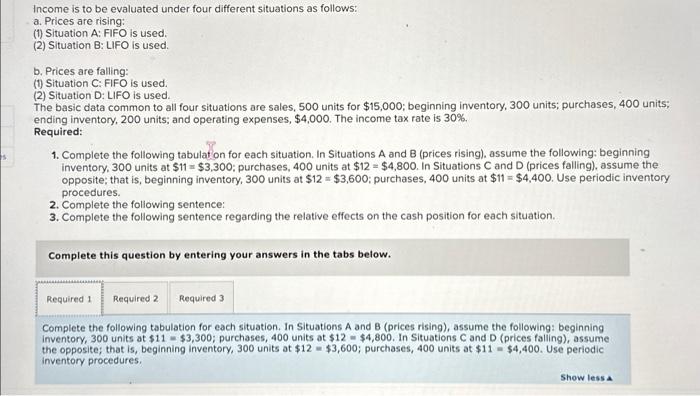
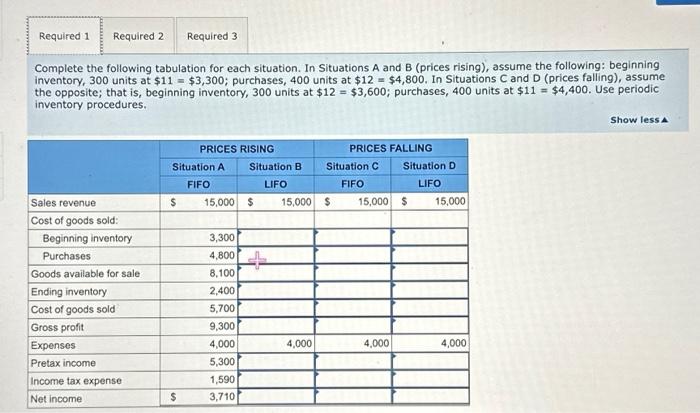
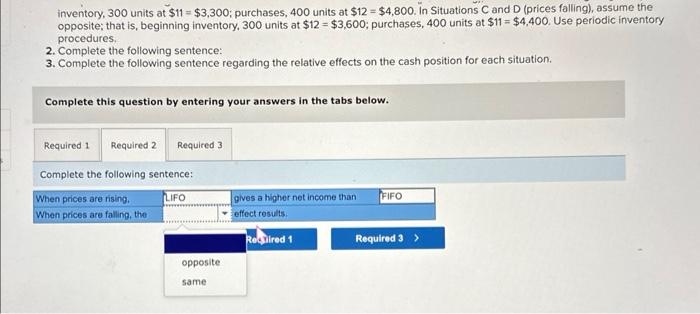
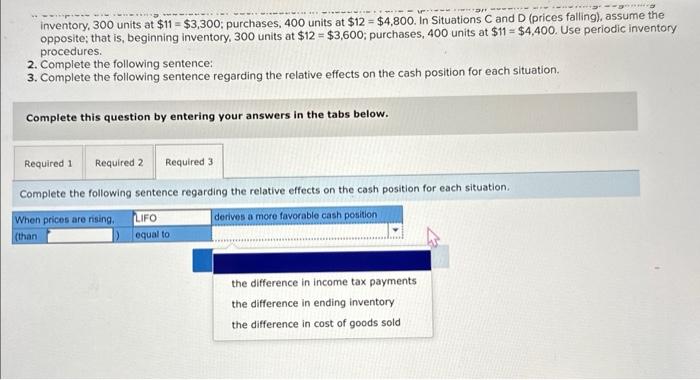
Complete the following tabulation for each situation. In Situations A and B (prices rising), assume the following: beginning inventory, 300 units at $11=$3,300; purchases, 400 units at $12=$4,800. In Situations C and D (prices falling), assume the opposite; that is, beginning inventory, 300 units at $12=$3,600; purchases, 400 units at $11=$4,400. Use periodic inventory procedures. inventory, 300 units at $11=$3,300; purchases, 400 units at $12=$4,800. In Situations C and D (prices falling), assume the opposite; that is, beginning inventory, 300 units at $12=$3,600; purchases, 400 units at $11=$4,400. Use periodic inventory procedures. 2. Complete the following sentence: 3. Complete the following sentence regarding the relative effects on the cash position for each situation. Complete this question by entering your answers in the tabs below. Complete the following sentence regarding the relative effects on the cash position for each situation. inventory, 300 units at $11=$3,300; purchases, 400 units at $12=$4,800. In Situations C and D (prices falling), assume the opposite; that is, beginning inventory, 300 units at $12=$3,600; purchases, 400 units at $11=$4,400. Use periodic inventory procedures. 2. Complete the following sentence: 3. Complete the following sentence regarding the relative effects on the cash position for each situation. Complete this question by entering your answers in the tabs below. Complete the following sentence: Income is to be evaluated under four different situations as follows: a. Prices are rising: (1) Situation A: FIFO is used. (2) Situation B: LIFO is used. b. Prices are falling: (1) Situation C: FFFO is used. (2) Situation D: LIFO is used. The basic data common to all four situations are sales, 500 units for $15,000; beginning inventory, 300 units; purchases, 400 units; ending inventory, 200 units; and operating expenses, $4,000. The income tax rate is 30%. Required: 1. Complete the following tabulat on for each situation, In Situations A and B (prices rising), assume the following: beginning inventory, 300 units at $11=$3,300; purchases, 400 units at $12=$4,800. In Situations C and D (prices falling), assume the opposite; that is, beginning inventory, 300 units at $12=$3,600; purchases, 400 units at $11=$4,400. Use periodic inventory procedures. 2. Complete the following sentence: 3. Complete the following sentence regarding the relative effects on the cash position for each situation. Complete this question by entering your answers in the tabs below. Complete the following tabulation for each situation. In Situations A and B (prices rising), assume the following: beginning inventory, 300 units at $11=$3,300; purchases, 400 units at $12=$4,800. In Situations C and D (prices falling), assume the opposite; that is, beginning inventory, 300 units at $12=$3,600; purchases, 400 units at $11=$4,400. Use periodic inventory procedures
Step by Step Solution
There are 3 Steps involved in it

Get step-by-step solutions from verified subject matter experts