







Question: Complete the following textbook exercises and problems: Page 53, exercise 3.1-4 [don't just answer yes or no] Page 60, exercise 3.2-3, all 3 parts. You'll
Complete the following textbook exercises and problems:
- Page 53, exercise 3.1-4 [don't just answer yes or no]
- Page 60, exercise 3.2-3, all 3 parts. You'll find Stirling's approximation for n! helpful, which is in equation 3.18 in the book. The reason it will be helpful is that the approach involving limits will be easier, but you'll need L'Hopital's rule which involves derivatives and you can't take the derivative of n! but you can take the derivative of Stirling's approximation.]
- Page 61, problem 3-2. Provide your answers in the form of a table such as in the book. But, also make sure you include work for full credit. You can use either limits or the relevant definitions (e.g., where you find values of constants c and k, etc) to prove your answers. I believe that the limit approach will be easier for most of these.
- Page 456, exercise 17.1-3
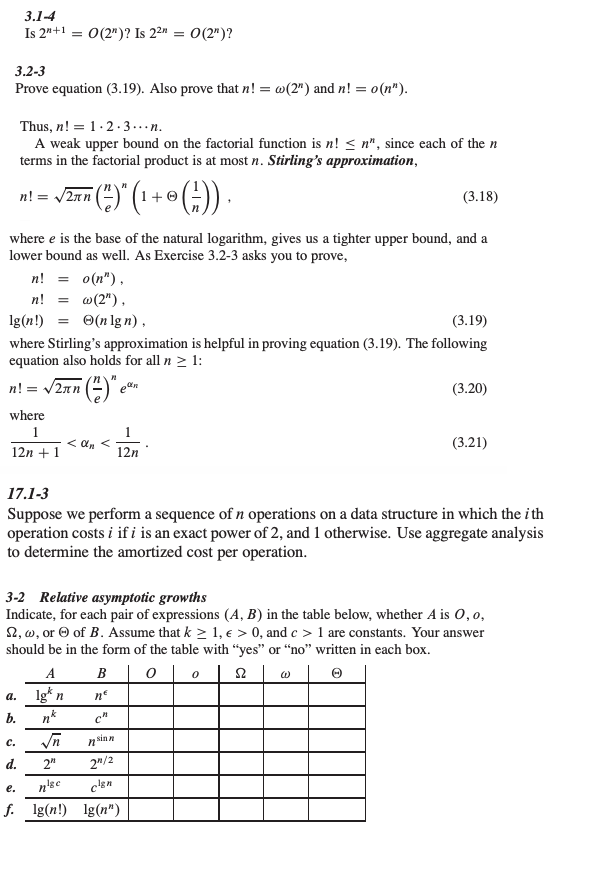
3.1-4 Is 2n+1 = 0(2")? Is 22n = 0(2")? 3.2-3 Prove equation (3.19). Also prove that n! = w(2") and n! = o(n"). Thus, n! = 1.2.3...n. A weak upper bound on the factorial function is n!
Step by Step Solution
There are 3 Steps involved in it
1 Expert Approved Answer
Step: 1 Unlock

Question Has Been Solved by an Expert!
Get step-by-step solutions from verified subject matter experts
Step: 2 Unlock
Step: 3 Unlock
 Study Help