







Question: Complete the following writing assignment: Analyze the attached 10_pages. Write about them, summarize what you read, and connect it to personal experiences. CHAPTER 15 Sexual
Complete the following writing assignment:
Analyze the attached 10_pages. Write about them, summarize what you read, and connect it to personal experiences.
![Disorders, fifth edition (DSM-5; American Psychiatric Association [APA], 2013). This represents a](https://dsd5zvtm8ll6.cloudfront.net/si.experts.images/questions/2024/05/6634387cced55_3646634387c937b8.jpg)
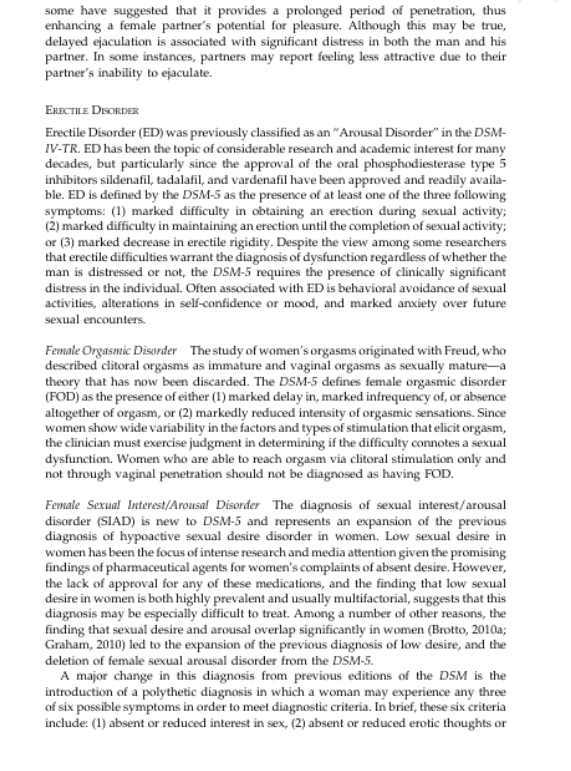
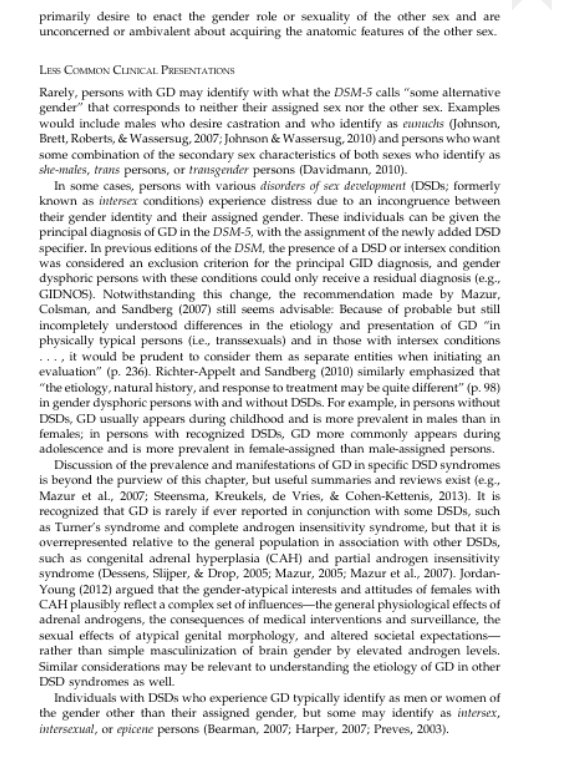
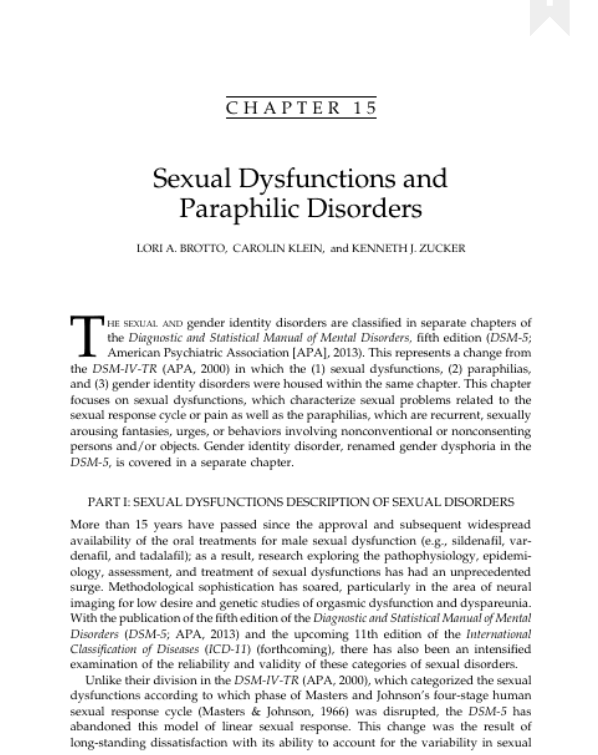
CHAPTER 15 Sexual Dysfunctions and Paraphilic Disorders LORI A. BROTTO, CAROLIN KLEIN, and KENNETH J. ZUCKER T HE SEXUAL AND gender identity disorders are classified in separate chapters of the Diagnostic and Statistical Manual of Mental Disorders, fifth edition (DSM-5; American Psychiatric Association [APA], 2013). This represents a change from the DSM-IV-TR (APA, 2000) in which the (1) sexual dysfunctions, (2) paraphilias, and (3) gender identity disorders were housed within the same chapter. This chapter focuses on sexual dysfunctions, which characterize sexual problems related to the sexual response cycle or pain as well as the paraphilias, which are recurrent, sexually arousing fantasies, urges, or behaviors involving nonconventional or nonconsenting persons and/or objects. Gender identity disorder, renamed gender dysphoria in the DSM-5, is covered in a separate chapter. PART I: SEXUAL DYSFUNCTIONS DESCRIPTION OF SEXUAL DISORDERS More than 15 years have passed since the approval and subsequent widespread availability of the oral treatments for male sexual dysfunction (e.g., sildenafil, var- denafil, and tadalafil); as a result, research exploring the pathophysiology, epidemi- ology, assessment, and treatment of sexual dysfunctions has had an unprecedented surge. Methodological sophistication has soared, particularly in the area of neural imaging for low desire and genetic studies of orgasmic dysfunction and dyspareunia. With the publication of the fifth edition of the Diagnostic and Statistical Manual of Mental Disorders (DSM-5; APA, 2013) and the upcoming 11th edition of the International Classification of Diseases (ICD-11) (forthcoming), there has also been an intensified examination of the reliability and validity of these categories of sexual disorders. Unlike their division in the DSM-IV-TR (APA, 2000), which categorized the sexual dysfunctions according to which phase of Masters and Johnson's four-stage human sexual response cycle (Masters & Johnson, 1966) was disrupted, the DSM-5 has abandoned this model of linear sexual response. This change was the result of long-standing dissatisfaction with its ability to account for the variability in sexual
Step by Step Solution
There are 3 Steps involved in it
In the engrossing Chapter 15 of Sexual Dysfunctions and Paraphilic Disorders a thorough investigation reveals the complex nature of these disorders Ex... View full answer

Get step-by-step solutions from verified subject matter experts
 Study Help