







Question: Complete the missing values in the table below under the assumption that unsigned arithmetic is being used. The first row illustrates the process. Binary
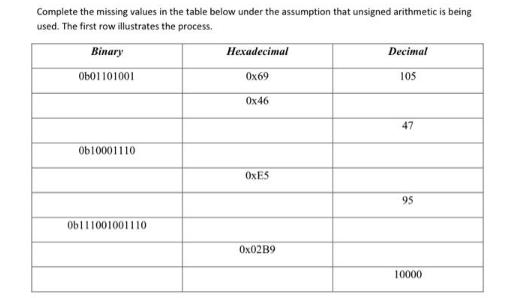
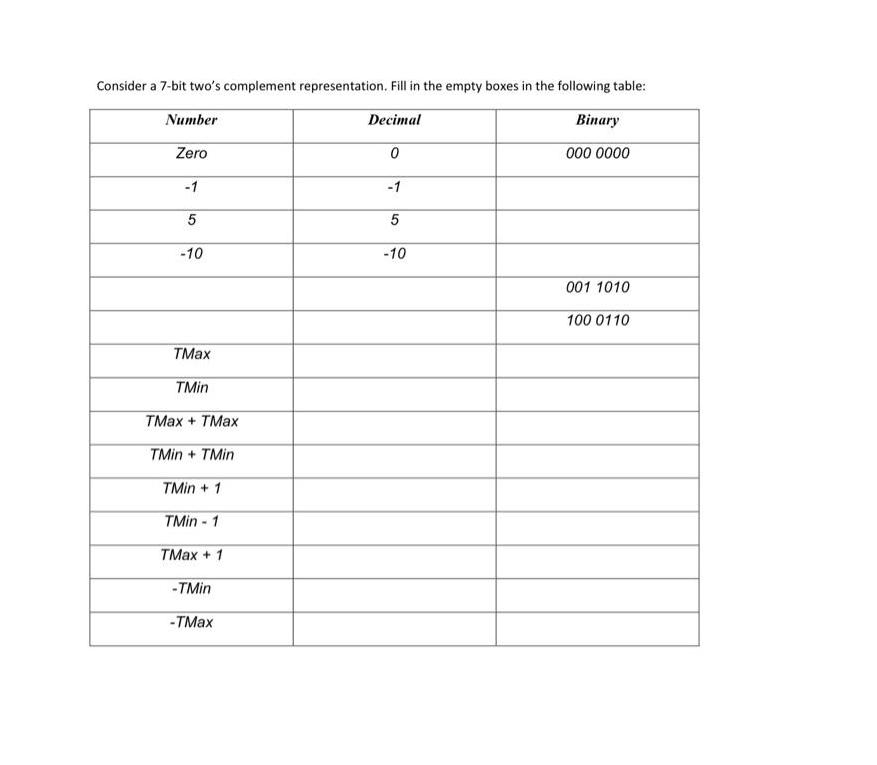
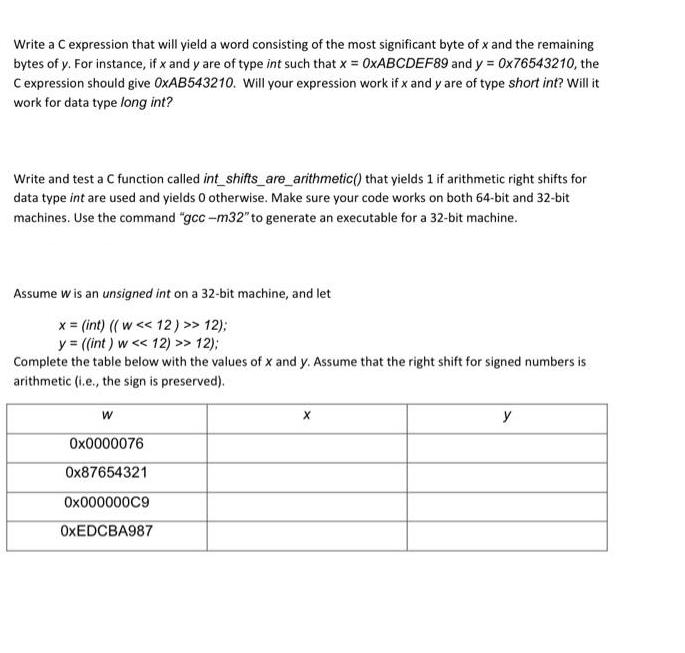
Complete the missing values in the table below under the assumption that unsigned arithmetic is being used. The first row illustrates the process. Binary 0b01101001 Ob10001110 Ob111001001110 Hexadecimal 0x69 0x46 OxE5 0x02B9 Decimal 105 47 95 10000 Consider a 7-bit two's complement representation. Fill in the empty boxes in the following table: Decimal Binary 0 Number Zero -1 5 -10 TMax TMin TMax + TMax TMin + TMin TMin + 1 TMin-1 TMax + 1 -TMin -TMax -1 5 -10 000 0000 001 1010 100 0110 Write a C expression that will yield a word consisting of the most significant byte of x and the remaining bytes of y. For instance, if x and y are of type int such that x = OxABCDEF89 and y = 0x76543210, the C expression should give OxAB543210. Will your expression work if x and y are of type short int? Will it work for data type long int? Write and test a C function called int_shifts_are_arithmetic() that yields 1 if arithmetic right shifts for data type int are used and yields 0 otherwise. Make sure your code works on both 64-bit and 32-bit machines. Use the command "gcc-m32" to generate an executable for a 32-bit machine. Assume w is an unsigned int on a 32-bit machine, and let x = (int) (( w < < 12) >> 12); y = ((int) w < < 12) >> 12); Complete the table below with the values of x and y. Assume that the right shift for signed numbers is arithmetic (i.e., the sign is preserved). W 0x0000076 0x87654321 0x000000C9 OxEDCBA987 X y
Step by Step Solution
3.46 Rating (146 Votes )
There are 3 Steps involved in it
I see multiple images containing tables with missing values related to binary hexadecimal and decimal conversions twos complement binary representation and operations on hexadecimal numbers simulating ... View full answer

Get step-by-step solutions from verified subject matter experts
 Study Help