







Question: Complete the table below by replacing the bracketed text with your responses. An example has been provided in the first row. Ideology / Purpose Sentencing
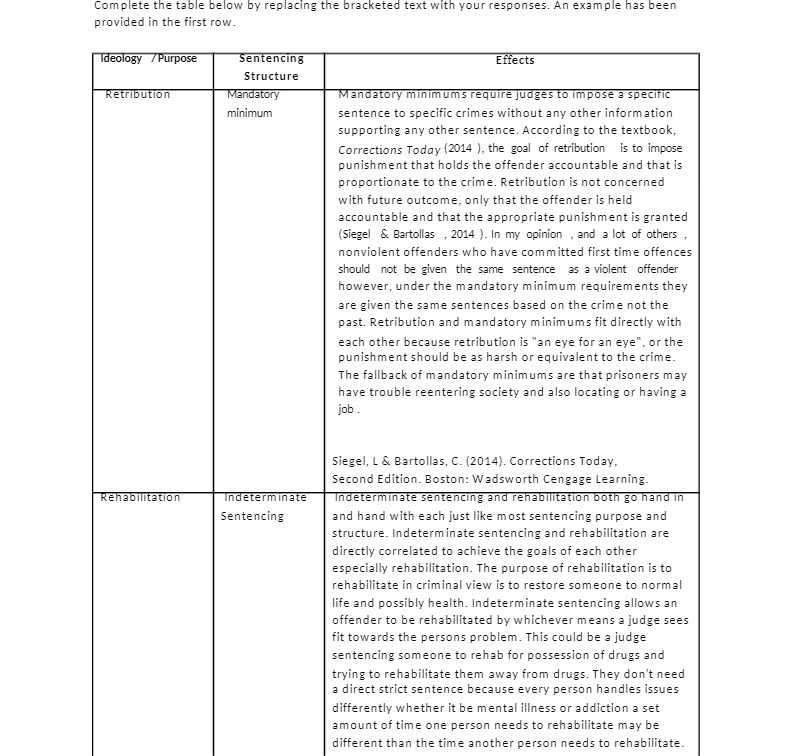
Complete the table below by replacing the bracketed text with your responses. An example has been provided in the first row. Ideology / Purpose Sentencing Effects Structure Retribution Mandatory Mandatory minimums require judges to impose a specific minimum sentence to specific crimes without any other information supporting any other sentence. According to the textbook, Corrections Today (2014 ), the goal of retribution is to impose punishment that holds the offender accountable and that is proportionate to the crime. Retribution is not concerned with future outcome, only that the offender is held accountable and that the appropriate punishment is granted (Siegel & Bartollas , 2014 ). In my opinion , and a lot of others nonviolent offenders who have committed first time offences should not be given the same sentence as a violent offender however, under the mandatory minimum requirements they are given the same sentences based on the crime not the past. Retribution and mandatory minimums fit directly with each other because retribution is "an eye for an eye", or the punishment should be as harsh or equivalent to the crime. The fallback of mandatory minimums are that prisoners may have trouble reentering society and also locating or having a job Siegel, L & Bartollas, C. (2014). Corrections Today, Second Edition. Boston: Wadsworth Cengage Learning. Rehabilitation Indeterminate Indeterminate sentencing and rehabilitation both go hand in Sentencing and hand with each just like most sentencing purpose and structure. Indeterminate sentencing and rehabilitation are directly correlated to achieve the goals of each other especially rehabilitation. The purpose of rehabilitation is to rehabilitate in criminal view is to restore someone to normal life and possibly health. Indeterminate sentencing allows an offender to be rehabilitated by whichever means a judge sees fit towards the persons problem. This could be a judge sentencing someone to rehab for possession of drugs and trying to rehabilitate them away from drugs. They don't need a direct strict sentence because every person handles issues differently whether it be mental illness or addiction a set amount of time one person needs to rehabilitate may be different than the time another person needs to rehabilitate
Step by Step Solution
There are 3 Steps involved in it

Get step-by-step solutions from verified subject matter experts
 Study Help