







Question: Complete the #TODO portion of the Python program pattern _ nbrs . py , given below, for it to display the pattern shown below for
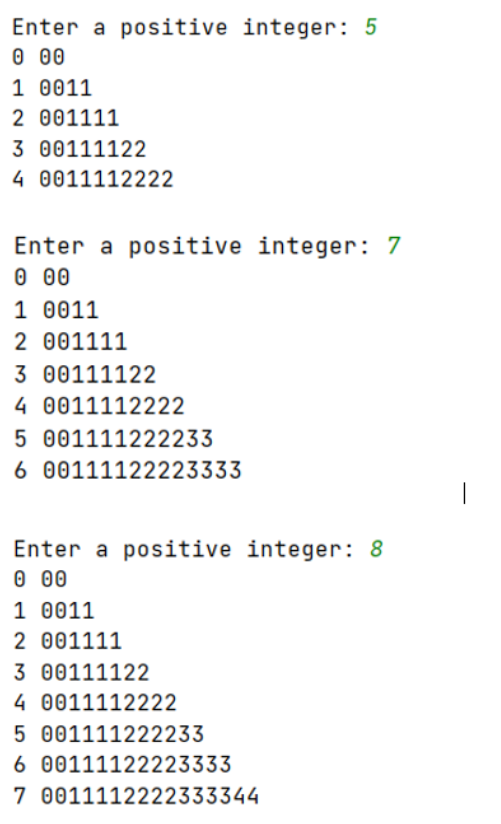
Complete the #TODO portion of the Python program patternnbrspy given below, for it to display the pattern shown below for n and respectively. The modification must be restricted to and only to the #TODO portion. No modifications shall be made to the provided code.The expected inputoutput behavior of the program is illustrated by the following examples:
Enter a positive integer:
Enter a positive integer:
Enter a positive integer:
The Python program is shown below:
#TODO
n intinputEnter a positive integer:
for i in rangen:
s
flag False
k
for j in rangei:
k fmapkflag
s s strk
#TODO
printis
Complete #TODO portions of the program without changing anything else in the program. I need you to fill out both #TODO portions since the last solution you gave me was incompleted.
The output of the program i should be getting and I enter a positive integer for example lets say should be:
After each iteration the numbers in the output have to increase by each time I enter a psotive integer. Since it starts off at digits and then with digits and goes up by each time. How do I implement this in my program for the output to look what I said above?
Step by Step Solution
There are 3 Steps involved in it
1 Expert Approved Answer
Step: 1 Unlock

Question Has Been Solved by an Expert!
Get step-by-step solutions from verified subject matter experts
Step: 2 Unlock
Step: 3 Unlock
 Study Help