



Question: Compound Interest and Regular Deposits 1-x 1. We open a Christmas savings account that earns 6 percent nominal annual interest and we deposit $100 on
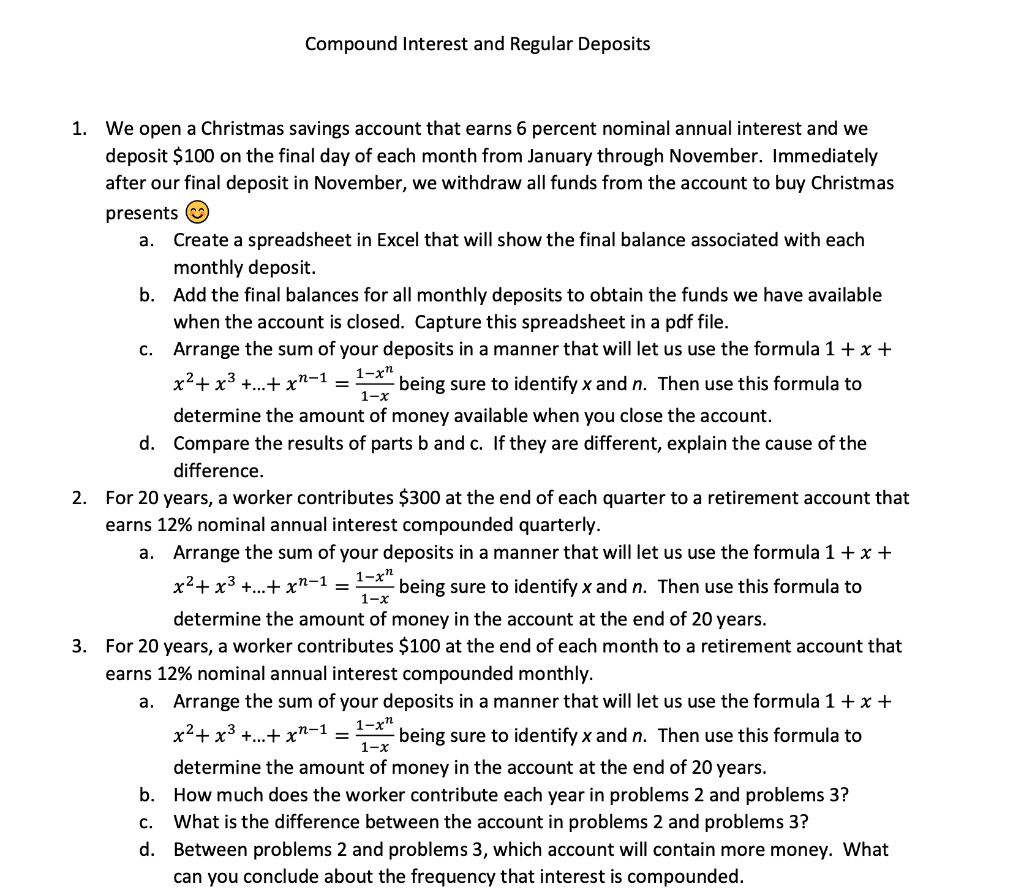
Compound Interest and Regular Deposits 1-x 1. We open a Christmas savings account that earns 6 percent nominal annual interest and we deposit $100 on the final day of each month from January through November. Immediately after our final deposit in November, we withdraw all funds from the account to buy Christmas presents a. Create a spreadsheet in Excel that will show the final balance associated with each monthly deposit. b. Add the final balances for all monthly deposits to obtain the funds we have available when the account is closed. Capture this spreadsheet in a pdf file. c. Arrange the sum of your deposits in a manner that will let us use the formula 1 + x + 1-xn x2 + x3 +...+xn-1 = being sure to identify x and n. Then use this formula to determine the amount of money available when you close the account. d. Compare the results of parts b and c. If they are different, explain the cause of the difference. 2. For 20 years, a worker contributes $300 at the end of each quarter to a retirement account that earns 12% nominal annual interest compounded quarterly. a. Arrange the sum of your deposits in a manner that will let us use the formula 1 + x + x2+x3 +...+ xn-1 = 1-3" being sure to identify x and n. Then use this formula to 1- determine the amount of money in the account at the end of 20 years. 3. For 20 years, a worker contributes $100 at the end of each month to a retirement account that earns 12% nominal annual interest compounded monthly. a. Arrange the sum of your deposits in a manner that will let us use the formula 1 + x + x2+x3 +...+ xn-1 = being sure to identify x and n. Then use this formula to 1-x determine the amount of money in the account at the end of 20 years. b. How much does the worker contribute each year in problems 2 and problems 3? What is the difference between the account in problems 2 and problems 3? d. Between problems 2 and problems 3, which account will contain more money. What can you conclude about the frequency that interest is compounded. 1-7 c. Compound Interest and Regular Deposits 1-x 1. We open a Christmas savings account that earns 6 percent nominal annual interest and we deposit $100 on the final day of each month from January through November. Immediately after our final deposit in November, we withdraw all funds from the account to buy Christmas presents a. Create a spreadsheet in Excel that will show the final balance associated with each monthly deposit. b. Add the final balances for all monthly deposits to obtain the funds we have available when the account is closed. Capture this spreadsheet in a pdf file. c. Arrange the sum of your deposits in a manner that will let us use the formula 1 + x + 1-xn x2 + x3 +...+xn-1 = being sure to identify x and n. Then use this formula to determine the amount of money available when you close the account. d. Compare the results of parts b and c. If they are different, explain the cause of the difference. 2. For 20 years, a worker contributes $300 at the end of each quarter to a retirement account that earns 12% nominal annual interest compounded quarterly. a. Arrange the sum of your deposits in a manner that will let us use the formula 1 + x + x2+x3 +...+ xn-1 = 1-3" being sure to identify x and n. Then use this formula to 1- determine the amount of money in the account at the end of 20 years. 3. For 20 years, a worker contributes $100 at the end of each month to a retirement account that earns 12% nominal annual interest compounded monthly. a. Arrange the sum of your deposits in a manner that will let us use the formula 1 + x + x2+x3 +...+ xn-1 = being sure to identify x and n. Then use this formula to 1-x determine the amount of money in the account at the end of 20 years. b. How much does the worker contribute each year in problems 2 and problems 3? What is the difference between the account in problems 2 and problems 3? d. Between problems 2 and problems 3, which account will contain more money. What can you conclude about the frequency that interest is compounded. 1-7 c
Step by Step Solution
There are 3 Steps involved in it

Get step-by-step solutions from verified subject matter experts