







Question: Computational physics. This is an assignment question designed to be done on Python 3.5. please help me figure out the codes needed to solve this
Computational physics. This is an assignment question designed to be done on Python 3.5. please help me figure out the codes needed to solve this question.
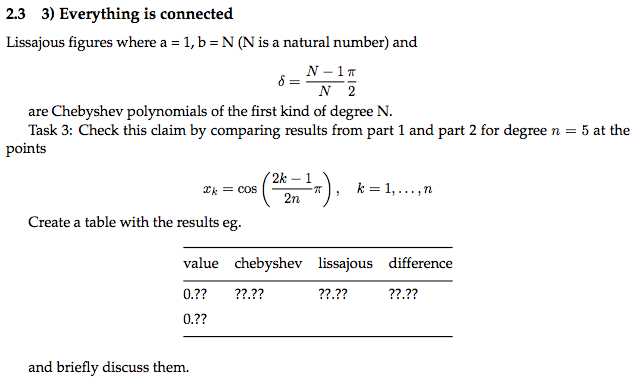
Here are the questions and codes from part 1 and 2.
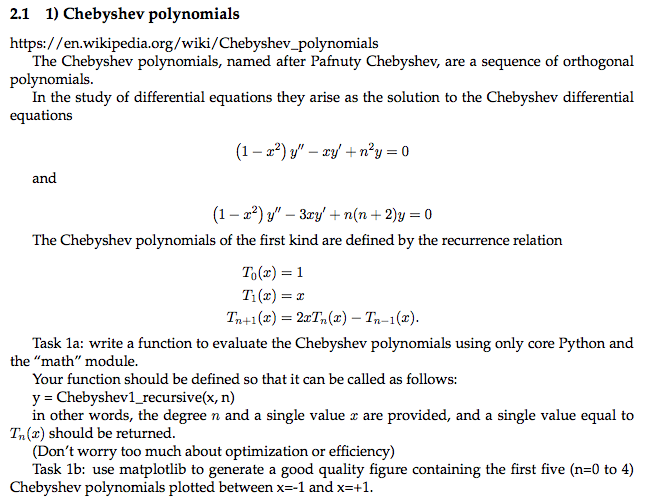
ANSWER:
def Chebyshev1_recursive(x,n): if n == 0: return 1 elif n == 1: return x else: return 2*x*(Chebyshev1_recursive(x, n-1))-Chebyshev1_recursive(x,(n-2))
import matplotlib.pyplot as plt %matplotlib inline xlist = [] for x in range(-100,102,2): xlist.append(x/100)
for n in range(0,5): ylist = [] for x in range(0,101): ylist.append(Chebyshev1_recursive(xlist[x],n))
plt.plot(xlist, ylist,'-')
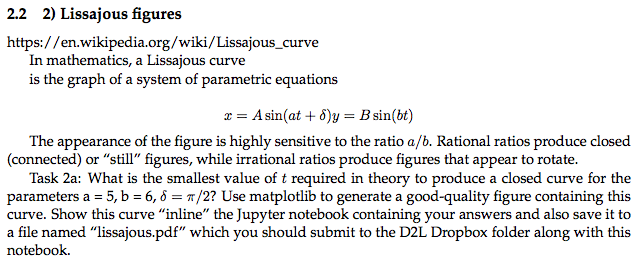
ANSWER:
from numpy import sin,pi,linspace from pylab import plot,show,subplot
a = [1,3,5,3] # plotting the curves for b = [1,5,7,4] # different values of a/b delta = pi/2 t = linspace(-pi,pi,300)
for i in range(0,4): x = sin(a[i] * t + delta) y = sin(b[i] * t) subplot(2,2,i+1) plot(x,y)
show()
2.3 3) Everything is connected Lissajous figures where a 1, b N (N is a natural number) and N 2 are Chebyshev polynomials of the first kind of degree N Task 3: Check this claim by comparing results from part 1 and part 2 for degree n 5 at the points 2k -1 2n 1,..., n cos Create a table with the results eg. value chebyshev lissajous difference 0.?? 0.?? and briefly discuss them. 2.3 3) Everything is connected Lissajous figures where a 1, b N (N is a natural number) and N 2 are Chebyshev polynomials of the first kind of degree N Task 3: Check this claim by comparing results from part 1 and part 2 for degree n 5 at the points 2k -1 2n 1,..., n cos Create a table with the results eg. value chebyshev lissajous difference 0.?? 0.?? and briefly discuss them
Step by Step Solution
There are 3 Steps involved in it

Get step-by-step solutions from verified subject matter experts
 Study Help