







Question: Compute the equivalent units of production using the weighted-average method. Compute the cost per equivalent unit using the weighted-average method. Assign costs to units using
- Compute the equivalent units of production using the weighted-average method.
- Compute the cost per equivalent unit using the weighted-average method.
- Assign costs to units using the weighted-average method.
- Prepare a cost reconciliation report.
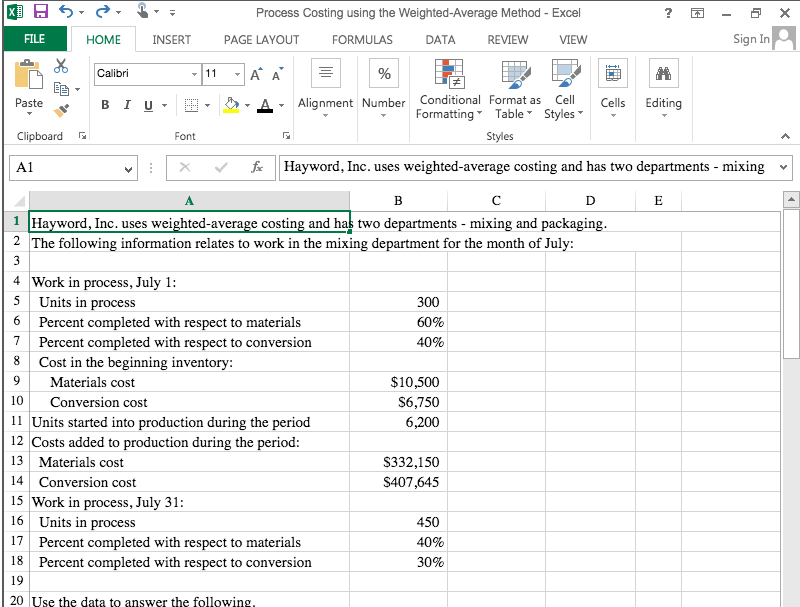
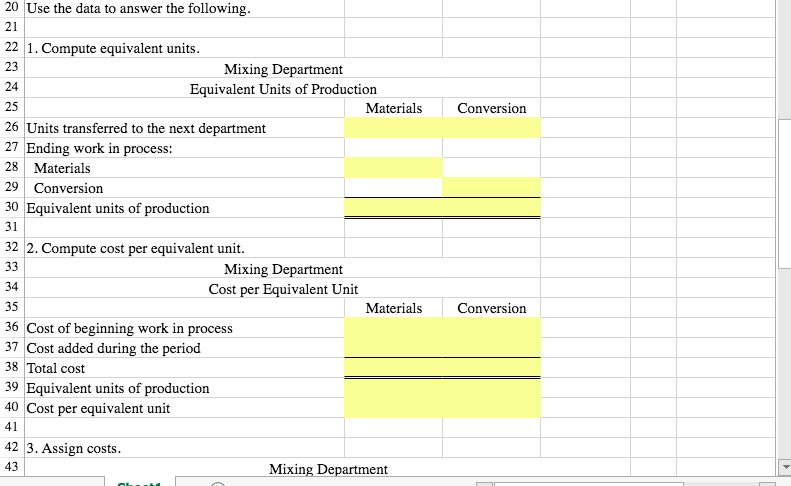
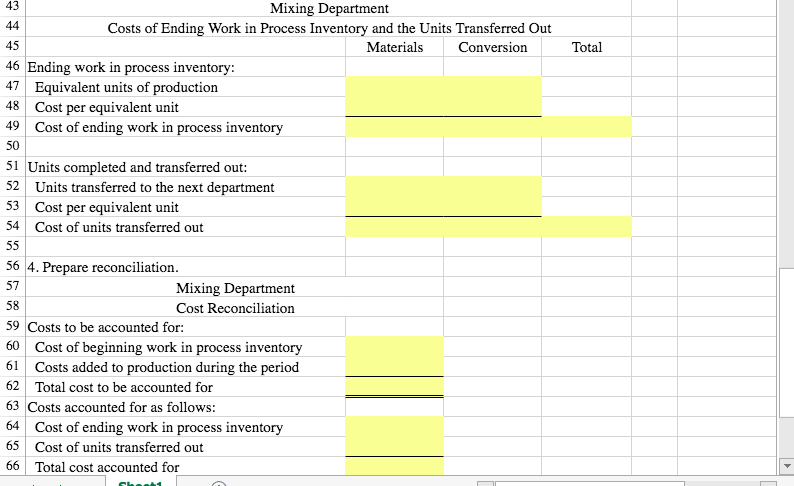
? X Process Costing using the Weighted-Average Method - Excel PAGE LAYOUT FORMULAS DATA REVIEW VIEW - Sign In FILE INSERT * HOME Calibri B I -11 MA = % D # Paste U. 10. - A Cells Editing Alignment Number Conditional Format as Cell Formatting Table Styles Styles Clipboard A1 x fax Hayword, Inc. uses weighted-average costing and has two departments - mixing B C D E 1 Hayword, Inc. uses weighted average costing and has two departments - mixing and packaging. 2 The following information relates to work in the mixing department for the month of July: 300 60% 40% 4 Work in process, July 1: 5 Units in process 6 Percent completed with respect to materials 7 Percent completed with respect to conversion 8 Cost in the beginning inventory: 9 Materials cost 10 Conversion cost | 11 Units started into production during the period | 12 Costs added to production during the period: 13 Materials cost 14 Conversion cost 15 Work in process, July 31: 16 Units in process 17 Percent completed with respect to materials 18 Percent completed with respect to conversion $10,500 S6,750 6,200 $332,150 $407,645 450 40% 30% 19 | 20 Use the data to answer the following. 20 Use the data to answer the following. 25 Conversion 22 1. Compute equivalent units. Mixing Department Equivalent Units of Production Materials 26 Units transferred to the next department 27 Ending work in process: 28 Materials 29 Conversion 30 Equivalent units of production Conversion 2. Compute cost per equivalent unit. Mixing Department Cost per Equivalent Unit Materials 36 Cost of beginning work in process 37 Cost added during the period 38 Total cost 39 Equivalent units of production 40 Cost per equivalent unit 41 42 3. Assign costs. 43 Mixing Department Total Mixing Department Costs of Ending Work in Process Inventory and the Units Transferred Out Materials Conversion 46 Ending work in process inventory: 47 Equivalent units of production 48 Cost per equivalent unit 49 Cost of ending work in process inventory 50 51 Units completed and transferred out: 52 Units transferred to the next department 53 Cost per equivalent unit 54 Cost of units transferred out 55 56 4. Prepare reconciliation. 57 Mixing Department 58 Cost Reconciliation 59 Costs to be accounted for: 60 Cost of beginning work in process inventory 61 Costs added to production during the period 62 Total cost to be accounted for 63 Costs accounted for as follows: 64 Cost of ending work in process inventory 65 Cost of units transferred out 66 Total cost accounted for
Step by Step Solution
There are 3 Steps involved in it

Get step-by-step solutions from verified subject matter experts
 Study Help