



Question: Compute the predetermined overhead rate for the year. Break the rate down into variable and fixed elements. begin{tabular}{|l|l|l|} hline Predetermined overhead rate & & per
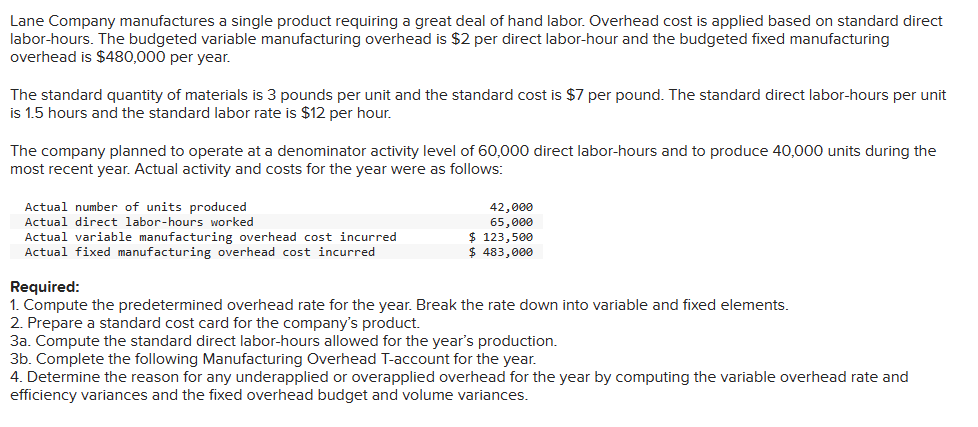

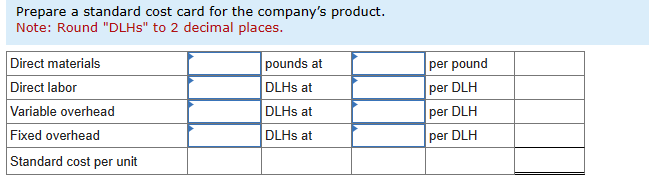

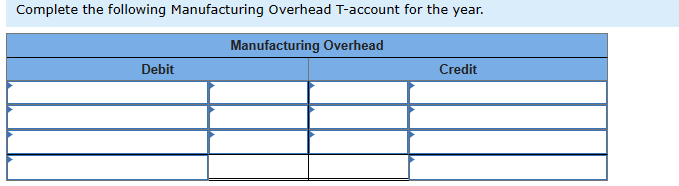
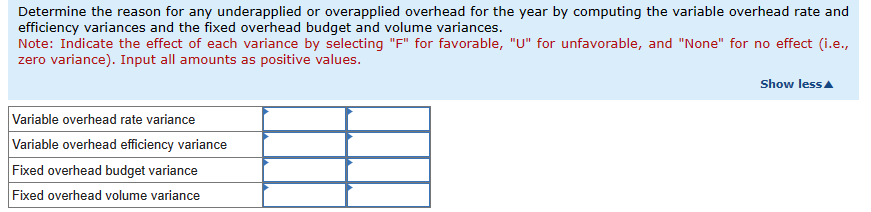
Compute the predetermined overhead rate for the year. Break the rate down into variable and fixed elements. \begin{tabular}{|l|l|l|} \hline Predetermined overhead rate & & per DLH \\ \hline Variable rate & & per DLH \\ \hline Fixed rate & & per DLH \\ \hline \end{tabular} Complete the following Manufacturing Overhead T-account for the year. Prepare a standard cost card for the company's product. Note: Round "DLHs" to 2 decimal places. Lane Company manufactures a single product requiring a great deal of hand labor. Overhead cost is applied based on standard direct labor-hours. The budgeted variable manufacturing overhead is $2 per direct labor-hour and the budgeted fixed manufacturing overhead is $480,000 per year. The standard quantity of materials is 3 pounds per unit and the standard cost is $7 per pound. The standard direct labor-hours per unit is 1.5 hours and the standard labor rate is $12 per hour. The company planned to operate at a denominator activity level of 60,000 direct labor-hours and to produce 40,000 units during the most recent year. Actual activity and costs for the year were as follows: Required: 1. Compute the predetermined overhead rate for the year. Break the rate down into variable and fixed elements. 2. Prepare a standard cost card for the company's product. 3a. Compute the standard direct labor-hours allowed for the year's production. 3b. Complete the following Manufacturing Overhead T-account for the year. 4. Determine the reason for any underapplied or overapplied overhead for the year by computing the variable overhead rate and efficiency variances and the fixed overhead budget and volume variances. Compute the standard direct labor-hours allowed for the year's production. Determine the reason for any underapplied or overapplied overhead for the year by computing the variable overhead rate and efficiency variances and the fixed overhead budget and volume variances. Note: Indicate the effect of each variance by selecting "F" for favorable, "U" for unfavorable, and "None" for no effect (i.e., zero variance). Input all amounts as positive values
Step by Step Solution
There are 3 Steps involved in it

Get step-by-step solutions from verified subject matter experts