







Question: Compute the underapplied or overapplied overhead for the year (a) assuming that a plantwide overhead rate is used, and (b) assuming that departmental overhead rates
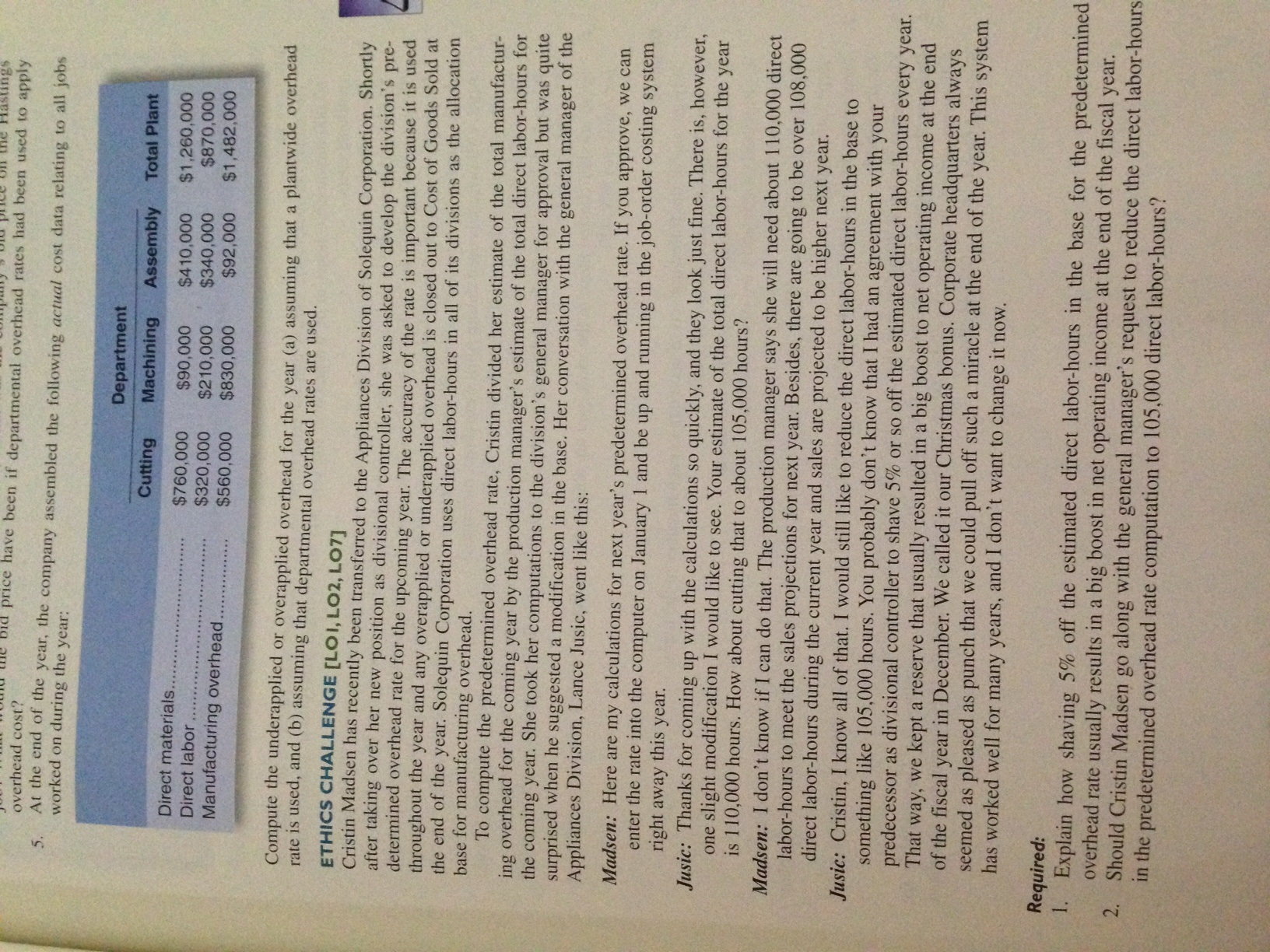
Compute the underapplied or overapplied overhead for the year (a) assuming that a plantwide overhead rate is used, and (b) assuming that departmental overhead rates are used. Cristin Madsen has lecently been transferred to the Appliances Division of Solequin Corporation. Shortly after taking ovei her new position as divisional controller, she was asked to develop the division's predetermined overhead rate for the upcoming year. The accuracy of the rate is important because it is used throughout the year and any overapplied or underapplied overhead is closed out to Cost of Goods Sold at the end of the year. Solequin Corporation uses direct labor-hours in all of its divisions as the allocation base for manufacturing overhead. To compute the predetermined overhead rate, Cristin divided her estimate of the total manufacturing overhead for the coming year by the production manager's estimate of the total direct labor-hours for the coming year. She took her computations to the division's general manager for approval but was quite surprised when he suggested a modification in the base. Her conversation with the general manager of the Appliances Division, Lance Jusic. went like this: Madsen: Here are my calculations for next year's predetermined overhead rate. If you approve, we can enter the rate into the computer on January 1 and be up and running in the job-order costing system right away this year. Jusic: Thanks for coming up with the calculations so quickly, and they look just line. There is, however, one slight modification I w'ould like to see. Your estimate of the total direct labor-hours for the year is 110,000 hours. How about cutting that to about 105,000 hours? Madsen: 1 don't know if I can do that. The production manager says she will need about 110,000 direct labor-hours to meet the sales projections for next year. Besides, there are going to be over 108,000 direct labor-hours during the current year and sales are projected to be higher next year. Jusic: Cristin, 1 know all of that. 1 would still like to reduce the direct labor-hours in the base to something like 105.000 hours. You probably don't know that 1 had an agreement with your predecessor as divisional controller to shave 5% or so off the estimated direct labor-hours every year. That way, we kept a reserve that usually resulted in a big boost to net operating income at the end of the fiscal year in December. We called it our Christmas bonus. Corporate headquarters alw'ays seemed as pleased as punch that we could pull off such a miracle at the end of the year. This system has worked well for many years, and I don't want to change it now. 1. Explain how shaving 5% off the estimated direct labor-hours in the base for the predetermined overhead rate usually results in a big boost in net operating income at the end of the fiscal year. Should Cristin Madsen go along with the general manager's request to reduce the direct labor-hours in the predetermined overhead rate computation to 105.000 direct labor-hours? Compute the underapplied or overapplied overhead for the year (a) assuming that a plantwide overhead rate is used, and (b) assuming that departmental overhead rates are used. Cristin Madsen has lecently been transferred to the Appliances Division of Solequin Corporation. Shortly after taking ovei her new position as divisional controller, she was asked to develop the division's predetermined overhead rate for the upcoming year. The accuracy of the rate is important because it is used throughout the year and any overapplied or underapplied overhead is closed out to Cost of Goods Sold at the end of the year. Solequin Corporation uses direct labor-hours in all of its divisions as the allocation base for manufacturing overhead. To compute the predetermined overhead rate, Cristin divided her estimate of the total manufacturing overhead for the coming year by the production manager's estimate of the total direct labor-hours for the coming year. She took her computations to the division's general manager for approval but was quite surprised when he suggested a modification in the base. Her conversation with the general manager of the Appliances Division, Lance Jusic. went like this: Madsen: Here are my calculations for next year's predetermined overhead rate. If you approve, we can enter the rate into the computer on January 1 and be up and running in the job-order costing system right away this year. Jusic: Thanks for coming up with the calculations so quickly, and they look just line. There is, however, one slight modification I w'ould like to see. Your estimate of the total direct labor-hours for the year is 110,000 hours. How about cutting that to about 105,000 hours? Madsen: 1 don't know if I can do that. The production manager says she will need about 110,000 direct labor-hours to meet the sales projections for next year. Besides, there are going to be over 108,000 direct labor-hours during the current year and sales are projected to be higher next year. Jusic: Cristin, 1 know all of that. 1 would still like to reduce the direct labor-hours in the base to something like 105.000 hours. You probably don't know that 1 had an agreement with your predecessor as divisional controller to shave 5% or so off the estimated direct labor-hours every year. That way, we kept a reserve that usually resulted in a big boost to net operating income at the end of the fiscal year in December. We called it our Christmas bonus. Corporate headquarters alw'ays seemed as pleased as punch that we could pull off such a miracle at the end of the year. This system has worked well for many years, and I don't want to change it now. 1. Explain how shaving 5% off the estimated direct labor-hours in the base for the predetermined overhead rate usually results in a big boost in net operating income at the end of the fiscal year. Should Cristin Madsen go along with the general manager's request to reduce the direct labor-hours in the predetermined overhead rate computation to 105.000 direct labor-hours
Step by Step Solution
There are 3 Steps involved in it

Get step-by-step solutions from verified subject matter experts
 Study Help