







Question: Compute this in Matlab format please. Infinite Series Trigonometric functions are usually calculated on computers using truncated infinite series. An infinite series is an infinite
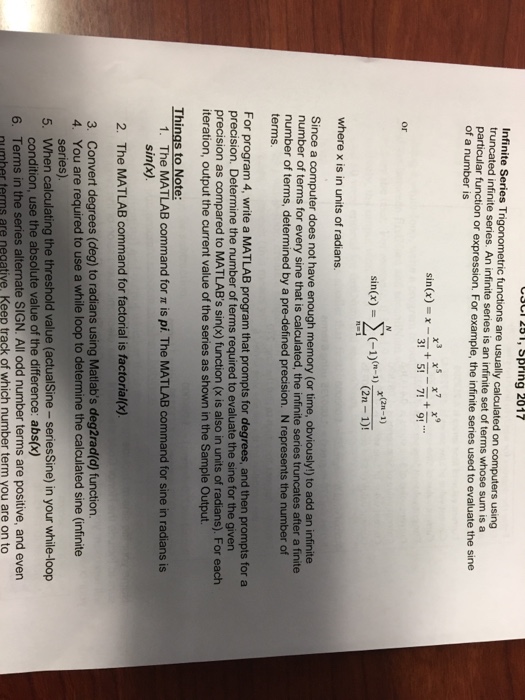
Infinite Series Trigonometric functions are usually calculated on computers using truncated infinite series. An infinite series is an infinite set of terms whose is particular function or expression. For example, the infinite series used evaluate the sine of a number is sin(x) = x - x^3/3! + x^5/5! - x^7/7! + x^9/9! ... or sin(x) = sigma^N _n=1 (-1)^(n-1) x^(2n-1)/(2n - 1)! where x is in units of radians. Since a computer does not have enough memory (or time, obviously!) to add an infinite number of terms for every sine that is calculated, the infinite series truncates after a finite number of terms, determined by a pre-defined precision. N represents the number of terms. For program 4, write a MATLAB program that prompts for degrees, and then prompts for a precision. Determine the number of terms required to evaluate the sine for the given precision as compared to MATLAB's sin(x) function (x is also in units of radians). For each iteration, output the current value of the series as shown in the Sample Output. 1. The MATLAB command for is pi. The MATLAB command for sine in radians is sin(x). The MATLAB command for factorial is factorial(x). Convert degrees (deg) to radians using Matlab's deg2rad(d) function. You are required to use a while loop to determine the calculated sine (infinite series) When calculating the threshold value (actualSine - series Sine) in your while-loop condition, use the absolute value of the difference: abs(x) Terms in the series alternate SIGN. All odd number terms are positive, and even number terms are negative, Keep track of which number term you are on to
Step by Step Solution
There are 3 Steps involved in it

Get step-by-step solutions from verified subject matter experts
 Study Help