







Question: Computer Architecture Problem 1 (20 points) The new VIVE Pro Virtual Reality stereo display uses 3 primary colors for each pixel. Assume a 24 bit
Computer Architecture
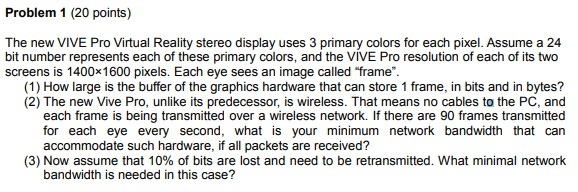
Problem 1 (20 points) The new VIVE Pro Virtual Reality stereo display uses 3 primary colors for each pixel. Assume a 24 bit number represents each of these primary colors, and the VIVE Pro resolution of each of its two screens is 1400x1600 pixels. Each eye sees an image called "frame" (1) How large is the buffer of the graphics hardware that can store 1 frame, in bits and in bytes? (2) The new Vive Pro, unlike its predecessor, is wireless. That means no cables to the PC, and each frame is being transmitted over a wireless network. If there are 90 frames transmitted for each eye every second, what is your minimum network bandwidth that can accommodate such hardware, if all packets are received? (3) Now assume that 10% of bits are lost and need to be retransmitted. What minimal network bandwidth is needed in this case? Problem 1 (20 points) The new VIVE Pro Virtual Reality stereo display uses 3 primary colors for each pixel. Assume a 24 bit number represents each of these primary colors, and the VIVE Pro resolution of each of its two screens is 1400x1600 pixels. Each eye sees an image called "frame" (1) How large is the buffer of the graphics hardware that can store 1 frame, in bits and in bytes? (2) The new Vive Pro, unlike its predecessor, is wireless. That means no cables to the PC, and each frame is being transmitted over a wireless network. If there are 90 frames transmitted for each eye every second, what is your minimum network bandwidth that can accommodate such hardware, if all packets are received? (3) Now assume that 10% of bits are lost and need to be retransmitted. What minimal network bandwidth is needed in this case
Step by Step Solution
There are 3 Steps involved in it

Get step-by-step solutions from verified subject matter experts
 Study Help