







Question: Computer networks I want normal solution not a code thank you Consider two network entities, A and B, which are connected by a perfect bi-directional
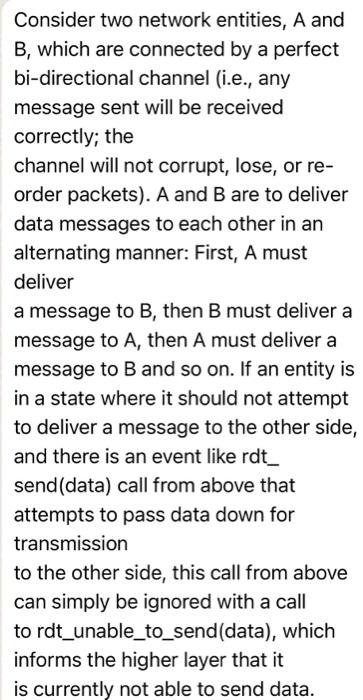
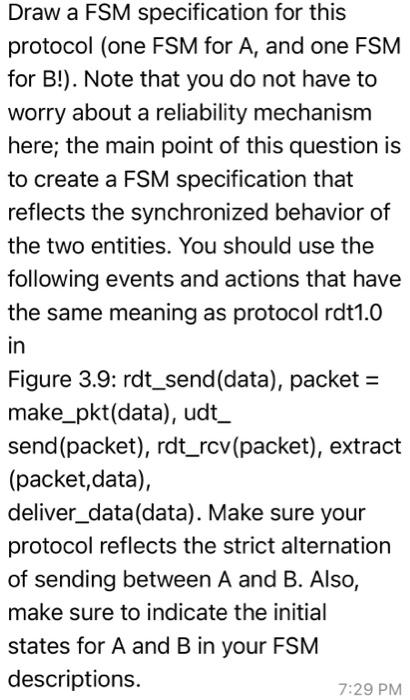
Consider two network entities, A and B, which are connected by a perfect bi-directional channel (i.e., any message sent will be received correctly; the channel will not corrupt, lose, or reorder packets). A and B are to deliver data messages to each other in an alternating manner: First, A must deliver a message to B, then B must deliver a message to A, then A must deliver a message to B and so on. If an entity is in a state where it should not attempt to deliver a message to the other side, and there is an event like rdt send(data) call from above that attempts to pass data down for transmission to the other side, this call from above can simply be ignored with a call to rdt_unable_to_send(data), which informs the higher layer that it is currently not able to send data. Draw a FSM specification for this protocol (one FSM for A, and one FSM for B!). Note that you do not have to worry about a reliability mechanism here; the main point of this question is to create a FSM specification that reflects the synchronized behavior of the two entities. You should use the following events and actions that have the same meaning as protocol rdt1.0 in Figure 3.9: rdt_send(data), packet = make_pkt(data), udt_ send(packet), rdt_rcv(packet), extract (packet,data), deliver_data(data). Make sure your protocol reflects the strict alternation of sending between A and B. Also, make sure to indicate the initial states for A and B in your FSM descriptions
Step by Step Solution
There are 3 Steps involved in it

Get step-by-step solutions from verified subject matter experts
 Study Help