







Question: Computer Networks Match the property or statement in the left oclumn with the most appropriate HTTP property or option in the right column. A An
Computer Networks
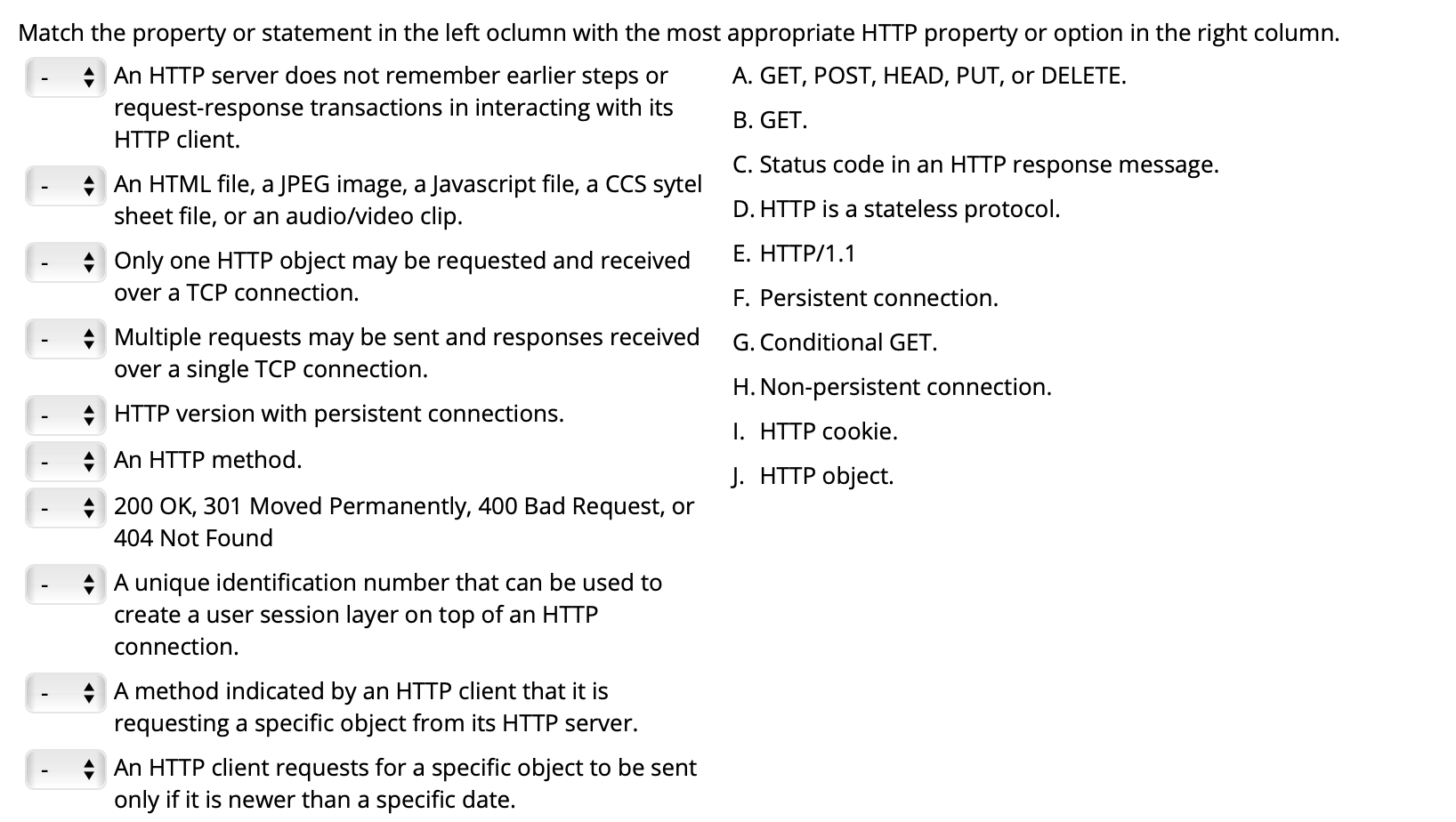
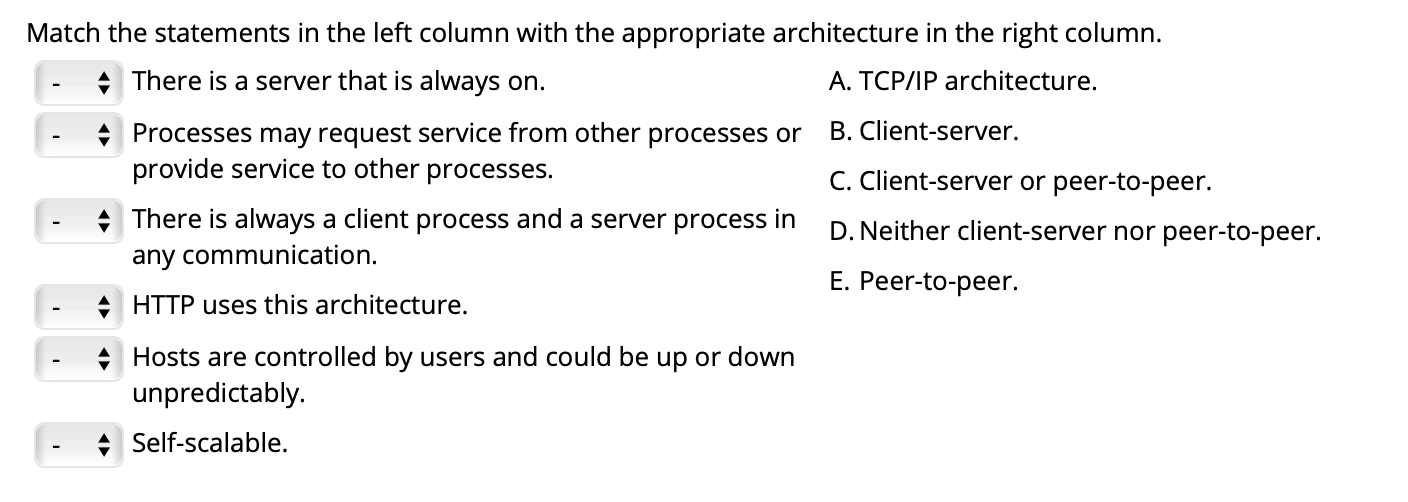
Match the property or statement in the left oclumn with the most appropriate HTTP property or option in the right column. A An HTTP server does not remember earlier steps or A. GET, POST, HEAD, PUT, or DELETE. request-response transactions in interacting with its B. GET. HTTP client. C. Status code in an HTTP response message. An HTML file, a JPEG image, a Javascript file, a CCS sytel sheet file, or an audio/video clip. D. HTTP is a stateless protocol. Only one HTTP object may be requested and received E. HTTP/1.1 over a TCP connection. F. Persistent connection. A Multiple requests may be sent and responses received G. Conditional GET. over a single TCP connection. H. Non-persistent connection. HTTP version with persistent connections. 1. HTTP cookie. An HTTP method. J. HTTP object. 200 OK, 301 Moved Permanently, 400 Bad Request, or 404 Not Found A unique identification number that can be used to create a user session layer on top of an HTTP connection. A A method indicated by an HTTP client that it is requesting a specific object from its HTTP server. 4 An HTTP client requests for a specific object to be sent only if it is newer than a specific date. Match the statements in the left column with the appropriate architecture in the right column. There is a server that is always on. A. TCP/IP architecture. Processes may request service from other processes or B. Client-server. provide service to other processes. C. Client-server or peer-to-peer. There is always a client process and a server process in D. Neither client-server nor peer-to-peer. any communication. E. Peer-to-peer. HTTP uses this architecture. Hosts are controlled by users and could be up or down unpredictably. Self-scalable
Step by Step Solution
There are 3 Steps involved in it

Get step-by-step solutions from verified subject matter experts
 Study Help