







Question: Computer practical 1 : intro to Fourier transforms 1 . 5 We are now going to apply our functions on a more elaborate signal, to
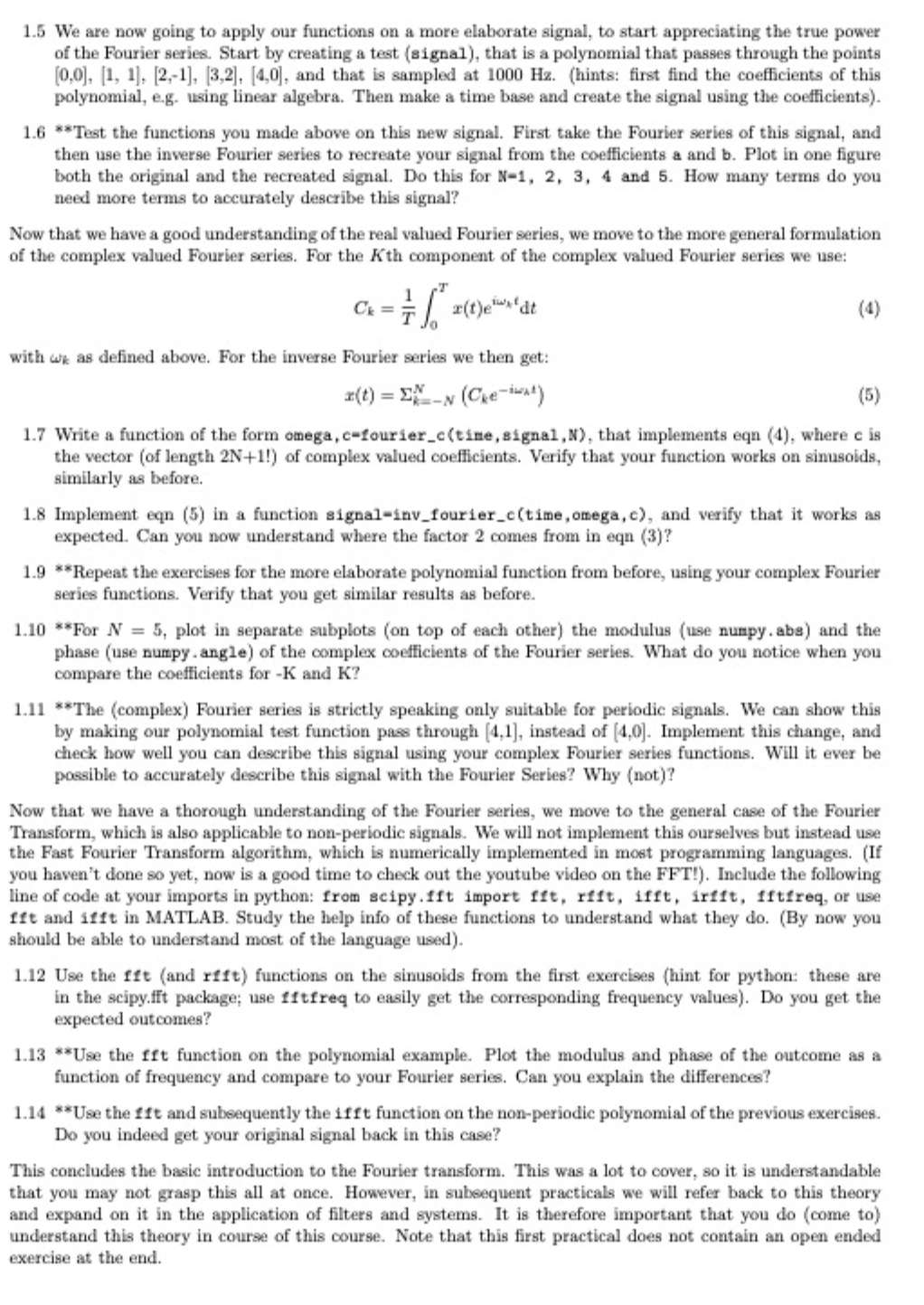
Computer practical : intro to Fourier transforms We are now going to apply our functions on a more elaborate signal, to start appreciating the true power
of the Fourier series. Start by creating a test signal that is a polynomial that passes through the points
and that is sampled at hints: first find the coefficients of this
polynomial, eg using linear algebra. Then make a time base and create the signal using the coefficients
Test the functions you made above on this new signal. First take the Fourier series of this signal, and
then use the inverse Fourier series to recreate your signal from the coefficients a and b Plot in one figure
both the original and the recreated signal. Do this for and How many terms do you
need more terms to accurately describe this signal?
Now that we have a good understanding of the real valued Fourier series, we move to the more general formulation
of the complex valued Fourier series. For the th component of the complex valued Fourier series we use:
with as defined above. For the inverse Fourier series we then get:
Write a function of the form omega,courierctimesignal, that implements eqn where is
the vector of length of complex valued coefficients. Verify that your function works on sinusoids
similarly as before.
Implement eqn in a function signalinvfourierctimeomega,c and verify that it works as
expected. Can you now understand where the factor comes from in eqn
Repeat the exercises for the more elaborate polynomial function from before, using your complex Fourier
series functions. Verify that you get similar results as before.
For plot in separate subplots on top of each other the modulus use numpy. abs and the
phase use numpy angle of the complex coefficients of the Fourier series. What do you notice when you
compare the coefficients for and
The complex Fou
This assignment is intended to refresh your programming and basic math skills and to become acquainted
with Fourier transforms. We start with making some periodic test data, and applying the discrete Fourier series
to this. Then we'll compare our results to that of a Python or MATLAB implementation of the Fast Fourier
Transform, and explore some numerical properties thereof. We'll use the following real valued formulation of
the forward Fourier series only applicable to real valued signals:
With and is the period time of the signal. This gives the following formulation for the inverse
Fourier series:
where is the number of terms in the Fourier series can go up to infinity in the general case
Write a function to calculate the Fourier series for a real valued signal, based on the formulation in equa
tions and the call to your function should look like this: omega a bfourierabtimesignal,n
where signaltime describes the signal of which you take the Fourier series, and a and b are vectors of
length which are defined by the integrals in eqns and
Test your function by applying it separately to a sine and a cosine function of with amplitude
First create the test signal over a time interval of sampled at How many terms in
the Fourier series do you need to describe this signal? Do you get the expected outcome? Increase the
amplitude and frequency of the test signal and see if you get the expected outcomes in terms of a and b
Write a function to calculate the inverse Fourier series for a real valued signal, based on the formulation
in eqn The call to your function should look like this: signalinvfourierabtime onega,ab
where the variables are defined similarly as above.
Again test your function by inputting known values eg the ones you created before
Step by Step Solution
There are 3 Steps involved in it
1 Expert Approved Answer
Step: 1 Unlock

Question Has Been Solved by an Expert!
Get step-by-step solutions from verified subject matter experts
Step: 2 Unlock
Step: 3 Unlock
 Study Help