





Question: COMPUTER SCIENCE - GRAPGH THEORY AND APPLICATION 3. Let n be a non-negative integer. Suppose that in a school, there are 3 classes, A, B

COMPUTER SCIENCE - GRAPGH THEORY AND APPLICATION
COMPUTER SCIENCE - GRAPGH THEORY AND APPLICATION
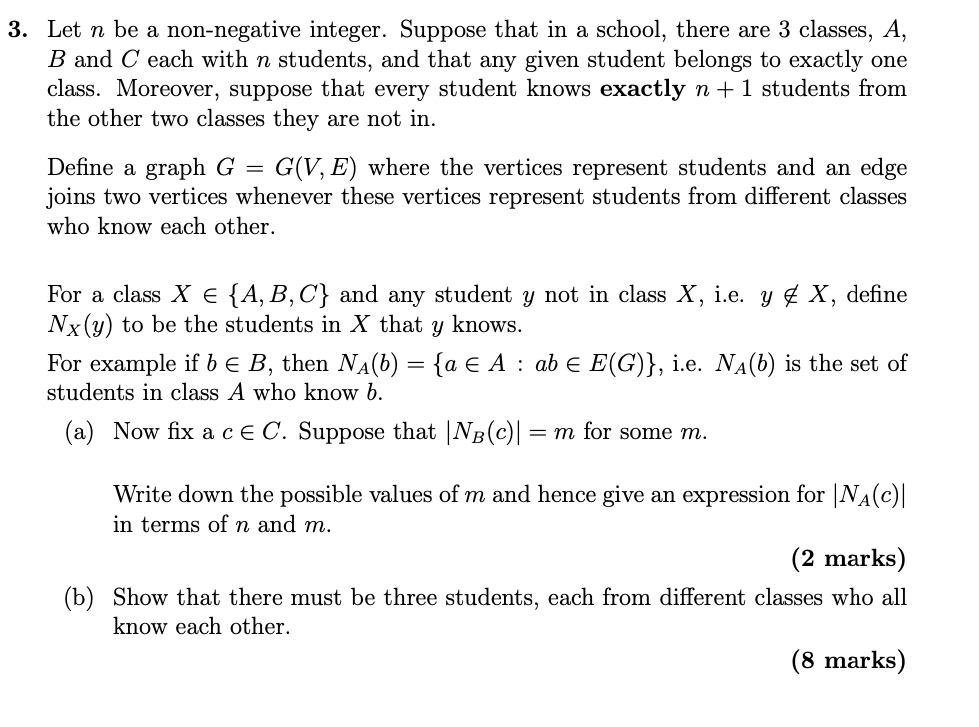
3. Let n be a non-negative integer. Suppose that in a school, there are 3 classes, A, B and 0 each with 'n, students, and that any given student belongs to exactly one class. Moreover, suppose that every student knows exactly 'n, + 1 students from the other two classes they are not in. Dene a graph G = C(V, E) where the vertices represent students and an edge joins two vertices whenever these vertices represent students from different classes who know each other. For a class X E {A,B, C} and any student 3; not in class X, i.e. y i X, dene N X (y) to be the students in X that y knows. For example if b E B, then NA(b) = {a E A : ab 6 E(G)}, i.e. NAG) is the set of students in class A who know 6. (a) Now x a c E 0. Suppose that |N3(c)| = m for some m. Write down the possible values of m and hence give an expression for |NA(c)| in terms of n, and m. (2 marks) (b) Show that there must be three students, each from different classes who all know each other. (8 marks)

Step by Step Solution

There are 3 Steps involved in it

1 Expert Approved Answer
Step: 1 Unlock blur-text-image

Question Has Been Solved by an Expert!

Get step-by-step solutions from verified subject matter experts

Step: 2 Unlock
Step: 3 Unlock

Students Have Also Explored These Related Mathematics Questions!