



Question: Computer science question urgent solve ASAP Consider the following Management - Trainee game. There are two types of trainees: Lazy type and Industrious type. Suppose
Computer science question urgent solve ASAP
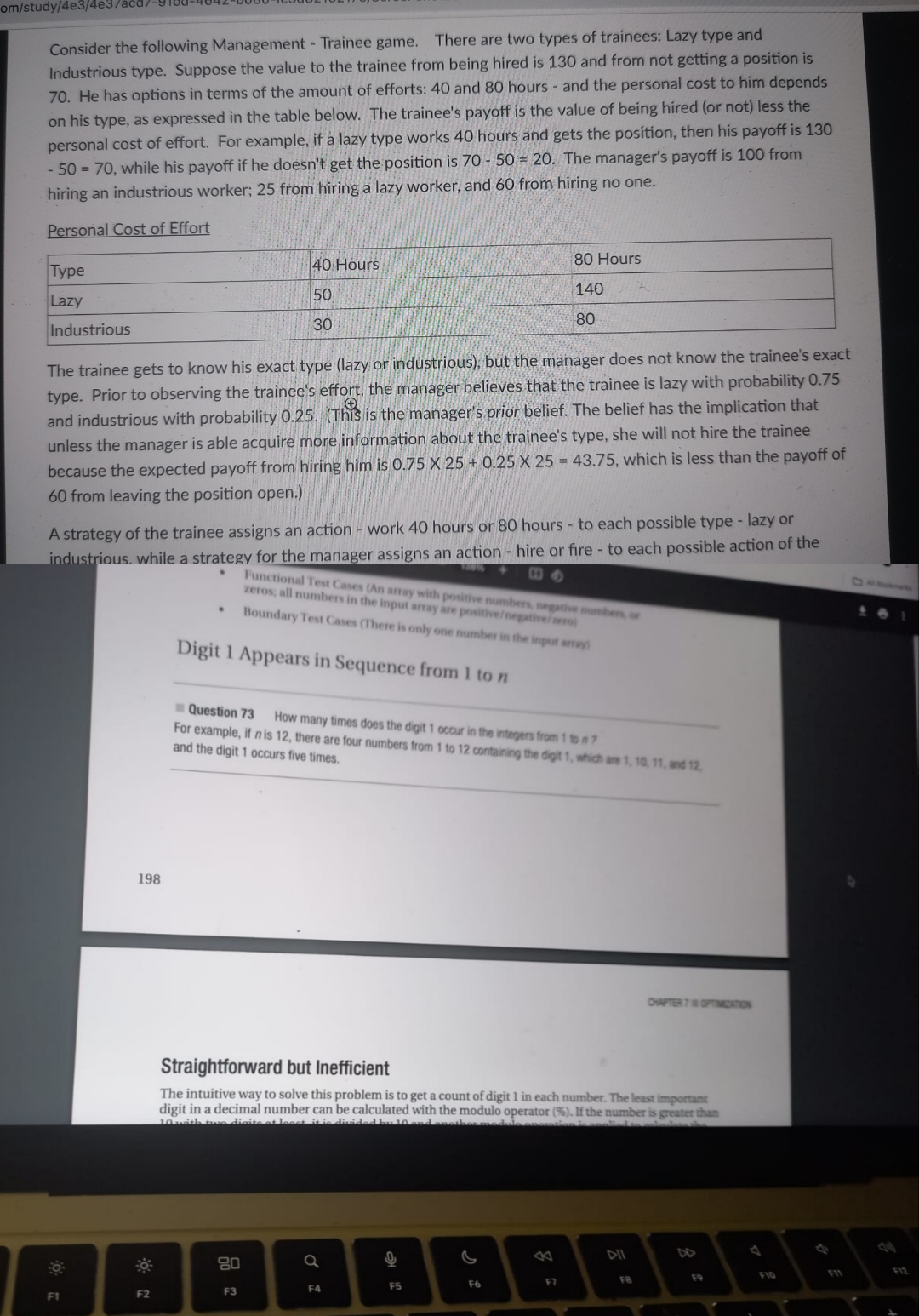
Consider the following Management Trainee game. There are two types of trainees: Lazy type and Industrious type. Suppose the value to the trainee from being hired is and from not getting a position is He has options in terms of the amount of efforts: and hours and the personal cost to him depends on his type, as expressed in the table below. The trainee's payoff is the value of being hired or not less the personal cost of effort. For example, if a lazy type works hours and gets the position, then his payoff is while his payoff if he doesn't get the position is The manager's payoff is from hiring an industrious worker; from hiring a lazy worker, and from hiring no one.
Personal Cost of Effort
tableType Hours, HoursLazyIndustrious
The trainee gets to know his exact type lazy or industrious but the manager does not know the trainee's exact type. Prior to observing the trainee's effort, the manager believes that the trainee is lazy with probability and industrious with probability This is the manager's prior belief. The belief has the implication that unless the manager is able acquire more information about the trainee's type, she will not hire the trainee because the expected payoff from hiring him is which is less than the payoff of from leaving the position open.
A strategy of the trainee assigns an action work hours or hours to each possible type lazy or industrious. while a strategy for the manager assigns an action hire or fire to each possible action of the zeros; all numbers in the input array are positivenequativement
Boundary Test Cases There is only one number in the inpurtarnat
Digit Appears in Sequence from to Question How many times does the digit occur in the integers from io
For example, if is there are four numbers from to containing the digit which ans wat and the digit occurs five times.
Oupret a ornceros
Straightforward but Inefficient
The intuitive way to solve this problem is to get a count of digit in each number. The least important digit in a decimal number can be calculated with the modulo operator $ If the number is greater than
Step by Step Solution
There are 3 Steps involved in it
1 Expert Approved Answer
Step: 1 Unlock

Question Has Been Solved by an Expert!
Get step-by-step solutions from verified subject matter experts
Step: 2 Unlock
Step: 3 Unlock