







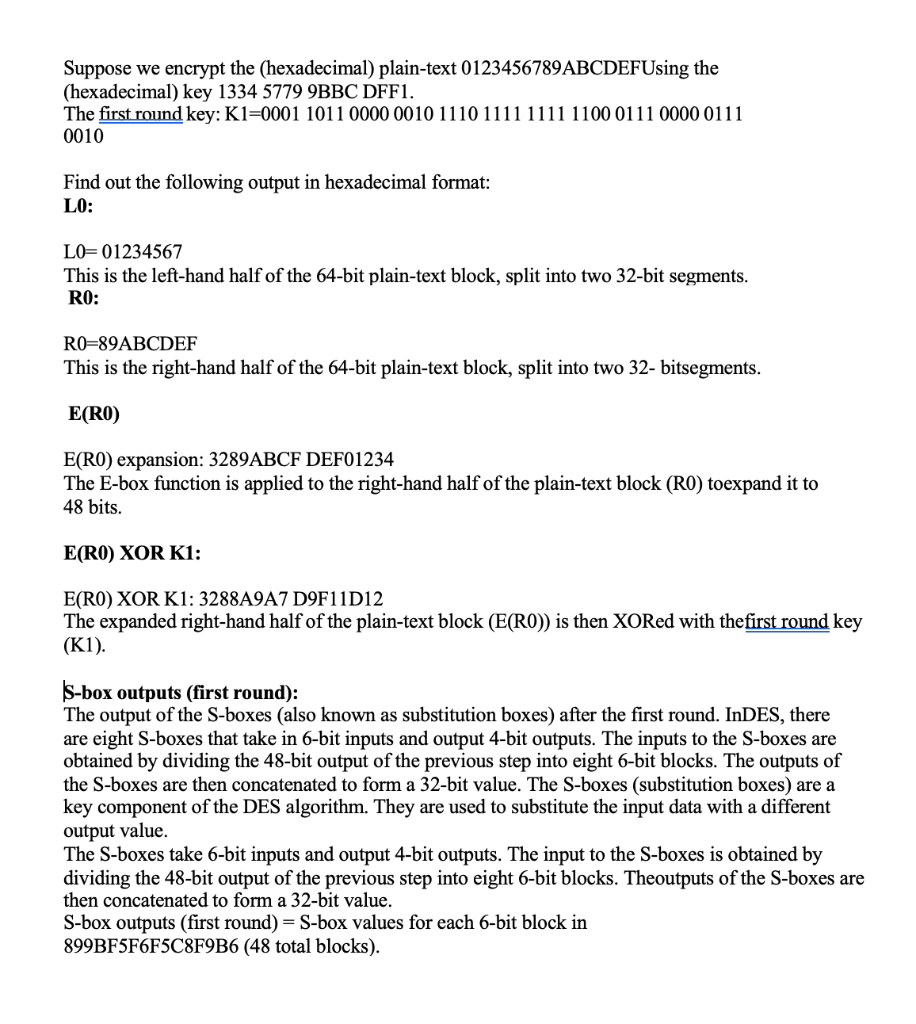
Question: computer Science... Suppose we encrypt the ( hexadecimal ) plain - text 0 1 2 3 4 5 6 7 8 9 ABCDEFUsing the (
computer Science...
Suppose we encrypt the hexadecimal plaintext ABCDEFUsing the hexadecimal key BBC DFF
The first round key: K
Find out the following output in hexadecimal format:
L:
This is the lefthand half of the bit plaintext block, split into two bit segments.
R:
ABCDEF
This is the righthand half of the bit plaintext block, split into two bitsegments.
expansion: ABCF DEF
The Ebox function is applied to the righthand half of the plaintext block R toexpand it to bits.
ER XOR K:
ER XOR K: AA DFD
The expanded righthand half of the plaintext block is then XORed with thefirst round key K
Sbox outputs first round:
The output of the Sboxes also known as substitution boxes after the first round. InDES, there are eight Sboxes that take in bit inputs and output bit outputs. The inputs to the Sboxes are obtained by dividing the bit output of the previous step into eight bit blocks. The outputs of the Sboxes are then concatenated to form a bit value. The Sboxes substitution boxes are a key component of the DES algorithm. They are used to substitute the input data with a different output value.
The Sboxes take bit inputs and output bit outputs. The input to the Sboxes is obtained by dividing the bit output of the previous step into eight bit blocks. Theoutputs of the Sboxes are then concatenated to form a bit value.
Sbox outputs first round Sbox values for each bit block in
BFFFCFB total blocks
Step by Step Solution
There are 3 Steps involved in it
1 Expert Approved Answer
Step: 1 Unlock

Question Has Been Solved by an Expert!
Get step-by-step solutions from verified subject matter experts
Step: 2 Unlock
Step: 3 Unlock
 Study Help