







Question: ( Computer Simulation Programming ) This question asks you to conduct a simulation experiment to examine the finite - sample distributions of t ratios using
Computer Simulation Programming
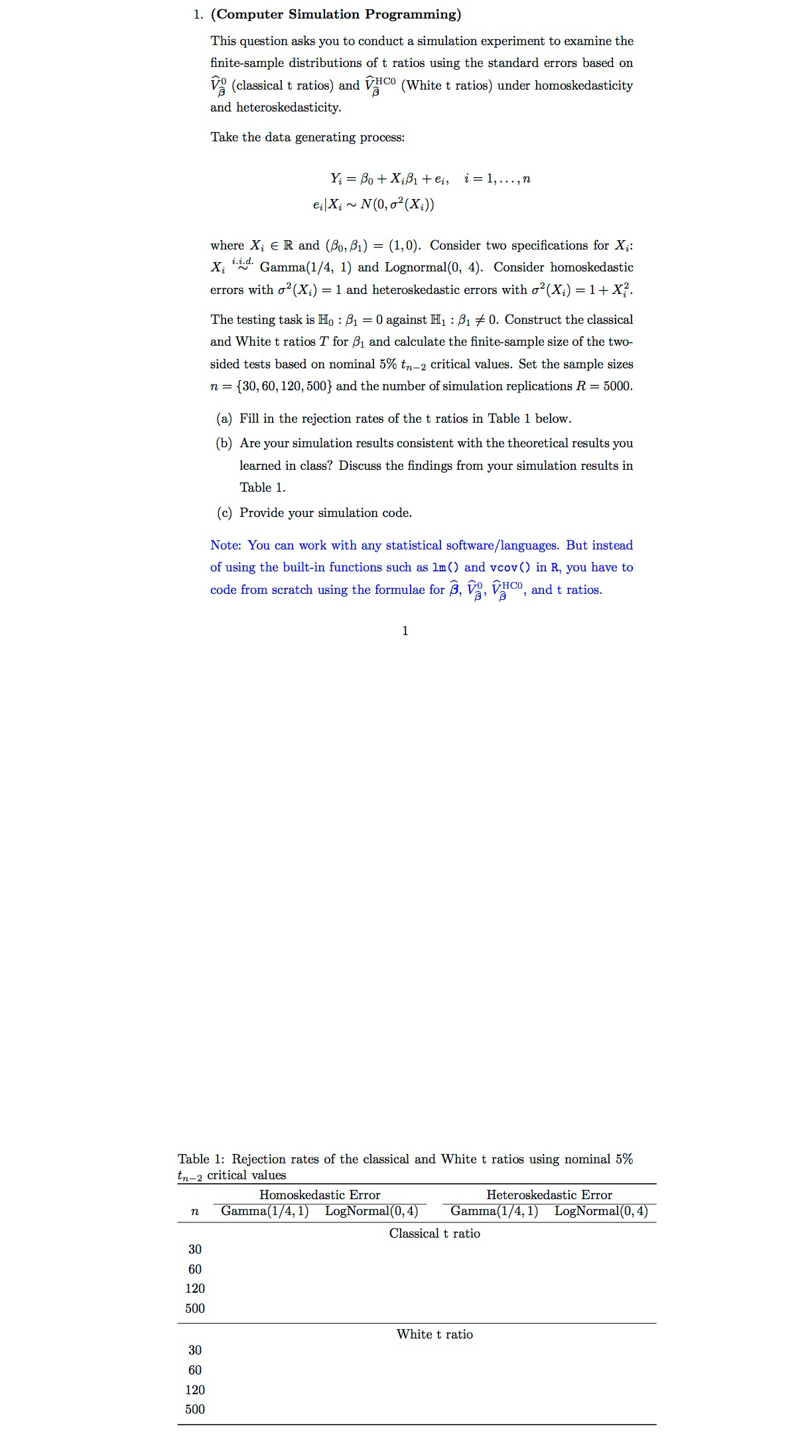
This question asks you to conduct a simulation experiment to examine the finitesample distributions of ratios using the standard errors based on widehatclassical t ratios and widehatWhite t ratios under homoskedasticity and heteroskedasticity.
Take the data generating process:
dots,
where inR and Consider two specifications for : and Lognormal Consider homoskedastic errors with and heteroskedastic errors with
The testing task is : against : Construct the classical and White ratios for and calculate the finitesample size of the twosided tests based on nominal critical values. Set the sample sizes and the number of simulation replications
a Fill in the rejection rates of the ratios in Table below.
b Are your simulation results consistent with the theoretical results you learned in class? Discuss the findings from your simulation results in Table
c Provide your simulation code.
Note: You can work with any statistical softwarelanguages But instead of using the builtin functions such as and vcov in you have to code from scratch using the formulae for widehatwidehatwidehat and t ratios.
Table : Rejection rates of the classical and White t ratios using nominal critical values
tableHomoskedastic Error,Heteroskedastic ErrorLogNormalLogNormal
Step by Step Solution
There are 3 Steps involved in it
1 Expert Approved Answer
Step: 1 Unlock

Question Has Been Solved by an Expert!
Get step-by-step solutions from verified subject matter experts
Step: 2 Unlock
Step: 3 Unlock
 Study Help