







Question: computer vision please explain all my doubts in detail, will rate, thanks Don't comment! please explain this equation in detail. why we use normalized cross-correlation
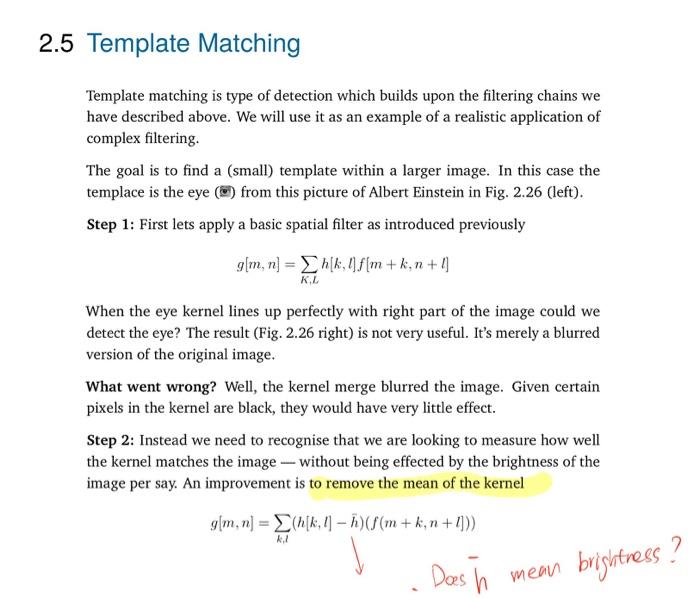
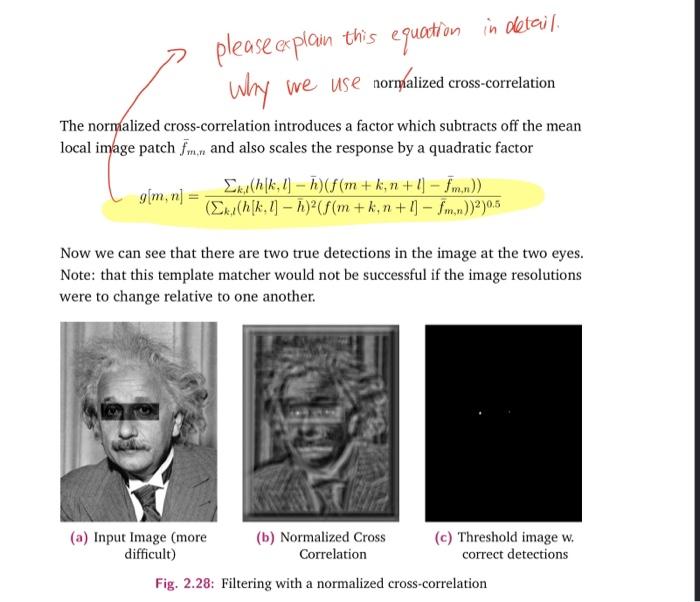
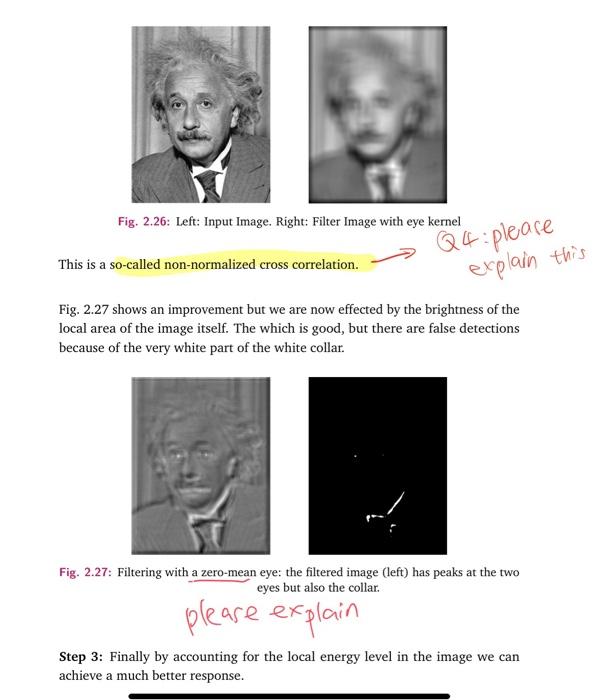
please explain this equation in detail. why we use normalized cross-correlation The normalized cross-correlation introduces a factor which subtracts off the mean local image patch fm. and also scales the response by a quadratic factor Ex. (h|k, 1) - h)f(m + k,n+ 11 - fm.n)) (Ex/(h[k.1] - A)?(f(m+k, n + 11 - fm,n))2)0.5 Now we can see that there are two true detections in the image at the two eyes. Note: that this template matcher would not be successful if the image resolutions were to change relative to one another. (a) Input Image (more (b) Normalized Cross (c) Threshold image w. difficult) Correlation correct detections Fig. 2.28: Filtering with a normalized cross-correlation Fig. 2.26: Left: Input Image. Right: Filter Image with eye kernel 24 pleare This is a so-called non-normalized cross correlation. explain this Fig. 2.27 shows an improvement but we are now effected by the brightness of the local area of the image itself. The which is good, but there are false detections because of the very white part of the white collar. Fig. 2.27: Filtering with a zero-mean eye: the filtered image (left) has peaks at the two eyes but also the collar. exo Step 3: Finally by accounting for the local energy level in the image we can achieve a much better response. please explain this equation in detail. why we use normalized cross-correlation The normalized cross-correlation introduces a factor which subtracts off the mean local image patch fm. and also scales the response by a quadratic factor Ex. (h|k, 1) - h)f(m + k,n+ 11 - fm.n)) (Ex/(h[k.1] - A)?(f(m+k, n + 11 - fm,n))2)0.5 Now we can see that there are two true detections in the image at the two eyes. Note: that this template matcher would not be successful if the image resolutions were to change relative to one another. (a) Input Image (more (b) Normalized Cross (c) Threshold image w. difficult) Correlation correct detections Fig. 2.28: Filtering with a normalized cross-correlation Fig. 2.26: Left: Input Image. Right: Filter Image with eye kernel 24 pleare This is a so-called non-normalized cross correlation. explain this Fig. 2.27 shows an improvement but we are now effected by the brightness of the local area of the image itself. The which is good, but there are false detections because of the very white part of the white collar. Fig. 2.27: Filtering with a zero-mean eye: the filtered image (left) has peaks at the two eyes but also the collar. exo Step 3: Finally by accounting for the local energy level in the image we can achieve a much better response
Step by Step Solution
There are 3 Steps involved in it

Get step-by-step solutions from verified subject matter experts
 Study Help