







Question: Computing Assignment Gaussian Elimination on a large random matrix Required submission: 1 page PDF document and Matlab code uploaded to Canvas. To complete this assignment,
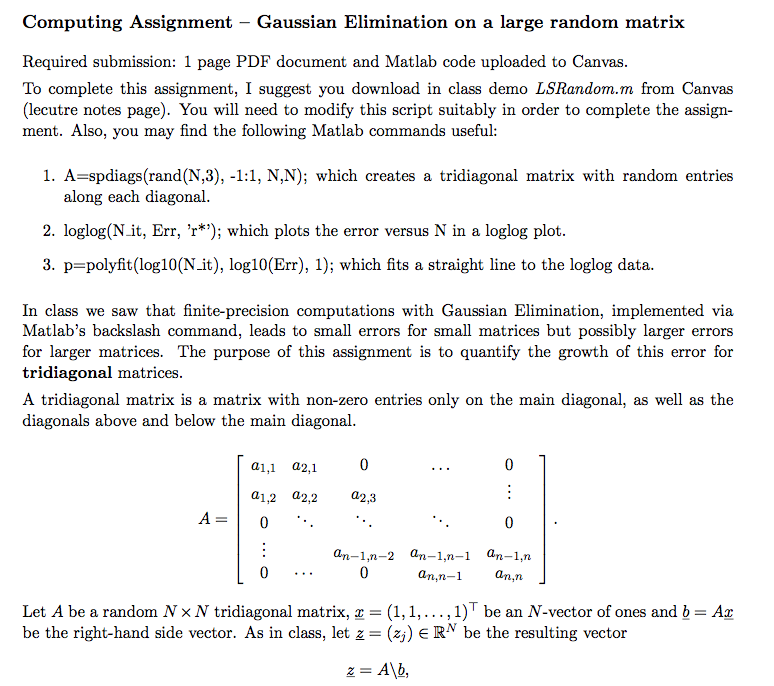
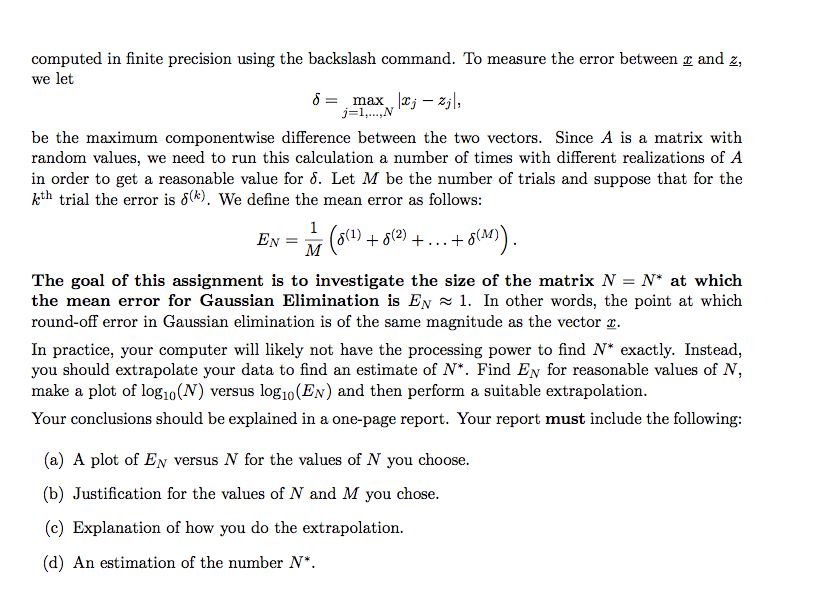
Computing Assignment Gaussian Elimination on a large random matrix Required submission: 1 page PDF document and Matlab code uploaded to Canvas. To complete this assignment, I suggest you download in class demo LSRandom.m from Canvas (lecutre notes page). You will need to modify this script suitably in order to complete the assign- ment. Also, you may find the following Matlab commands useful: 1. A spdiags(rand(N,3), -1:1, N,N); which creates a tridiagonal matrix with random entries along each diagona 2. loglog(N-it, Err, 'r which plots the error versus N in a loglog plot 3. p polyfit (log10(N-it), log10(Err), 1); which fits a straight line to the loglog data. In class we saw that finite precision computations with Gaussian Elimination, implemented via Matlab's backslash command, leads to small errors for small matrices but possibly larger errors for larger matrices. The purpose of this assignment is to quantify the growth of this error for tridiagonal matrices. A tridiagonal matrix is a matrix with non-zero entries only on the main diagonal, as well as the diagonals above and below the main diagonal. 1,1 2,1 1,2 a2,2 a2,3 an-1 n-2 an-1,n-1 an-1,n an, n-1 m,n. Let A be a random NxN tridiagonal matrix, z (1,1 1) be an N-vector of ones and b Ar be the right-hand side vector. As in class, let z (zi) ERN be the resulting vector A b
Step by Step Solution
There are 3 Steps involved in it

Get step-by-step solutions from verified subject matter experts
 Study Help