



Question: (Computing the standard deviation for a portfolio of two risky investments) Mary Guilott recently graduated from college and is evaluating an investment in two
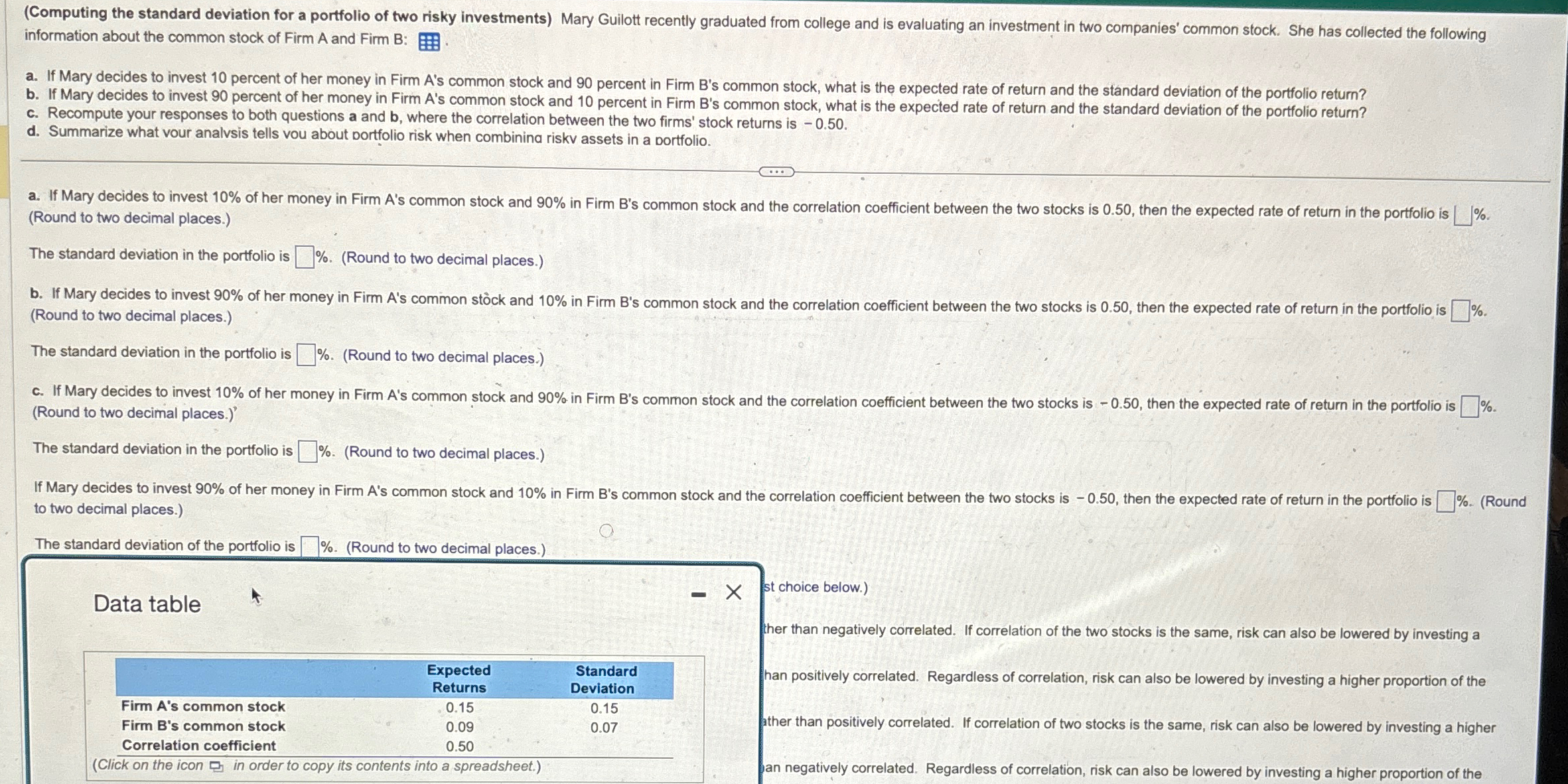
(Computing the standard deviation for a portfolio of two risky investments) Mary Guilott recently graduated from college and is evaluating an investment in two companies' common stock. She has collected the following information about the common stock of Firm A and Firm B: a. If Mary decides to invest 10 percent of her money in Firm A's common stock and 90 percent in Firm B's common stock, what is the expected rate of return and the standard deviation of the portfolio return? b. If Mary decides to invest 90 percent of her money in Firm A's common stock and 10 percent in Firm B's common stock, what is the expected rate of return and the standard deviation of the portfolio return? c. Recompute your responses to both questions a and b, where the correlation between the two firms' stock returns is -0.50. d. Summarize what your analvsis tells vou about portfolio risk when combinina risky assets in a portfolio. a. If Mary decides to invest 10% of her money in Firm A's common stock and 90% in Firm B's common stock and the correlation coefficient between the two stocks is 0.50, then the expected rate of return in the portfolio is %. (Round to two decimal places.) The standard deviation in the portfolio is %. (Round to two decimal places.) b. If Mary decides to invest 90% of her money in Firm A's common stock and 10% in Firm B's common stock and the correlation coefficient between the two stocks is 0.50, then the expected rate of return in the portfolio is %. (Round to two decimal places.) The standard deviation in the portfolio is %. (Round to two decimal places.) c. If Mary decides to invest 10% of her money in Firm A's common stock and 90% in Firm B's common stock and the correlation coefficient between the two stocks is -0.50, then the expected rate of return in the portfolio is %. (Round to two decimal places.)' The standard deviation in the portfolio is %. (Round to two decimal places.) If Mary decides to invest 90% of her money in Firm A's common stock and 10% in Firm B's common stock and the correlation coefficient between the two stocks is -0.50, then the expected rate of return in the portfolio is %. (Round to two decimal places.) The standard deviation of the portfolio is %. (Round to two decimal places.) Data table - st choice below.) ther than negatively correlated. If correlation of the two stocks is the same, risk can also be lowered by investing a Expected Returns Firm A's common stock .0.15 Standard Deviation 0.15 han positively correlated. Regardless of correlation, risk can also be lowered by investing a higher proportion of the Firm B's common stock 0.09 0.07 ather than positively correlated. If correlation of two stocks is the same, risk can also be lowered by investing a higher Correlation coefficient 0.50 (Click on the icon in order to copy its contents into a spreadsheet.) an negatively correlated. Regardless of correlation, risk can also be lowered by investing a higher proportion of the
Step by Step Solution
There are 3 Steps involved in it

Get step-by-step solutions from verified subject matter experts