







Question: Concept Calculation. Chapter 13 Critical Concept - The Trustee's Responsibility How does the failure of an organization to prepare for equipment replacement at the end
Concept Calculation.
Chapter 13
Critical Concept - The Trustee's Responsibility
How does the failure of an organization to prepare for equipment replacement at the end of its useful life impact the overall operations of the organization and its patients?
Chapter 14
Critical concept - Creating a Financial Analysis
Ratio analysis - in your opinion, shouldn't the organization already know how it's doing without exploring financial analysis? How can you trust the organization's interpretation of the numbers generated by the financial analysis?
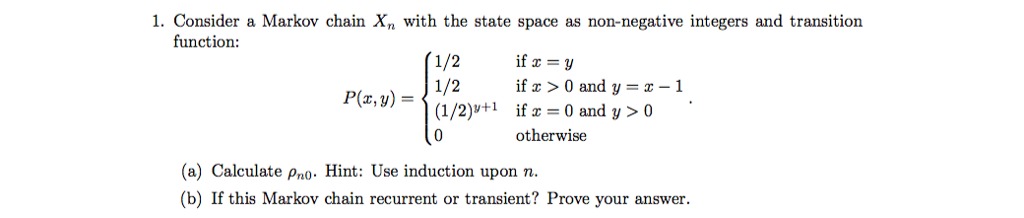
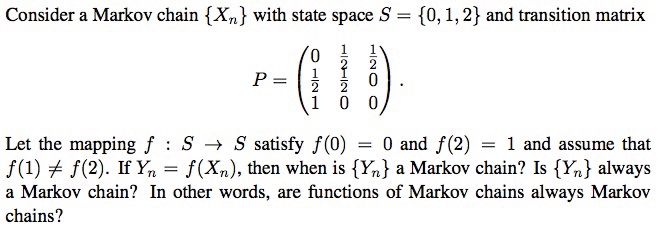
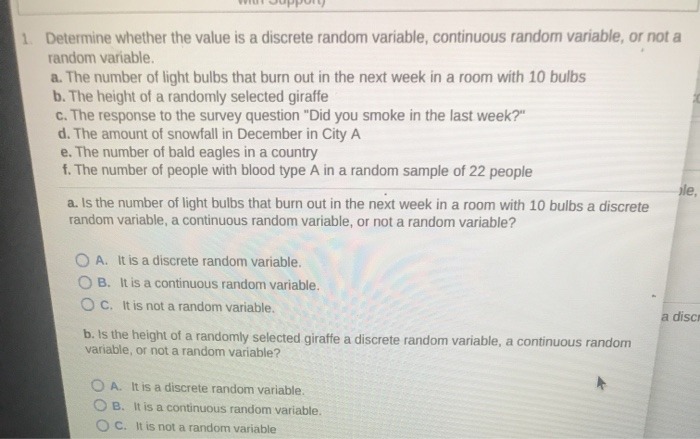
1. Consider a Markov chain X, with the state space as non-negative integers and transition function: 1/2 if x = y 1/2 if x > 0 and y = x - 1 P(x, y) = (1/2) #+1 if x = 0 and y > 0 O otherwise (a) Calculate Pno. Hint: Use induction upon n. (b) If this Markov chain recurrent or transient? Prove your answer.Consider a Markov chain { Xn } with state space S' = {0, 1, 2} and transition matrix P = Let the mapping f : S -> S satisfy f(0) = 0 and f(2) = 1 and assume that f(1) # f(2). If Ym = f(X ), then when is { Y } a Markov chain? Is {Ym } always a Markov chain? In other words, are functions of Markov chains always Markov chains?1. Determine whether the value is a discrete random variable, continuous random variable, or not a random variable. a. The number of light bulbs that burn out in the next week in a room with 10 bulbs b. The height of a randomly selected giraffe c. The response to the survey question "Did you smoke in the last week?" d. The amount of snowfall in December in City A e. The number of bald eagles in a country f. The number of people with blood type A in a random sample of 22 people ile, a. Is the number of light bulbs that burn out in the next week in a room with 10 bulbs a discrete random variable, a continuous random variable, or not a random variable? A. It is a discrete random variable. O B. It is a continuous random variable. O C. It is not a random variable. a disc b. Is the height of a randomly selected giraffe a discrete random variable, a continuous random variable, or not a random variable? O A. It is a discrete random variable. O B. It is a continuous random variable. O C. It is not a random variable
Step by Step Solution
There are 3 Steps involved in it

Get step-by-step solutions from verified subject matter experts
 Study Help