



Question: CONCEPTS FOR ANALYSIS CA14-1 (Bond Theory: Balance Sheet Presentations Interest Rate, Premium) On January 1, 2017, Nichols Company issued for $1,085,800 its 20 year, 11%
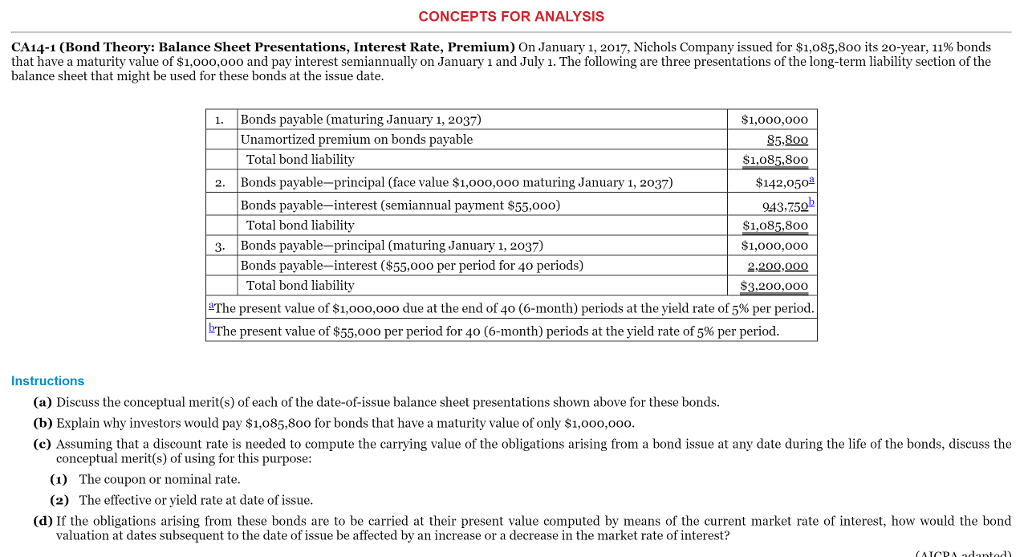
CONCEPTS FOR ANALYSIS CA14-1 (Bond Theory: Balance Sheet Presentations Interest Rate, Premium) On January 1, 2017, Nichols Company issued for $1,085,800 its 20 year, 11% bonds that have a maturity value of $1,ooo,ooo and pay interest semiannually on January i and July 1. The following are three presentations of the long-term liability section of the balance sheet that might be used for these bonds at the issue date Bonds payable (maturing January 1, 2037) Unamortized premium on bonds payable Total bond liability Bonds payable-principal (face value $1,ooo,ooo maturing January 1, 2037) Bonds payable-interest (semiannual payment $55,0o0) Total bond liability Bonds payable-principal (maturing January 1, 2037) Bonds payable-interest ($55.0oo per period for 40 periods) Total bond liability $1,000,000 85.800 $1,085,800 1. 2. $142,0503 943250 $1,085.800 $1,000,000 2.200,000 $3.200,000 The present value of $1,000,000 due at the end of 40 (6-month) periods at the yield rate of 5% per period 3 bThe present value of $55,000 per period for 40 (6-month) periods at the yield rate of 5% per period Instructions (a) Discuss the conceptual merit(s) of each of the date-of-issue balance sheet presentations shown above for these bonds. (b) Explain why investors would pay $1,o85,8oo for bonds that have a maturity value of only $1,000,0oo (e) Assuming that a discount rate is needed to compute the carrying value of the obligations arising from a bond issue at any date during the life of the bonds, discuss the conceptual merit(s) of using for this purpose: (1) The coupon or nominal rate. (2) The effective or yield rate at date of issue. (d) If the obligations arising from these bonds are to be carried at their present value computed by means of the current market rate of interest, how would the bond valuation at dates subsequent to the date of issue be affected by an increase or a decrease in the market rate of interest
Step by Step Solution
There are 3 Steps involved in it

Get step-by-step solutions from verified subject matter experts