





Question: Conceptualize risks for the example presented in Section 1.1. 1.1 PERSONAL CASE: MANAGEMENT OF TIME IN AN ACADEMICALLY RIGOROUS ENVIRONMENT A student in a highly

Conceptualize risks for the example presented in Section 1.1. Conceptualize risks for the example presented in
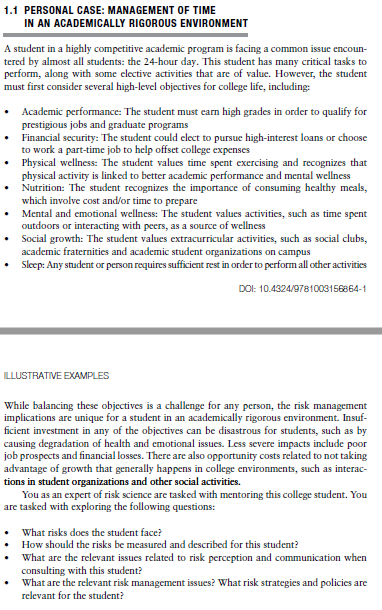
1.1 PERSONAL CASE: MANAGEMENT OF TIME IN AN ACADEMICALLY RIGOROUS ENVIRONMENT A student in a highly competitive academic program is facing a common issue encoun- tered by almost all students: the 24-hour day. This student has many critical tasks to perform, along with some clective activities that are of value. However, the student must first consider several high-level objectives for college life, including: Academic performance: The student must earn high grades in order to qualify for prestigious jobs and graduate programs Financial security: The student could clect to pursue high-interest loans or choose to work a part-time job to help offset college expenses Physical wellness: The student values time spent exercising and recognizes that physical activity is linked to better academic performance and mental wellness Nutrition: The student recognizes the importance of consuming healthy meals, which involve cost and/or time to prepare Mental and emotional wellness: The student values activities, such as time spent outdoors or interacting with peers, as a source of wellness Social growth: The student values extracurricular activities, such as social clubs, academic fraternities and academic student organizations on campus Sleep: Any student or person requires sufficient rest in order to perform all other activities DOI: 10.4324/9781003156864-1 . ILLUSTRATIVE EXAMPLES While balancing these objectives is a challenge for any person, the risk management implications are unique for a student in an academically rigorous environment. Insuf- ficient investment in any of the objectives can be disastrous for students, such as by causing degradation of health and emotional issues. Less severe impacts include poor job prospects and financial losses. There are also opportunity costs related to not taking advantage of growth that generally happens in college environments, such as interac- tions in student organizations and other social activities. You as an expert of risk science are tasked with mentoring this college student. You are tasked with exploring the following questions: What risks does the student face? How should the risks be measured and described for this student? What are the relevant issues related to risk perception and communication when consulting with this student? What are the relevant risk management issues? What risk strategies and policies are relevant for the student

Step by Step Solution

There are 3 Steps involved in it

1 Expert Approved Answer
Step: 1 Unlock blur-text-image

Question Has Been Solved by an Expert!

Get step-by-step solutions from verified subject matter experts

Step: 2 Unlock
Step: 3 Unlock

Students Have Also Explored These Related General Management Questions!