



Question: conclusion about the differences between the means of the two groups. Use Ho: (-2) = 0 as your null. (2 points) the following data

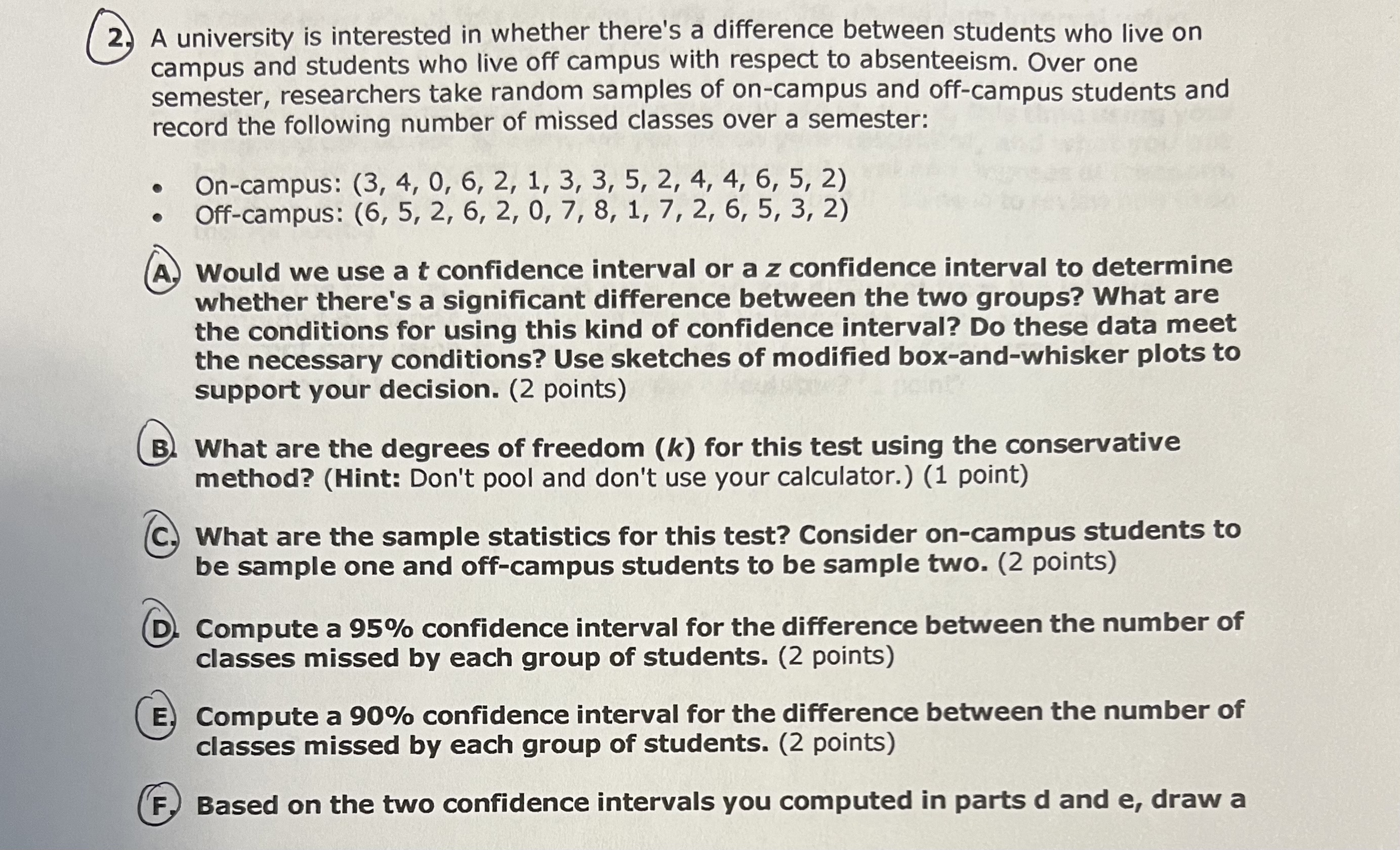
conclusion about the differences between the means of the two groups. Use Ho: (-2) = 0 as your null. (2 points) the following data an to act 2) A university is interested in whether there's a difference between students who live on campus and students who live off campus with respect to absenteeism. Over one semester, researchers take random samples of on-campus and off-campus students and record the following number of missed classes over a semester: B On-campus: (3, 4, 0, 6, 2, 1, 3, 3, 5, 2, 4, 4, 6, 5, 2) Off-campus: (6, 5, 2, 6, 2, 0, 7, 8, 1, 7, 2, 6, 5, 3, 2) Would we use a t confidence interval or a z confidence interval to determine whether there's a significant difference between the two groups? What are the conditions for using this kind of confidence interval? Do these data meet the necessary conditions? Use sketches of modified box-and-whisker plots to support your decision. (2 points) What are the degrees of freedom (k) for this test using the conservative method? (Hint: Don't pool and don't use your calculator.) (1 point) C. What are the sample statistics for this test? Consider on-campus students to be sample one and off-campus students to be sample two. (2 points) D. Compute a 95% confidence interval for the difference between the number of classes missed by each group of students. (2 points) E) Compute a 90% confidence interval for the difference between the number of classes missed by each group of students. (2 points) F. Based on the two confidence intervals you computed in parts d and e, draw a
Step by Step Solution
There are 3 Steps involved in it

Get step-by-step solutions from verified subject matter experts