







Question: Conclusion: Experiment 2 - Bending Water Objective: To have a better understanding of static electricity. Materials: a hard rubber or plastic comb a sink and
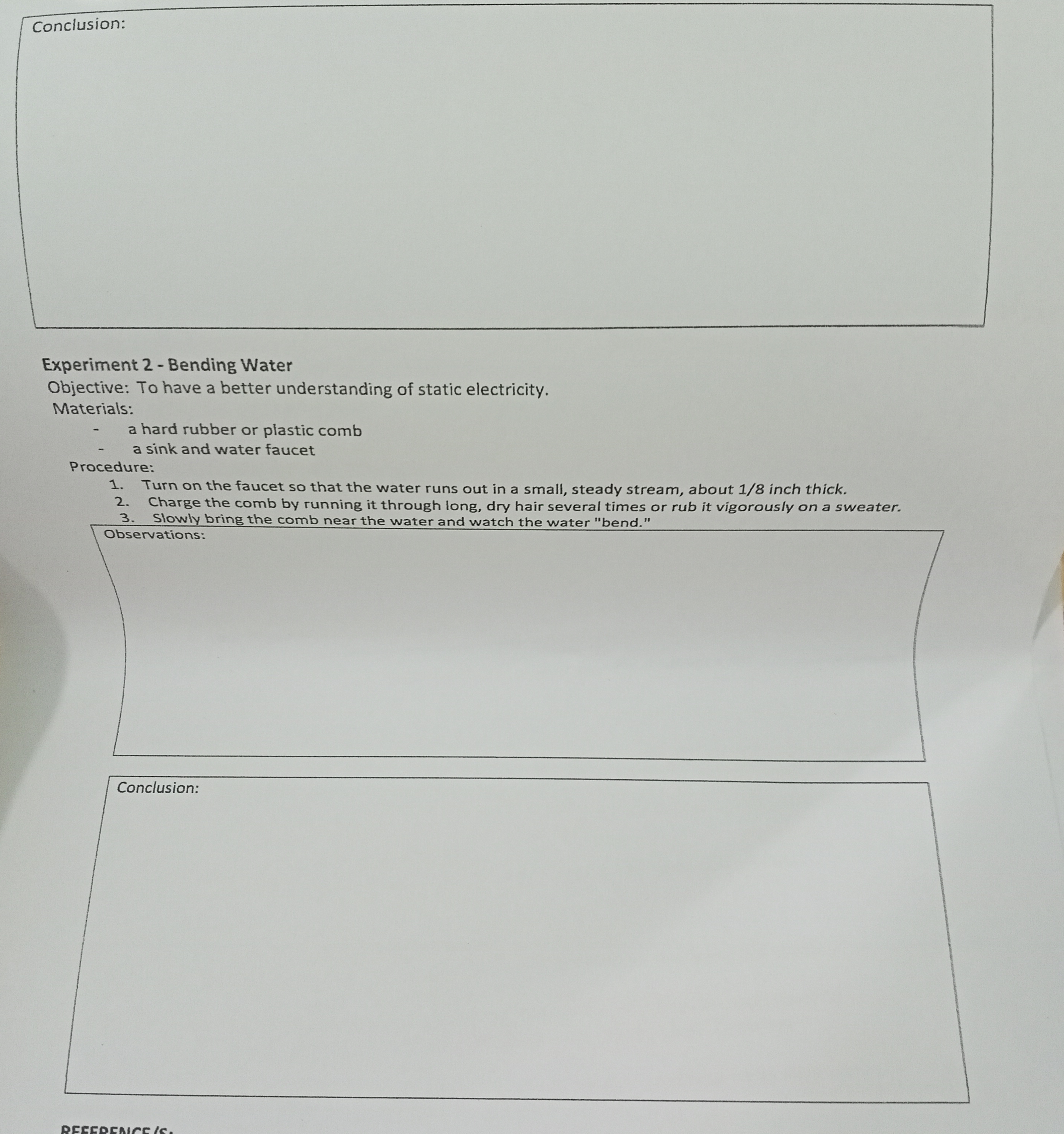
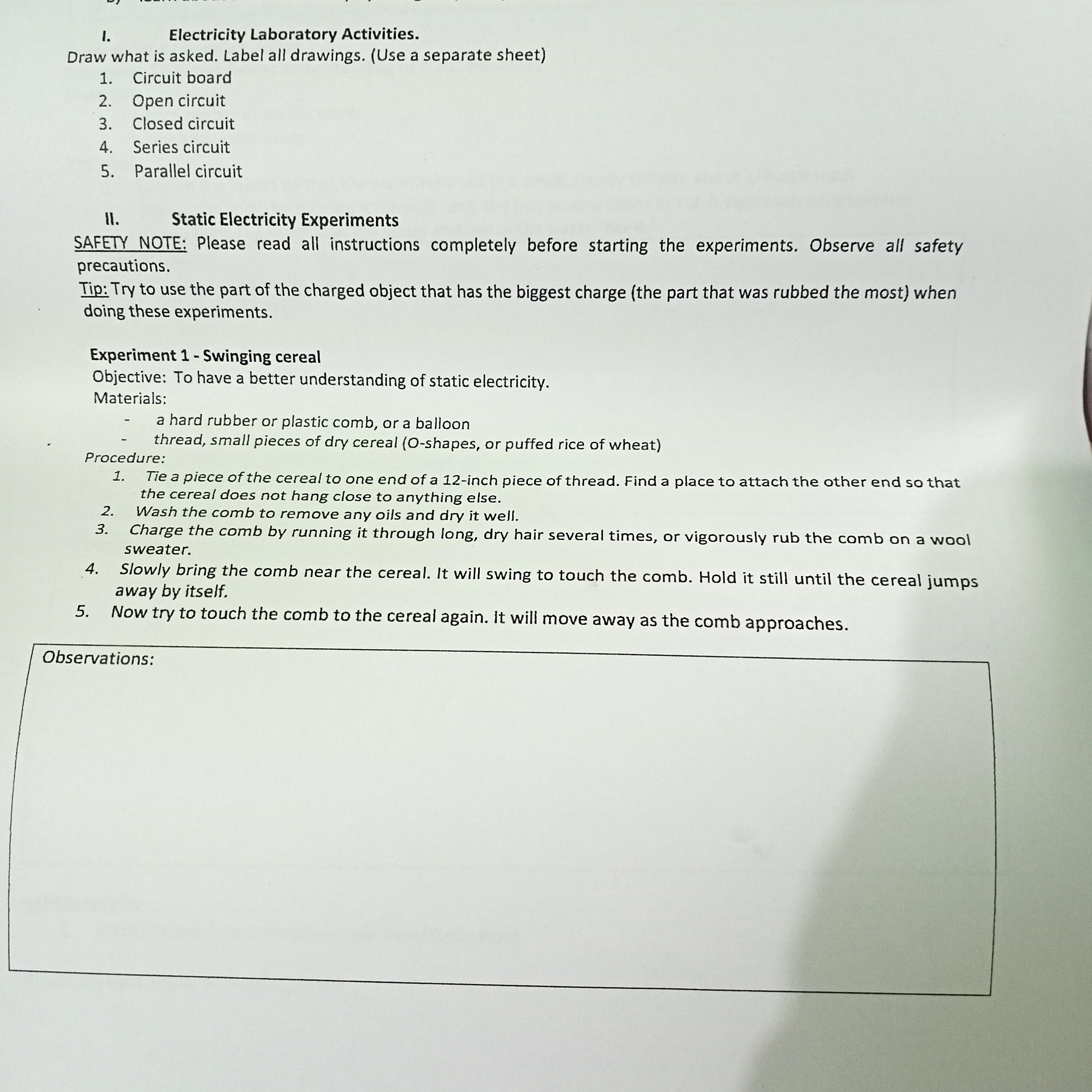
Conclusion: Experiment 2 - Bending Water Objective: To have a better understanding of static electricity. Materials: a hard rubber or plastic comb a sink and water faucet Procedure: 1. Turn on the faucet so that the water runs out in a small, steady stream, about 1/8 inch thick. 2 . Charge the comb by running it through long, dry hair several times or rub it vigorously on a sweater. Slowly bring the comb near the water and watch the water "bend." Observations: Conclusion:_, ._____,_,,,,, l. Electricity Laboratory Activities. Draw what is asked. Label all drawings. (Use a separate sheet) 1. Circuit board 2. Open circuit ' 3. Closed circuit 4. Series circuit 5. Parallel circuit ll. Static Electricity Experiments SAFETY NOTE: Please read all instructions completely before starting the experiments. Observe all safety precautions. m'iry to use the part of the charged object that has the biggest charge (the part that was rubbed the most) when doing these experiments. Experiment 1 - Swinging cereal Objective: To have a better understanding of static electricity. Materials: - a hard rubber or plastic comb, or a balloon . - thread, small pieces of dry cereal (0-shapes, or puffed rice of wheat) Procedure: 1. We a piece ofthe cereal to one end of a 12inch piece of thread. Find a place to attach the other end so that the cereal does not hang close to anything else. 2. Wash the comb to remove any oils and dry it well. 3. Charge the comb by running it through long, dry hair several times, or vigorously rub the comb on a woo\\ sweater. ' _4. Slowly bring the comb near the cereal. it will swing to touch the comb. Hold it still until the cereal jumps away by itself. 5. Now try to touch the comb to the cereal again. it will move away as the comb approaches. Observations
Step by Step Solution
There are 3 Steps involved in it

Get step-by-step solutions from verified subject matter experts
 Study Help